Introduction
The fuel cell electric vehicle (FCEV) market refers to vehicles powered by hydrogen fuel cells that generate electricity through electrochemical reactions, offering zero-emission transportation. Key raw materials include hydrogen gas, platinum-based catalysts, carbon fiber tanks, and advanced membranes. Market growth is driven by rising environmental concerns, demand for clean mobility, and faster refueling compared to battery electric vehicles. FCEVs are widely used in passenger cars, buses, trucks, and commercial fleets requiring long driving ranges. Governments worldwide are supporting the market through hydrogen infrastructure investments, subsidies, and carbon reduction policies. In January 2024, Japan expanded its hydrogen subsidy program to promote fuel cell vehicle adoption, boosting infrastructure development. Recent developments include automakers advancing fuel cell technology and forming partnerships for hydrogen supply chains. Technological advancements such as improved fuel cell efficiency, reduced platinum usage, and enhanced hydrogen storage systems are further accelerating market expansion and making FCEVs more commercially viable globally.
- In March 2026, Toyota announced its plan to join Volvo Group and Daimler Truck’s hydrogen fuel cell joint venture, aiming to accelerate development and reduce costs of fuel cell technologies for commercial vehicles.
- In December 2025, India launched a hydrogen fuel cell vehicle pilot project to promote clean mobility and support the country’s transition toward low-carbon transportation systems.
- In November 2025, Hyundai introduced the next-generation NEXO fuel cell vehicle with improved range, efficiency, and performance, highlighting ongoing advancements in hydrogen-powered mobility technology.
Navigate Future Markets with Confidence: Insights from Spherical Insights LLP
The insights presented in this blog are derived from comprehensive market research conducted by Spherical Insights LLP, a trusted advisory partner to leading global enterprises. Backed by in-depth data analysis, expert forecasting, and industry-specific intelligence, our reports empower decision-makers to identify strategic growth opportunities in fast-evolving sectors. Clients seeking detailed market segmentation, competitive landscapes, regional outlooks, and future investment trends will find immense value in the full report. By leveraging our research, businesses can make informed decisions, gain a competitive edge, and stay ahead in the transition toward sustainable and profitable solutions.
Unlock exclusive market insights—Download the Brochure now and dive deeper into the future of the Fuel Cell Electric Vehicle Market.
Market Segmentation
Global Fuel Cell Electric Vehicle Market Size, Share, and COVID-19 Impact Analysis, By Vehicle Type (Passenger Cars, Commercial Vehicles, Buses, Trucks), By Fuel Cell Type (Proton Exchange Membrane Fuel Cells (PEMFC), Phosphoric Acid Fuel Cells (PAFC), Solid Oxide Fuel Cells (SOFC)), By Power Output (Below 100 kW, 100–200 kW, Above 200 kW), By Range (Short Range, Medium Range, Long Range), By End-User (Private, Fleet Operators, Public Transport Authorities), By Region (North America, Europe, Asia Pacific, Latin America, Middle East & Africa), Analysis and Forecast, 2026–2035.
Fuel Cell Electric Vehicle Market Size & Statistics
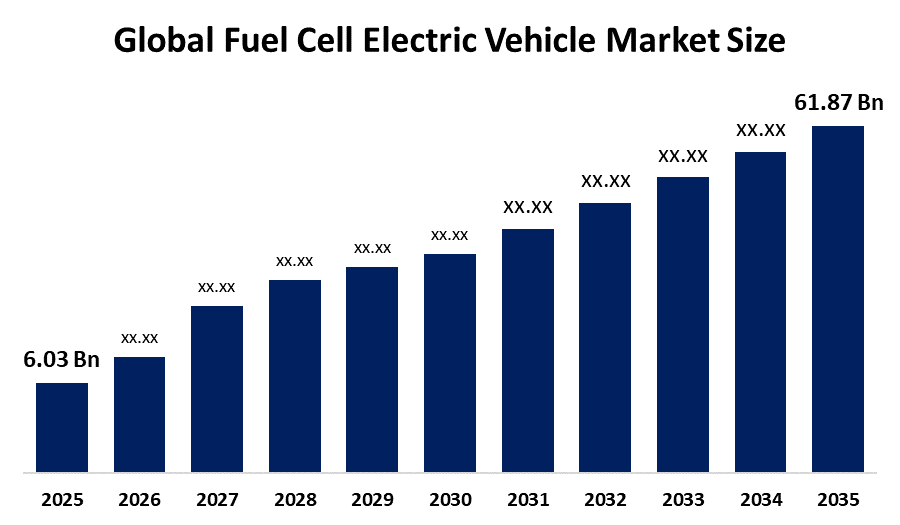
- The Market Size for Fuel Cell Electric Vehicle Was Estimated to be worth USD 6.03 Billion in 2025.
- The Market is Going to Expand at a CAGR of 26.22% between 2026 and 2035.
- The Global Fuel Cell Electric Vehicle Market Size is anticipated to reach USD 61.87 Billion by 2035.
- Asia Pacific is expected to grow the fastest during the forecast period in the Fuel Cell Electric Vehicle Market.
- North America is expected to generate the highest demand during the forecast period in the Fuel Cell Electric Vehicle market.

Regional growth and demand
Asia Pacific is expected to grow the fastest during the forecast period in the Fuel Cell Electric Vehicle market. The region’s rapid expansion is driven by strong government support for hydrogen mobility, rising environmental concerns, and increasing investments in hydrogen production and refueling infrastructure. Countries such as China, Japan, South Korea, and India are actively promoting fuel cell vehicles through subsidies, pilot projects, and national hydrogen missions. Growing urbanization and demand for clean public transportation, including hydrogen-powered buses and commercial fleets, are further accelerating adoption. In addition, regional automakers are heavily investing in fuel cell technology, strengthening the supply chain and supporting large-scale deployment.
In March 2026, Toyota Motor Corporation expanded its hydrogen fuel cell partnerships across Japan and China to accelerate commercial vehicle deployment, strengthening regional supply chains. In February 2026, the Government of India advanced its National Green Hydrogen Mission by funding pilot fuel cell bus and truck projects, boosting infrastructure development. In January 2026, Hyundai Motor Company announced increased investment in next-generation hydrogen fuel cell systems and export plans across Southeast Asia, supporting regional adoption.
Unlock exclusive market insights—Download the Brochure now and dive deeper into the future of the Fuel Cell Electric Vehicle Market.
North America is expected to generate the highest demand during the forecast period in the Fuel Cell Electric Vehicle market. Demand is fueled by increasing focus on decarbonization, supportive government policies, and investments in hydrogen infrastructure, particularly in the United States and Canada. The presence of key automotive and technology companies advancing fuel cell systems, along with expanding hydrogen refueling networks, is boosting market growth. Moreover, rising adoption of fuel cell trucks and commercial vehicles for long-haul transportation, coupled with initiatives aimed at reducing carbon emissions, is contributing to sustained demand across the region.
In March 2026, General Motors expanded hydrogen fuel cell production capabilities in the U.S., targeting commercial fleet applications and long-haul transport. In February 2026, Nikola Corporation launched new hydrogen-powered truck deployments and infrastructure partnerships, accelerating market penetration. In January 2026, U.S. Department of Energy announced additional funding for hydrogen hubs and refueling infrastructure projects, strengthening the ecosystem for fuel cell electric vehicles and supporting large-scale commercialization.
Ready to lead the Fuel Cell Electric Vehicle?
Discover the regional trends and growth factors shaping the industry. We’re here to assist with expert, personalized data.
Call +1 303 800 4326 or Send us a message for a personalized consultation.
Top 10 Trends in the Fuel Cell Electric Vehicle Market
• Increasing investments in hydrogen infrastructure development
• Growing demand for zero-emission commercial vehicles
• Expansion of hydrogen refueling station networks
• Rising government support through subsidies and policies
• Adoption of fuel cell technology in heavy-duty transport
• Advancements in hydrogen production and storage technologies
• Increasing partnerships between automakers and energy companies
• Expansion of green hydrogen projects globally
• Growing focus on long-range and fast-refueling vehicles
• Strategic collaborations and investments in fuel cell innovation
Unlock exclusive market insights—Download the Brochure now and dive deeper into the future of the Fuel Cell Electric Vehicle Market.
Top 5 Trends
- Increasing Investments in Hydrogen Infrastructure Development
Governments and private players are significantly investing in hydrogen production, storage, and refueling infrastructure to support the growth of fuel cell electric vehicles. These investments are critical in addressing one of the key barriers to FCEV adoption—limited refueling availability. Countries across the Asia Pacific, Europe, and North America are launching large-scale hydrogen corridor projects, enabling seamless long-distance travel. Additionally, energy companies are partnering with automotive manufacturers to build integrated hydrogen ecosystems, ensuring reliable fuel supply and accelerating the commercialization of fuel cell mobility solutions.
- Growing Demand for Zero-Emission Commercial Vehicles
The demand for zero-emission transportation is rapidly increasing, particularly in commercial and heavy-duty vehicle segments. Fuel cell electric vehicles are gaining traction in logistics, freight, and public transportation due to their longer range and faster refueling compared to battery electric vehicles. Fleet operators are adopting hydrogen-powered trucks and buses to meet stringent emission regulations and sustainability targets. This trend is especially prominent in regions with strong environmental policies, where companies are actively transitioning to cleaner mobility alternatives.
- Expansion of Hydrogen Refueling Station Networks
The global expansion of hydrogen refueling infrastructure is a key trend shaping the fuel cell electric vehicle market. Governments and private investors are deploying hydrogen stations along highways and urban centers to support increasing vehicle adoption. The development of hydrogen corridors is enabling long-haul transportation and improving accessibility for commercial fleets. This infrastructure growth is reducing range anxiety and making fuel cell vehicles a more viable option for consumers and businesses, thereby supporting overall market expansion.
- Adoption of Fuel Cell Technology in Heavy-Duty Transport
Fuel cell technology is increasingly being adopted in heavy-duty vehicles such as trucks, buses, and industrial transport equipment. These vehicles require longer operational hours and higher energy density, which fuel cells can efficiently provide. Automakers and logistics companies are collaborating to deploy hydrogen-powered fleets, particularly for long-distance and high-load applications. This trend is driving innovation in fuel cell systems and supporting the transition toward sustainable freight and public transportation solutions globally.
- Technological Advancements in Hydrogen Production and Fuel Cell Systems
Continuous advancements in hydrogen production methods, such as green hydrogen from renewable energy sources, and improvements in fuel cell efficiency are transforming the market. Innovations aimed at reducing platinum usage, enhancing durability, and improving energy efficiency are making fuel cell vehicles more cost-effective. Additionally, advancements in hydrogen storage and distribution technologies are improving safety and scalability. These technological developments are strengthening the commercial viability of fuel cell electric vehicles and accelerating their adoption across multiple sectors.
Empower your strategic planning:
Stay informed with the latest industry insights and market trends to identify new opportunities and drive growth in the Fuel Cell Electric Vehicle market. To explore more in-depth trends, insights, and forecasts, please refer to our detailed report.
Unlock exclusive market insights—Download the Brochure now and dive deeper into the future of the Fuel Cell Electric Vehicle Market.
Top 25 Companies Leading the Fuel Cell Electric Vehicle Market
- Toyota Motor Corporation
- Hyundai Motor Company
- Honda Motor Co., Ltd.
- General Motors
- BMW AG
- Daimler Truck AG
- Volvo Group
- Nikola Corporation
- Ballard Power Systems Inc.
- Plug Power Inc.
- Bloom Energy Corporation
- Cummins Inc.
- Doosan Fuel Cell Co., Ltd.
- Toshiba Energy Systems & Solutions Corporation
- Panasonic Corporation
- Mitsubishi Power
- Air Liquide
- Linde plc
- Nel ASA
- ITM Power plc
- PowerCell Sweden AB
- ElringKlinger AG
- Symbio (Faurecia Michelin Hydrogen Company)
- Hyzon Motors Inc.
- Riversimple Movement Ltd
- Toyota Motor Corporation
Headquarters: Toyota City, Japan
Toyota Motor Corporation is a global leader in fuel cell electric vehicles, best known for its Mirai model, one of the first mass-produced hydrogen-powered passenger cars. The company has been at the forefront of hydrogen mobility, investing heavily in fuel cell system development, hydrogen infrastructure partnerships, and commercial vehicle applications. Toyota is expanding its fuel cell technology into buses, trucks, and stationary power solutions, while collaborating with global partners to build a hydrogen ecosystem. Its focus on reducing costs, improving durability, and scaling production positions it as a dominant player in advancing fuel cell electric mobility worldwide.
- Hyundai Motor Company
Headquarters: Seoul, South Korea
Hyundai Motor Company is a key innovator in the fuel cell electric vehicle market, with its flagship NEXO SUV and hydrogen-powered commercial vehicles. The company is actively investing in hydrogen technology and aims to become a global leader in hydrogen mobility through its “Hydrogen Vision 2040” strategy. Hyundai is expanding fuel cell applications beyond passenger vehicles into trucks, buses, and industrial mobility solutions. It is also developing next-generation fuel cell systems with improved efficiency and reduced costs, while forming strategic partnerships to expand hydrogen refueling infrastructure globally.
- Honda Motor Co., Ltd.
Headquarters: Tokyo, Japan
Honda Motor Co., Ltd. has been a pioneer in hydrogen fuel cell technology, with models such as the Clarity Fuel Cell. The company continues to invest in next-generation fuel cell systems and is collaborating with global partners to expand hydrogen-powered mobility. Honda is focusing on improving fuel cell durability, reducing system costs, and integrating hydrogen solutions into both automotive and stationary power applications. Its commitment to carbon neutrality and sustainable mobility is driving innovation in fuel cell electric vehicles and supporting long-term market growth.
- General Motors
Headquarters: Detroit, Michigan, United States
General Motors is actively advancing fuel cell technology through its Hydrotec fuel cell platform, targeting both automotive and industrial applications. The company is focusing on commercial vehicles, military applications, and backup power systems. GM collaborates with partners to scale hydrogen infrastructure and develop cost-effective fuel cell solutions. Its investments in research, production capabilities, and strategic alliances are positioning it as a key player in the fuel cell electric vehicle ecosystem, particularly in North America.
- BMW AG
Headquarters: Munich, Germany
BMW AG is investing in hydrogen fuel cell technology as part of its long-term electrification strategy. The company has introduced hydrogen-powered prototypes such as the iX5 Hydrogen and is collaborating with technology partners to advance fuel cell systems. BMW focuses on integrating hydrogen solutions alongside battery electric vehicles to provide flexible zero-emission mobility options. Its research emphasizes efficiency, scalability, and performance, supporting future commercialization of fuel cell vehicles in premium segments.
Unlock exclusive market insights—Download the Brochure now and dive deeper into the future of the Fuel Cell Electric Vehicle Market.
Are you ready to discover more about the Fuel Cell Electric Vehicle market?
The report provides an in-depth analysis of the leading companies operating in the global Fuel Cell Electric Vehicle market. It includes a comparative assessment based on their product portfolios, business overviews, geographical footprint, strategic initiatives, market segment share, and SWOT analysis. Each company is profiled using a standardized format that includes:
Company Profiles
- Toyota Motor Corporation
- Business Overview
- Company Snapshot
- Products Overview
- Company Market Share Analysis
- Company Coverage Portfolio
- Financial Analysis
- Recent Developments
- Merger and Acquisitions
- SWOT Analysis
- Hyundai Motor Company
- Honda Motor Co., Ltd.
- General Motors
- BMW AG
- Daimler Truck AG
- Volvo Group
- Nikola Corporation
- Ballard Power Systems Inc.
- Others.
Conclusion
The fuel cell electric vehicle market is poised for substantial growth during the forecast period, driven by increasing global emphasis on decarbonization, clean energy adoption, and sustainable transportation solutions. The rising demand for zero-emission vehicles, particularly in commercial and heavy-duty segments, is accelerating the deployment of hydrogen-powered mobility. Strong government support through subsidies, hydrogen strategies, and infrastructure investments is further strengthening market expansion. In addition, continuous technological advancements in fuel cell efficiency, hydrogen storage, and cost reduction are improving the commercial viability of FCEVs. Strategic collaborations between automakers, energy companies, and technology providers are also fostering innovation and building a robust hydrogen ecosystem. Despite challenges such as high initial costs and limited refueling infrastructure, ongoing investments and policy support are expected to overcome these barriers. As hydrogen infrastructure expands and production becomes more sustainable, fuel cell electric vehicles are anticipated to play a crucial role in the global transition toward low-carbon and energy-efficient transportation systems.
Our Industry Reports:
Robotic Welding Market Size, Shares, Trends to 2035
Nuclear Waste Management Market Size, Share, Growth
Robotics Laser Welding Market Size, Growth, Forecast to 2035
Construction Punch List Software Market Size, Growth 2035
Furnace Filters Market Trend, Outlook Report 2035
About the Spherical Insights & Consulting
Spherical Insights & Consulting is a market research and consulting firm which provides actionable market research study, quantitative forecasting and trends analysis provides forward-looking insight especially designed for decision makers and aids ROI. Which is catering to different industry such as financial sectors, industrial sectors, government organizations, universities, non-profits and corporations. The company’s mission is to work with businesses to achieve business objectives and maintain strategic improvements.
CONTACT US:
For More Information on Your Target Market, Please Contact Us Below:
Phone: +1 303 800 4326 (the U.S.)
Phone: +91 90289 24100 (APAC)
Email: inquiry@sphericalinsights.com, sales@sphericalinsights.com
Contact Us: