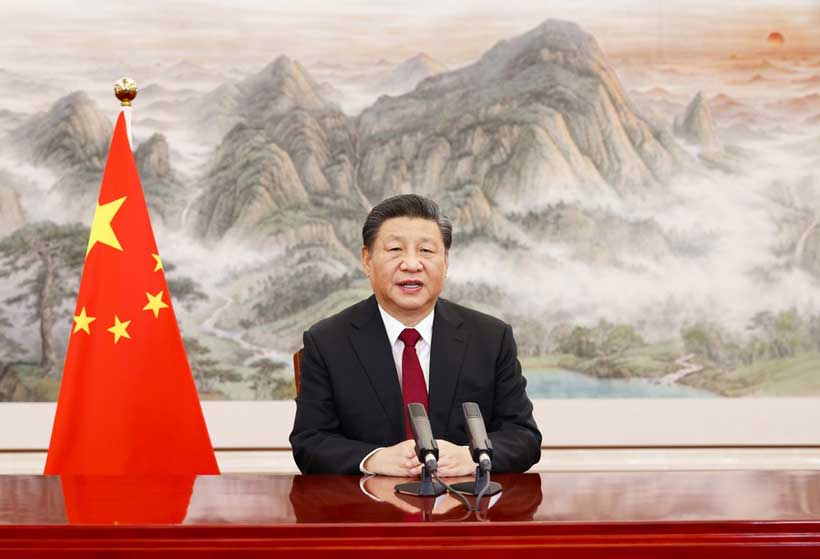
The world enters 2026 amid numerous aspirations. Traditionally, national leaders deliver New Year addresses to convey a vision of national development and prosperity, thereby encouraging public confidence in the government and its future trajectory.
For China—a civilization with a history spanning several millennia—these aspirations carry distinctive characteristics. Today, China stands as the world’s second-largest economy and has achieved remarkable socio-economic progress both domestically and internationally. Yet these accomplishments remain insufficient in Beijing’s eyes, as China continues to harbor a persistent concern: Taiwan.
China Is… Taiwan?
President Xi’s address was delivered against the backdrop of an increasingly complex and unpredictable global environment. Under the Trump 2.0 administration, the United States has significantly intensified maximum pressure on China. Developments throughout 2025 indicate that Washington has pursued a singular strategic path toward Beijing—seeking to constrain China’s global influence.
In his speech, President Xi asserted that “Chinese people on both sides of the Taiwan Strait share the same bloodline and kinship. National reunification, as a trend of the times, is unstoppable.” More notably, Xi officially established “Taiwan Recovery Day.” Referencing Taiwan—a highly sensitive subject for China over many decades—constitutes a move of profound geopolitical and geostrategic significance.
Previously, Beijing had commemorated China’s liberation from Japanese fascism, a move that appeared routine yet subtly conveyed a message to the international community: China is one entity; although divided, the Taiwan issue is an “internal family matter,” and China continues to respect the opinions of people across the Strait. The institutionalization of such commemorative days enhances China’s legitimacy regarding the Taiwan Strait issue, gradually blurring the “hard boundary” that Beijing’s leadership has long maintained.
Former Nazi Propaganda Minister Joseph Goebbels once stated that “a lie repeated often enough becomes the truth.” In this context, the repeated emphasis on shared blood ties between China and Taiwan aims to erode global perceptions regarding Taiwan’s historical and political origins.
Taiwan in 2026: Now or Never
Taiwan currently occupies a critical position in China’s strategic calculus. Beyond historically driven nationalism, the island functions as a “loaded gun” adjacent to the mainland. Viewed on the global map, China faces a geopolitical containment trap orchestrated by the United States. In Northeast Asia, Taiwan, Japan, and South Korea form an arc constraining China’s strategic maneuverability. The U.S. maintains substantial military forces in Japan (approximately 53,000 personnel) and South Korea (around 28,000 personnel). Consequently, Taiwan’s absorption is widely regarded by Chinese leadership as a strategic necessity and top priority.
In recent years, the international system has witnessed a succession of conflicts across multiple regions—patterns that appear increasingly non-random. The Russia–Ukraine war erupted in 2022 and continues to this day, inflicting severe economic and human losses. This conflict followed Russia’s annexation of Crimea and recognition of separatist regions in eastern Ukraine in 2014, raising questions as to why Moscow waited eight years before launching what it termed a “special military operation” to “liberate” Ukraine from a so-called “fascist” government under Volodymyr Zelensky.
Similarly, the Israel–Hamas conflict erupted in 2023 under atypical circumstances, with Hamas initiating an asymmetrical attack against a militarily superior Israel, followed by unprecedented Israel–Iran confrontations in 2024 and June 2025. Meanwhile, the Thailand–Cambodia conflict unexpectedly resurfaced and escalated in Southeast Asia in March 2025 after a 14-year hiatus. These events suggest that China may have orchestrated them, causing them to happen in order to leave the situation in Taiwan vulnerable.
Collectively, these conflicts suggest a chain reaction within the international system—one that diverts global attention away from Taiwan, the entity China is determined to reclaim in 2026 rather than 2027, as previously assessed by U.S. defense officials during both the Biden (2021–2024) and Trump (2025–present) administrations. In international relations, a state whose resources are dispersed cannot secure its strategic interests. The United States, currently weakened and unable to concentrate its full capacity, presents China with a “golden opportunity.”
Before closing out 2025, China launched large-scale military exercises dubbed “Justice Mission” beginning on 29 December 2025. These drills marked the largest scale to date and notably included live-fire exercises. China Central Television (CCTV) emphasized that Beijing would “show no mercy in combating separatism and promoting national reunification, continue anti-separatist and anti-intervention operations, and resolutely safeguard national sovereignty, unity, and territorial integrity.”
Beyond responding to Taiwan’s USD 40 billion arms purchase from the United States, Justice Mission reaffirmed China’s strategic objectives regarding Taiwan. Quiet preparations dating back to 2021 in Fujian Province suggest that Justice Mission may represent China’s final rehearsal before readiness to engage in combat and annex Taiwan.
The U.S. Midterm Elections: A Strategic Window
Notably, 2026 presents China with a singular opportunity: the U.S. midterm elections for both chambers of Congress. Many observers mistakenly overestimate the absolute power of the U.S. president while overlooking Congress’s decisive authority. Congress legitimizes and authorizes troop deployments by the White House. In cases of presidential vacancy, authority passes to the vice president or the Speaker of the House. Conversely, congressional opposition can block legislation, and a vacant Speaker position effectively paralyzes House operations.
Current trends suggest growing concern among U.S. allies due to Washington’s rigid tariff sanctions and opaque foreign policy approach. These dynamics may plausibly lead to Republican defeat in the upcoming midterm elections—an outcome President Donald Trump himself has acknowledged with concern.
Should China initiate military operations against Taiwan during the U.S. midterm elections, President Trump would face severe constraints. Acting decisively could trigger accusations of abusing power or exploiting a foreign crisis for domestic political gain. In the event of escalation into full-scale war, such actions could jeopardize congressional approval for funding, declarations of war, and overall political legitimacy.
Taiwan is not a formal U.S. ally, further complicating Washington’s calculus regarding direct military intervention. In his interview with 60 Minutes, President Trump declined to provide a definitive answer on this issue, reflecting his hesitation regarding Taiwan and how he might respond to Chinese escalation. Consequently, China possesses both the rationale and the opportunity to pursue annexation.
Conclusion
President Xi Jinping’s New Year address was delivered amid a global environment increasingly favorable to China. Under Donald Trump’s leadership, the United States appears to be losing strategic trust among partners and allies due to coercive and non-transparent approaches. This erosion may intensify tensions surrounding the upcoming U.S. midterm elections, thereby creating favorable conditions for China to employ force against Taiwan.
Accordingly, 2026 may prove decisive for the Taiwan issue. Either China succeeds, or—as Chinese policymakers often phrase it—Beijing may never again have the opportunity to “recover” the island.

