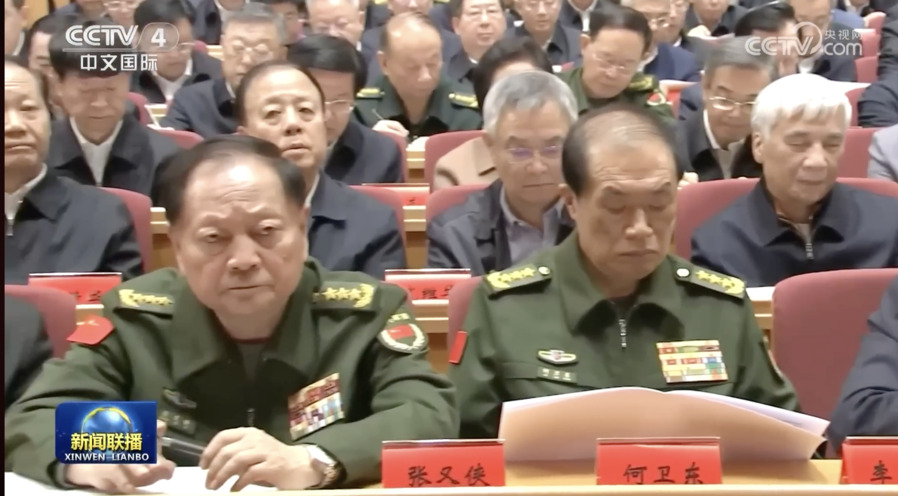
Xi Jinping’s January 2026 purge of Zhang Youxia, his vice chairman on China’s top military command body, sent shockwaves through the armed forces and froze the approval chain for major exercises. Insider sources say the Zhurihe base in Inner Mongolia, where the People’s Liberation Army practices seizing Taiwan’s government buildings, went dark for weeks as commanders waited to see who would survive the political fallout.
Weeks before CCP state media officially announced the downfall of Zhang Youxia, the former vice chairman of China’s top military command body, the Central Military Commission, China’s most advanced training base had already gone quiet. On Jan. 24, 2026, the regime confirmed that Zhang and Liu Zhenli, the military’s chief of the joint staff and a fellow commission member, had both been purged. But the operational consequences had begun well before the announcement.
A scholar who tracks Chinese military affairs and has sources inside the armed forces, identified as Mr. Wang, told overseas Chinese media that a contact in Inner Mongolia reported the Zhurihe training base had suspended exercises for roughly a month. No official explanation was given. Wang noted that large-scale drills at Zhurihe require formal approval from the Central Military Commission’s General Office, and some must be personally signed off by senior leaders. When the commission’s own leadership is being dismantled, the approvals simply stop flowing.
The dynamic Wang described is a well-documented pattern in authoritarian militaries: when senior officers are being arrested, everyone below them freezes. Commanders would rather do nothing than sign their name to an operation that could later be scrutinized by whoever replaces their former bosses.

Success
You are now signed up for our newsletter
Success
Check your email to complete sign up
Satellite images reveal mock-ups of Taiwan’s government buildings at the base
Zhurihe is where China’s military practices its most sensitive operations, including a potential invasion of Taiwan.
On Oct. 1, 2025, Japan’s Sankei Shimbun reported that newly released satellite imagery from a Japanese think tank showed the Chinese military had expanded its mock-up complex at the base. In addition to the previously documented replicas of Taiwan’s Presidential Office Building and Ministry of Foreign Affairs, Zhurihe now included a replica of Taiwan’s Judicial Yuan, connected to the mock presidential palace by an underground tunnel.
The systematic, building-by-building replication of Taiwan’s decision-making center signals that operational planning has moved beyond general amphibious-assault drills into rehearsals for what military analysts describe as a “decapitation strike,” an operation designed to paralyze Taiwan’s leadership in the opening hours of an attack.
Zhurihe started as an armored-vehicle training range but was expanded in 1997 into the largest combined-arms tactical base in the Chinese military, then upgraded again in 2011 to serve as the sole joint-operations experimentation ground for ground forces. Xi Jinping’s 2016 military reorganization transferred it to the newly created Army command. It is now widely described as the military’s most technologically advanced facility, which makes a months-long shutdown extraordinary.

The purged deputy had deep personal ties to the base
Weeks before Zhang Youxia’s downfall was made public, a former deputy commander of the Zhurihe base named Zhang Jixiang published a glowing reminiscence about him on WeChat, the Chinese social media platform. Writing on Dec. 2, 2025, on a military-linked account, Zhang Jixiang recalled that Zhang Youxia, during his time as deputy commander of the Beijing Military Region from 2005 to 2007, “was embedded at the Zhurihe base for extended periods, personally overseeing frontline training and keeping close tabs on every detail of the exercises.”
That a subordinate officer was still publishing laudatory accounts barely weeks before the purge announcement suggests the military establishment was caught off guard by Xi’s move.
Zhang Jixiang also disclosed that Zhang Youxia was the first senior officer to propose fusing battlefield data from Zhurihe’s live-force exercises into a unified system. Zhang Youxia personally led the development of what the military called a “multi-dimensional reconnaissance platform” and directed its operational validation exercise. His fingerprints are all over the base’s evolution into the facility it is today.

Xi Jinping secured the capital before moving against his deputy
Before ordering the arrest of his military vice chairman, Xi Jinping quietly installed a loyalist as commander of the troops guarding the capital.
On Feb. 4, 2026, CCP state-affiliated outlet Caixin, citing the Beijing Daily, reported that a major general named Chen Yuan had appeared in a leadership role at a Jan. 14 plenary session of the Beijing Garrison Command’s Party committee. The report did not specify Chen Yuan’s exact title, but by CCP convention, his presence in that capacity indicates he had been appointed commander of the Beijing Garrison, a post that had been vacant for nearly a year.
The Beijing Garrison controls the troops stationed in and around the capital, making it the single most sensitive military command for any leadership purge. Xi installed Chen Yuan before ordering the arrest of his vice chairman, which sources say occurred on Jan. 20. The sequencing makes clear this was a carefully choreographed operation.
According to Mr. Wang, rumors of Zhang Youxia’s impending downfall had circulated inside the military for nearly two months before the official announcement. If those rumors began in late November 2025, Xi’s preparations were underway well before the new year, and the appointment of Chen Yuan on or before Jan. 14 fits the timeline of a leader methodically securing every lever of force before striking.

CCP military media has gone silent on Zhurihe since late 2025
CCP military media outlets have published no reports about live-force exercises at Zhurihe since approximately December 2025. For the facility described as the military’s most advanced training ground, a blackout lasting months is highly unusual and consistent with Wang’s account of a prolonged suspension.
The silence raises a question that extends well beyond CCP internal politics. If the base where troops rehearse a Taiwan invasion has gone dark, the purge’s consequences reach into cross-strait security. Xi Jinping’s drive to consolidate personal control over the military may be undermining the very war-fighting capability that control is supposed to serve.
By Li Deyan