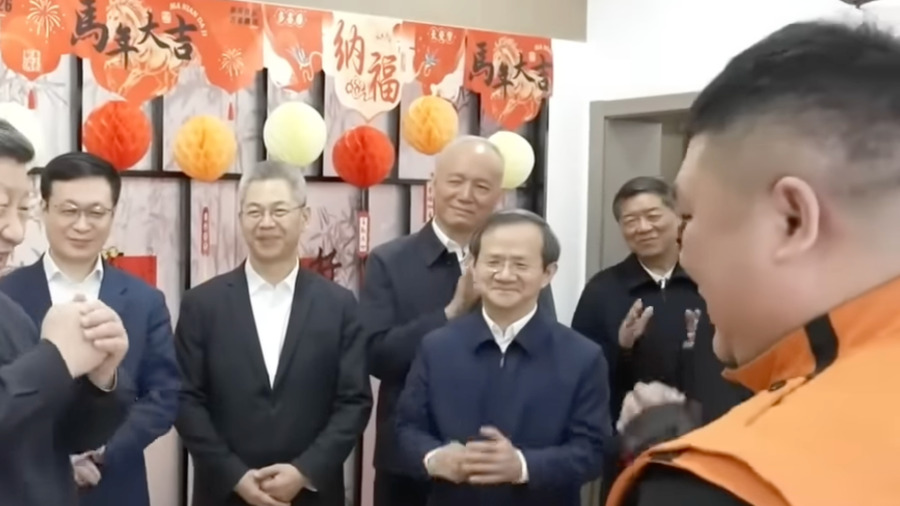
On the afternoon of March 7, Xi Jinping attended a plenary meeting of the People’s Liberation Army (PLA) and People’s Armed Police delegation to China’s National People’s Congress. One line from his speech quickly became the focal point repeated by Chinese state media and overseas propaganda outlets: “There must absolutely be no one in the military who harbors divided loyalties toward the Party.”
The wording is striking. Against the backdrop of China’s domestic tensions and recent international developments, Xi’s warning about “divided loyalties” suggests that the issue has become a major concern for him.
Other parts of his remarks hint that recent events may have had a psychological impact. The arrest of Venezuelan leader Nicolás Maduro and his wife, along with the decapitation strike on Iran’s Supreme Leader Ali Khamenei, appear to have resonated strongly in Beijing. Under such circumstances, a political campaign resembling the logic of “better to kill a thousand by mistake than to let one slip through” could soon sweep through China’s military and officialdom.
History suggests that such pressure often produces outcomes very different from what leaders expect.

Xi Jinping reveals his ‘Achilles’ heel’
After the March 7 meeting with the PLA and the People’s Armed Police, Xi’s warning about “divided loyalties” quickly became the main line promoted by Party propaganda outlets.
Success
You are now signed up for our newsletter
Success
Check your email to complete sign up
The phrase itself appears not to have featured prominently in his earlier speeches. In the past, Xi more often used a different formulation: “The gun must always remain in the hands of those who are loyal and reliable to the Party.”
At first glance the two statements address the same principle. Yet the shift in language—from emphasizing loyalty to warning against hidden disloyalty—offers a glimpse into Xi’s current mindset. It suggests he believes opposition exists within the military, even if he cannot clearly identify who or how many may be involved.
Recent developments appear to reinforce that concern. One example is Xi’s decision to alter his traditional Lunar New Year visits to military units. Instead of traveling to bases around the country, he delivered greetings via video screen. The change came shortly after the arrests of Zhang Youxia and Liu Zhenli, when Xi reportedly feared that their supporters within the armed forces could pose a threat.
On February 28, Khamenei was reportedly killed in a decapitation strike carried out by the United States and Israel. Days later, on March 3, the Chinese military’s official account on X published a message summarizing what it called “five lessons,” placing “internal traitors” at the top of the list of hidden dangers.
At roughly the same time, a video released by the U.S. Central Intelligence Agency circulated widely among Chinese communities inside and outside the country. The video featured phrases such as “The fate of the world is in your hands” and “I cannot let these madmen shape the world my daughter will live in.”
How can such “madmen” be stopped? The Trump administration and the Israeli government soon offered what they described as a real-world answer. With help from an insider close to Khamenei, thirty bunker-busting bombs were reportedly dropped on the main building of his residence and the surrounding compound.
For many observers, the operation demonstrated the ability to conduct highly precise strikes against authoritarian leaders while minimizing the impact on ordinary civilians.
As a Chinese saying puts it, “when one rabbit dies, the fox grieves.” For other authoritarian rulers, the message may be difficult to ignore.
Xi’s warning that the military must contain no one with “divided loyalties” reflects a deeper anxiety.
It also sends a signal to figures within the Chinese military, senior Party ranks, and their families: Xi may have inadvertently revealed his own “Achilles’ heel.” In what increasingly resembles a life-and-death struggle between Xi and segments of the military and political establishment, some may now believe there are ways to place him in the same position as Maduro or Khamenei.
That possibility is precisely what Xi fears most. He will almost certainly attempt to eliminate those he does not trust through political campaigns. History, however, suggests that such efforts rarely unfold the way leaders intend.

Xi’s environment changes overnight
Almost overnight, Xi Jinping’s security environment appears to have changed dramatically. The countless surveillance cameras spread across Beijing—and even within Zhongnanhai—may offer little reassurance.
In January 2021, the British newspaper Daily Mail cited a Surfshark study ranking the world’s cities by surveillance camera density. Beijing ranked first, with roughly 1.15 million cameras.
These cameras monitor the daily lives of Chinese citizens constantly, intruding deeply into personal privacy. For many people in China, life under such surveillance already feels like living inside a vast prison.
Xi himself may now be confronting a similar reality, especially amid reports that surveillance vulnerabilities played a role in tracking Khamenei.
On March 5, China’s state news agency Xinhua published an article titled “Israel hacked Tehran’s traffic cameras to collect intelligence on Khamenei.”
According to a report by the Financial Times, Israel spent years gathering intelligence in preparation for the operation, including hacking into Tehran’s traffic-camera monitoring system.
Citing two insiders, the report said Israeli operatives gained access to nearly every traffic camera in Tehran. Over several years, images captured by those cameras were encrypted and transmitted to intelligence terminals in southern Israel and Tel Aviv.
One camera on Pasteur Street proved especially valuable. Its angle captured the parking area where the bodyguards and drivers of Khamenei and other Iranian officials parked their vehicles each day, allowing intelligence personnel to monitor the heavily secured compound where Khamenei lived.
Israeli intelligence officers reportedly built detailed profiles for each bodyguard and driver. Using sophisticated algorithms, they enriched the data with personal information such as home addresses, work schedules, travel routes, and the officials each driver served.
According to intelligence officials, analysts were able to reconstruct what they described as the “life pattern” of Khamenei and other Iranian leaders.
Traffic-camera data represented only one of many intelligence channels. Signals intelligence gathered by the Israeli Defense Forces’ Unit 8200, field operations by Mossad agents, and reports compiled by Israeli military intelligence all contributed to building a comprehensive intelligence picture of Tehran.
Different readers may draw different conclusions from the article cited by Xinhua.
But it is not difficult to imagine the psychological impact such reports could have on Xi Jinping.
He may well picture the countless cameras surrounding Zhongnanhai, potentially revealing every detail of his daily life.
Xi now faces threats from multiple directions. He must guard against possible dissent within the military and the Party, while also confronting the vulnerabilities created by a vast surveillance network.
Few could have predicted that these two operations by the United States would so dramatically reshape Xi’s personal sense of security.
And this may be only the beginning.
The views expressed are solely those of the author.
By Jian Yi