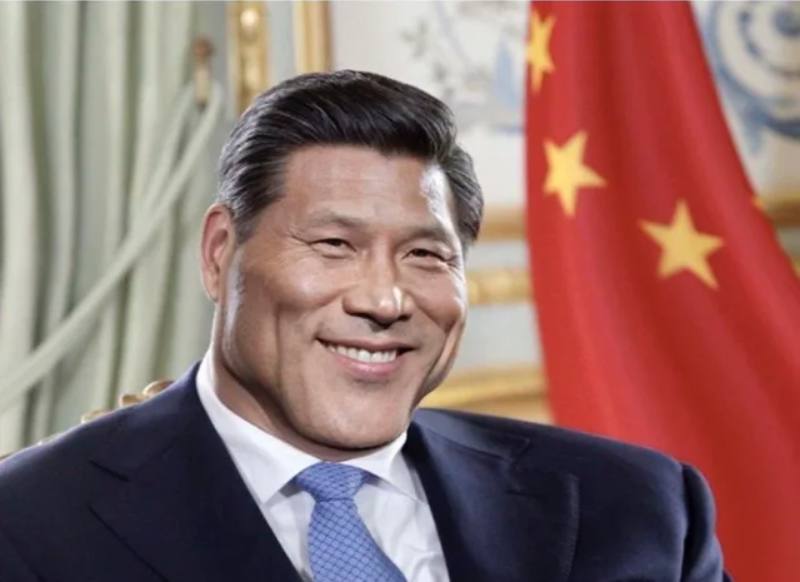
He could stop the Iran War. And in the process, rebalance the world’s great-power politics
Edited by Spencer Ackerman
OVER THE PAST 24 HOURS, the Iran War’s escalatory spiral has taken a frightening turn. The Israelis on Wednesday bombed Iran’s South Pars gas field. Its targeting indicates the Israelis may no longer believe regime collapse is on the horizon, as a successor regime or regimes would need its revenue. Widespread pain is instead the order of the day.
Iran, immediately pledging retaliation, attacked Qatar’s enormous export site for liquified natural gas, Ras Laffan Industrial City, the largest such site in the world. Seeing the writing on the wall for its own Habshan gas facility, the United Arab Emirates denounced the Israeli bombing, but Iran bombed it anyway. Donald Trump, who now faces $115/barrel brent crude and the likelihood of $150-plus barrel oil, shifted away from his previous caution against bombing oil infrastructure and threatened to blow up South Pars if Iran hits Qatari energy fields again.
We’re nearing the end of week three of Trump’s allegedly four-week war of aggression and he has achieved none of his stated objectives. Claiming an end to Iran’s nuclear efforts would require inserting a U.S. invasion force deep into Iran to dig out its uranium stockpile. The Iranian ballistic-missile magazine is deeper than the U.S. and Israel appear to have anticipated, though it’s important to remember Iran possesses not a single missile capable of hitting the United States. And destroying Iran’s missiles will require destroying its “missile cities.”
Despite a cascade of U.S.-Israeli assassinations, the Iranian regime has proven more durable than Trump or Benjamin Netanyahu expected. Closing the Strait of Hormuz has gained Iran the initiative in a war whose economic reverberations are global. The U.S. and Israel can kill people and blow stuff up, and it will not change the strategic picture. Only a reopened Strait, the status quo on February 28, can provide an outcome acceptable to a world watching energy prices rise and fertilizer provisions fall.
The Iranians are not looking for an off-ramp. They’ve told Drop Site’s Jeremy Scahill that they’ve been rebuffing efforts from Steve Witkoff (denied by the White House, for whatever that’s worth) to explore ways to climb down. After experiencing 15 years of economic siegecraft in the form of U.S. and U.N. sanctions before coming directly under attack by its main enemies, Iran is now looking to impose some pain. The Fed said on Wednesday that it expects “core” U.S. inflation, which apparently excludes food and energy prices, to reach 2.7 percent by the end of the year, revising upward an earlier estimate of 2.5 percent. That might be sanguine, but the point is that the central bankers see a ripple effect from this war lasting through at least the end of the year, and there is no end of the war in sight. The Iranians must reestablish a deterrent—whether on literal or economic battlefields, or through negotiations—or die trying. Meanwhile, the Israelis, whose interests are in a long war while the U.S. interests (such as we can say, given how insane this war is) are in a short one, are now blowing up stuff that makes oil prices rise higher and faster.
But the war can sure get worse. As the energy-field attacks unfolded Wednesday, Saudi Arabia intercepted Iranian ballistic missiles aimed at its Riyadh capital as well as drone strikes on one of its natural-gas facilities. For the first time, Riyadh hinted that it could heed Sen. Lindsey Graham’s exhortations and join the war. “I think it’s important for the Iranians to understand that the kingdom, but also its partners who have been attacked and beyond, have very significant capacities and capabilities that they could bring to bear should they choose to do so,” said Prince Faisal, the Saudi foreign minister. And if the Saudis are clearing their throats and loading their guns, the Houthis could be next, with their demonstrated capabilities to shut the Red Sea while their Iranian allies close the Strait.
That sound you hear, swelling above the sounds of regional chaos and global panic, is Xi Jinping’s music.
I AM NOT a China expert. I will not pretend to be one here. Many people in the west of divergent politics have over the past few years called for Xi Jinping to rescue their favored causes. Rules-Based International Order dead-enders hoped in vain in 2022 that Xi would restrain Russia in Ukraine. Just this week, Trump urged Xi to force open the Strait of Hormuz and thereby save the war he started. Xi, like Rorschach, has whispered “No.” Joyce Karam of al-Monitor’s China-Middle East newsletter wrote on Wednesday that China is in “no rush” to end the Iran War, and laid out reasons why a protracted conflict that drains American power redounds to Beijing’s benefit.
However. The looming entrance of Saudi Arabia into the conflict provides Xi with an opportunity. Whether he takes it or not will say a lot about Chinese power and geopolitical ambition at this stage in Beijing’s development. I make no predictions.
In 2023, China unexpectedly brokered a detente between Saudi Arabia and Iran. It was the inaugural exercise of Chinese power in the Middle East. As you can tell, it’s not going very well, although Beijing has not acted over the past three weeks as if it has lost face diplomatically. Still, China did not merely convene talks, it became a signatory to the deescalation, implicating Chinese prestige. That means China can intervene on the basis of an established diplomatic accord.
Chinese diplomats would not need the U.S. to be a party to their negotiations, but Washington would quickly be bound up in them. In order to prevent a Saudi-Iran exchange of fires, Beijing would need to provide Iran with reasons to stop its missile and drone barrage across the region. The only way to do that would be to give Iran the restored deterrent it seeks—or at least the promise of one, so Tehran has a basis for deescalation. That requires China to prevent Washington with a fait accompli and a tacit dare: a ceasefire in the Gulf—provided the Americans join it and bring the Israelis into it. The Americans would no longer be dealing with the Iranians. They’d be dealing with the far more powerful Chinese.
While there are many differences between the Iran War of 2026 and the Yom Kippur War of 1973, here the Chinese would be in the role Nixon and Kissinger played back then. They’d conduct delicate post-war arrangements and guarantees on their terms, as an inauguration of what their power can offer the region. And that would inevitably be a demonstration effect of what Chinese power can offer the world. Success would be by no means guaranteed and uncomfortable the whole way. The alternative is chaos that can impact the entire world.
Washington would hate this. Trump will for sure, but the Democrats and the Security State will hate it, too. Israel will hate it even more. Their war will be lost, having achieved nothing, and the U.S. will rightfully be twice humiliated—first by being unable to resolve the foolish war it launched, and then by requiring resolution from its chief geopolitical “competitor.” But this is the off-ramp Trump needs and cannot otherwise produce. The alternative is $150-or-higher oil and many more dead Americans in a war that can last years and decimate MAGA along with the people of the region and perhaps beyond, once the fertilizer shortages impact food supplies around the world. The $200 billion supplemental the Pentagon is already seeking would just be a down payment. And playing spoiler would risk a confrontation with China that neither an isolated, overstretched U.S. nor an Israel with minimal ties to a rising global power can afford. China can seriously checkmate the U.S. and Israel here.
To the best of my understanding, China does not wish to replace the U.S. in the Middle East, understandably seeing that as a headache it doesn’t need. Joyce Karam knows these issues better than I do. But I note that even her assessment that China can live with a long war is caveated: “A protracted conflict that harms U.S. standing, keeps Washington preoccupied and opens diplomatic and commercial space for Beijing is something Chinese leaders can live with — as long as the fallout does not seriously derail their own growth or trigger a wider regional collapse.” We can see that collapse is approaching. Reduced access to Saudi and Iranian oil will indeed derail Beijing’s growth, even as the Chinese make leaps and bounds in renewables. Karam’s reporting also suggests that whatever the Chinese reluctance, the Gulf is quietly looking to Beijing for intercession: “It is no surprise that [the Chinese] envoy, Zhai Jun, was received by senior officials in Saudi Arabia and the United Arab Emirates and that senior UAE official Khaldoon Al Mubarak visited Beijing this week. Gulf states could lean on China to help secure understandings with Iran on oil exports or the protection of vital infrastructure.”
Now, the existence of a need doesn’t mean that the Chinese have the will or the interest. All I’m saying is that the opportunity is there for the Chinese. It exposes the void at the heart of the international system set up by the United States—namely, the United States itself. One side of history is an erratic power no longer capable of providing the stability and prosperity central to its aspirations to global leadership and which it itself currently threatens. On the other side is China, a rising power that, as I understand, doesn’t wish to replace the United States geopolitically but instead seeks a more equitable distribution of geopolitical power; although that judgement of “more equitable” will inevitably mean “with a whole lot going to Beijing and its allies, which include Putin’s Russia.”
One of the distinguishing features of U.S. foreign policy in Trump 2, from the tariffs to the Iran War, is that it is disinterested in justifying its preeminence in global affairs beyond the sheer fact of its power. Look at one hideous case in point. In Zambia, the U.S. is denying the distribution of life-saving HIV medicines unless Zambia signs confiscatory deals with American companies to exploit its mineral wealth—”the potential use of sticks,” in the gangsterish language of a draft State Department memo. Currently much of that wealth is licensed to Chinese companies, whose government, for all its surely self-interested and exploitative reasons, did not threaten Zambia with a public-health crisis. If that example isn’t to your liking, how about this one: the U.S. caused the collapse of the Cuban power grid Tuesday through its oil embargo. The Chinese are building solar farms in Cuba.
Whether Americans like it or not, a very stark contrast between the purposes of American and Chinese geopolitical power is already on vivid display. By moving to end the Iran War, Xi has an opportunity to cement it. I don’t know if he would, nor do I know how durable a Chinese-brokered deescalation can be. But if Xi pulls one off, the sun will rise the day afterward on a much different geopolitical order than has existed since 1945.
A HOUSE NOTE. While I want to say much more about the major implications of Joe Kent’s MAGA-rending resignation from the (backwater) National Counterterrorism Center, there are some people who I want to talk to before I do that, since I am sure there are intra-right dynamics at work that I’m not attuned to. Kent, a figure who drew far-right lessons from his and his wife’s experience with the War on Terror, is a significant person I keep meaning to explore, but I never quite find the time.
However, this is unlikely to be the time, unfortunately.
The outbreak of the Iran War has put me behind schedule on revising the manuscript of THE TORTURE AND DELIVERANCE OF MAJID KHAN in line with my editor’s notes. Helen Rouner at Penguin is a godsend for this project and I am very grateful for her, particularly for her guidance and her understanding. But I have to finish-finish this book, and that is going to mean some reductions in the publication schedule for FOREVER WARS—and, for the editors reading, in my freelancing availability. I am trying to complete the most ambitious work of my career thus far, and a piece like the one you read above took me two drafts and the better part of a full day away from the manuscript. I have to take my foot off the FOREVER WARS gas pedal. (I also am about to sign a contract for another major initiative, but I can’t make more than that public at this time.)
To be clear: The quality of my work here will not suffer. I just have to produce it at a slower pace for a few weeks, until the manuscript is where Helen and I want it to be. Thank you for your understanding.
WALLER VS. WILDSTORM, the superhero spy thriller I co-wrote with my friend Evan Narcisse and which the masterful Jesús Merino illustrated, is available for purchase in a hardcover edition! If you don’t have single issues of WVW and you want a four-issue set signed by me, they’re going fast at Bulletproof Comics! Bulletproof is also selling signed copies of my IRON MAN run with Julius Ohta, so if you want those, buy them from Flatbush’s finest! IRON MAN VOL. 1: THE STARK-ROXXON WAR, the first five issues, is now collected in trade paperback! Signed copies of that are at Bulletproof, too! And IRON MAN VOL. 2: THE INSURGENT IRON MAN is available here!
No one is prouder of WVW than her older sibling, REIGN OF TERROR: HOW THE 9/11 ERA DESTABILIZED AMERICA AND PRODUCED TRUMP, which is available now in hardcover, softcover, audiobook and Kindle edition. And on the way is a new addition to the family: THE TORTURE AND DELIVERANCE OF MAJID KHAN.