WTI crude briefly slipped below the $90 mark as a fresh wave of diplomatic optimism swept energy markets, after US President Donald Trump signaled that a second round of talks in Islamabad could take place “over the next two days,” according to the New York Post. The move reflects a rapid unwind of the war premium, with markets increasingly anticipating that the next meeting could deliver a ceasefire extension—or even a “bridge deal” that charts a path toward de-escalation.
The next 48 hours are critical. With the ceasefire expiring in just one week, this second round of talks is seen as decisive. Without progress, markets risk snapping back into escalation mode. But for now, the bias is toward a negotiated extension.
Crucially, traders are not betting on a full resolution yet, but on a “bridge deal.” The working assumption is that both sides will compromise on the uranium enrichment dispute, splitting the gap between Washington’s proposed 20-year freeze and Tehran’s 5-year counteroffer.
At the same time, the reality of the Hormuz situation is being reassessed. Despite strong rhetoric, the blockade has not resulted in a full disruption of global supply. Instead, it is being viewed as a calibrated tool—one that increases pressure without triggering immediate escalation.
Another factor supporting optimism is the role of Pakistan’s Field Marshal Asim Munir. Trump’s explicit praise of Munir has reinforced the perception that the next round of talks could be more structured and outcome-oriented. his has helped reinforce confidence that a technical compromise is achievable.
If a bridge deal materializes—potentially alongside a 45-day ceasefire extension—the implication is clear: oil moves lower. Such an outcome would significantly reduce the probability of supply disruption, allowing WTI to drift toward the $80 level. Importantly, $80 is not “peace pricing,” but rather reduced war premium pricing.
| Scenario | Description | WTI Outlook | Market Interpretation |
|---|---|---|---|
| Escalation | Talks fail, blockade tightens | $95–110+ | War premium rebuilds |
| Ceasefire Extension | Temporary delay, no deal | $88–95 | Partial premium remains |
| Bridge Deal | Compromise reached, talks continue | $80–85 | Majority of premium removed |
| Full Resolution | Structural de-escalation | $70–75 | Near full normalization |
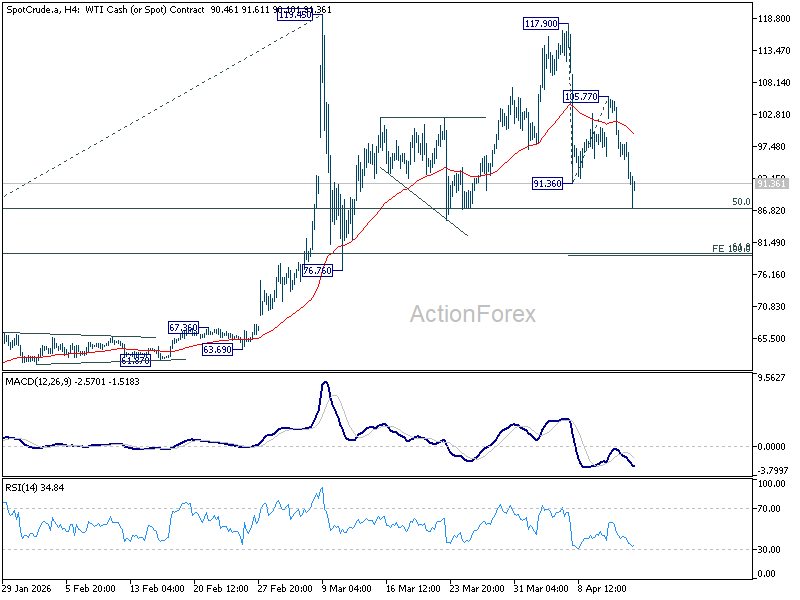
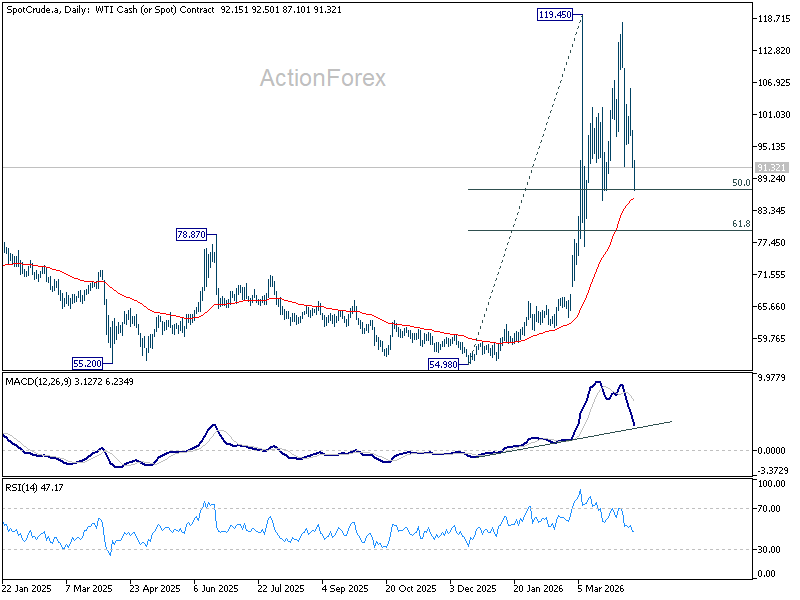
Technically, WTI crude’s fall from 117.90 resumed by breaking through 91.36, but halted just before 50% retracement of 54.98 to 119.45 at 87.21. Further decline is in favor in the near term as long as 55 4H EMA (now at 99.52) holds. Firm break of 87.21 will pave the way to 80, which is slightly above 61.8% retracement at 79.60, 100% projection of 117.90 to 91.36 from 105.77 at 79.23