Key Points
-
Greg Abel’s new role as Berkshire Hathaway CEO comes with about $378 billion in cash and Treasury bills.
-
Apple’s fiscal first-quarter results were driven by a 23% year-over-year jump in iPhone revenue.
-
I like the pairing of Apple’s strong growth with Berkshire’s optionality.
- 10 stocks we like better than Apple ›
It’s been a wild start to 2026. Many software stocks have nosedived amid investor fears that AI (artificial intelligence) may disrupt their businesses. Even some high-flying names from last year have been hit hard, including Palantir Technologies. Still, we’ve also seen companies with strong returns from last year, like Alphabet and Meta Platforms, continue to rise. In aggregate, we’ve somehow squeaked by with the S&P 500 gaining about 2% year to date as of this writing.
Just over one month into the year, it’s a good time for investors to check in and revisit their portfolios. As I look at mine, one thing I’m particularly happy about is my top two holdings: Apple (NASDAQ: AAPL) and Berkshire Hathaway (NYSE: BRK.A)(NYSE: BRK.B). While neither has matched the market’s returns so far this year, I’m more convinced now than I was at the start of 2026 that these are the right investments for me. I believe they not only contrast nicely with the market’s speculative hype for AI, but also complement each other well.
Where to invest $1,000 right now? Our analyst team just revealed what they believe are the 10 best stocks to buy right now. Continue »
Here’s a closer look at Berkshire Hathaway and Apple, and why they remain my top stocks to buy for 2026 and beyond.
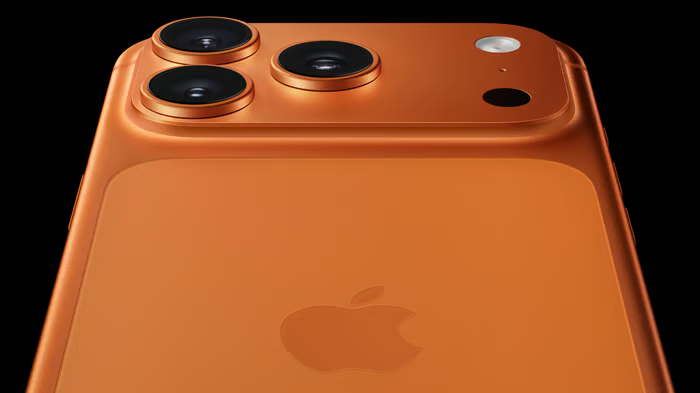
Image source: Apple.
Berkshire Hathaway
Down about 4% year to date, Berkshire Hathaway is a slightly better buy than it was at the beginning of the year, making it a good time to look at the stock.
The market is likely viewing the conglomerate with a wait-and-see approach, given that famed investor Warren Buffett stepped down as CEO at the end of 2025, handing the reins to his successor Greg Abel. In addition, there are questions about what the company will do with its massive cash position. The company’s cash, cash equivalents, and short-term U.S. treasury bills at the end of its most recent quarter totaled about $378 billion. This war chest is 36% of the company’s total market capitalization.
Trading at about 1.5 times its book value, shares look attractive. Berkshire’s oversized cash position is a war chest that can be invested if the market sells off. Meanwhile, the company owns an array of high-quality assets, including a sprawling insurance operation, a railroad, a diversified energy business, and meaningful equity stakes in steadily growing companies like American Express, Bank of America, Coca-Cola, Moody’s, and, of course, its largest equity holding of all: Apple.
While earnings from Berkshire’s insurance business are somewhat cyclical and difficult to predict, I believe the conglomerate is well-positioned to grow this core business and, of course, its earnings and book value over time.
Apple
Like Berkshire, shares of the iPhone maker have declined slightly year to date as well. The stock is down about 3% as of this writing.
Yet Apple’s latest earnings report, released last week, shows a major growth story.
The tech giant reported fiscal first-quarter revenue of $143.8 billion, up 16% year over year, and its earnings per share rose 19% year over year. The quarter was driven by huge growth in iPhone revenue. iPhone revenue increased 23% year over year.
This momentum was an acceleration from 8% year-over-year growth in the prior quarter. The company also guided to strong growth in fiscal Q2, with management stating that revenue could grow 13% to 16% year over year.
But what’s great about Apple, however, is more than just its recent results; it’s how the tech company is being more cautious about investing in AI compute than many other tech companies right now. This financial discipline is one reason the company posted such strong earnings growth in its most recent quarter. Apple’s earnings per share rose 19% year-over-year in fiscal Q1, outpacing social media company Meta Platforms, even though Meta’s revenue rose 24% year-over-year during the holiday quarter (much faster than Apple’s 16% growth); Meta’s earnings rose only 11% year over year, weighed down by heavy spending.
And then there’s Apple’s services segment, which commanded a gross profit margin of 75.4% for fiscal 2025, towering over its products segment’s 36.8% gross margin for the same period. Accounting for about 25% of Apple’s fiscal 2025 revenue, this is the company’s second-biggest segment after iPhone. Consistently growing at double-digit rates, this high-margin segment should be a catalyst for Apple’s earnings growth over the long haul.
In addition to each of these companies being good investments in their own right, they also offer a good mixture of offense and defense when paired together.
Of course, both companies face risks. Berkshire’s large cash position, for instance, raises the stakes for its CEO’s capital allocation choices this year and beyond. If Abel drops the ball with any major new investments, the stock could stumble. In addition, Apple is a large company that often faces regulatory scrutiny, and its global reach exposes it to geopolitical risks.
Overall, however, I believe these are great investments — especially when paired together.
Should you buy stock in Apple right now?
Before you buy stock in Apple, consider this:
The Motley Fool Stock Advisor analyst team just identified what they believe are the 10 best stocks for investors to buy now… and Apple wasn’t one of them. The 10 stocks that made the cut could produce monster returns in the coming years.
Consider when Netflix made this list on December 17, 2004… if you invested $1,000 at the time of our recommendation, you’d have $450,256!* Or when Nvidia made this list on April 15, 2005… if you invested $1,000 at the time of our recommendation, you’d have $1,171,666!*
Now, it’s worth noting Stock Advisor’s total average return is 942% — a market-crushing outperformance compared to 196% for the S&P 500. Don’t miss the latest top 10 list, available with Stock Advisor, and join an investing community built by individual investors for individual investors.
*Stock Advisor returns as of February 2, 2026.
Bank of America is an advertising partner of Motley Fool Money. American Express is an advertising partner of Motley Fool Money. Daniel Sparks and his clients have positions in Apple and Berkshire Hathaway. The Motley Fool has positions in and recommends Apple, Berkshire Hathaway, Meta Platforms, and Moody’s. The Motley Fool has a disclosure policy.
The views and opinions expressed herein are the views and opinions of the author and do not necessarily reflect those of Nasdaq, Inc.