Key Points
-
The Nasdaq fell 2.0% while the Dow lost just 0.4%, thanks to differences in how the indexes are weighted.
-
AI stocks are under pressure as investors question the return on investment from massive AI spending.
-
Stubborn inflation data is hurting financial stocks as investors expect the Fed to keep interest rates elevated.
- 10 stocks we like better than Dow Jones Industrial Average ›
The stock market has been choppy recently and is ending the week on a sour note. The three major market indexes are down again, and Nvidia (NASDAQ: NVDA) is still setting the tone on Wall Street.
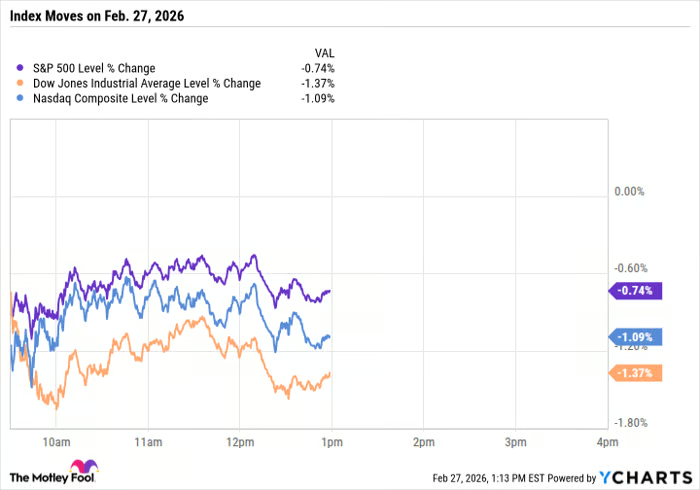
As of 1:10 p.m. ET, the Nasdaq Composite (NASDAQINDEX: ^IXIC) index fell 2% and the S&P 500 (SNPINDEX: ^GSPC) is down by 1.1%. The Dow Jones Industrial Average (DJINDICES: ^DJI) saw another milder drawdown, just like on Thursday. The oldest index only lost 0.4% today:
Will AI create the world’s first trillionaire? Our team just released a report on the one little-known company, called an “Indispensable Monopoly” providing the critical technology Nvidia and Intel both need. Continue »
AI nerves have market-moving power
Most of the hyperscalers are slouching today. Meta Platforms (NASDAQ: META) and Apple (NASDAQ: AAPL) dropped 2.5% lower and Microsoft (NASDAQ: MSFT) is down by 2%. But Nvidia’s 3% drop is larger, and amplified by the stock’s market-leading market cap of $4.3 trillion. Nvidia’s total market value fell by $132 billion today. If that value belonged to a stand-alone company, it would rank among the 90 largest names in the S&P 500. But I’m talking about Nvidia, so it’s just a 3% price drop.
Nvidia investors are still digesting Wednesday’s earnings report, which didn’t beat analyst estimates enough to impress investors. Yeah, it’s one of those high-priced market darlings that must deliver absolute perfection to support a lofty valuation.
On top of that, investors across the artificial intelligence (AI) industry aren’t seeing a strong return on investment from multi-billion-dollar AI systems. ChatGPT maker OpenAI landed $110 billion of cash infusions today, and the stocks of OpenAI’s new investors lost market value in response. That’s bad news for the S&P 500 and Nasdaq, where these trillion-dollar stocks play leading roles in the index’s total value and daily moves.
Image source: Getty Images.
The Dow fell, too, but for very different reasons
Once again, the Dow walked a different path because of its price-weighted structure. Tech stocks like Nvidia, Microsoft, and Apple barely moved the needle for this classic index, and the heaviest downward pressure came from a 7.2% retreat in Goldman Sachs (NYSE: GS) stock.
The financial sector is suffering as a producer-side inflation metric came in higher than expected in January. Stubborn inflation may keep Federal Reserve interest rates high in 2026, narrowing the profit margins of traditional banking and financial service operations.
American Express (NYSE: AXP) was the second-largest mover on the Dow, though its impact on the index score was about one-third of Goldman Sachs’.
So that’s the end of the week. By Thursday evening, the ups and downs of recent days added up to almost perfectly breakeven moves from last Friday’s closing, across all three of the leading indexes. Next week is also a new month, and the fourth-quarter earnings season is winding down. Investors will probably focus more on macroeconomic trends than single-company reports for a few weeks.
Should you buy stock in Dow Jones Industrial Average right now?
Before you buy stock in Dow Jones Industrial Average, consider this:
The Motley Fool Stock Advisor analyst team just identified what they believe are the 10 best stocks for investors to buy now… and Dow Jones Industrial Average wasn’t one of them. The 10 stocks that made the cut could produce monster returns in the coming years.
Consider when Netflix made this list on December 17, 2004… if you invested $1,000 at the time of our recommendation, you’d have $456,188!* Or when Nvidia made this list on April 15, 2005… if you invested $1,000 at the time of our recommendation, you’d have $1,133,413!*
Now, it’s worth noting Stock Advisor’s total average return is 916% — a market-crushing outperformance compared to 194% for the S&P 500. Don’t miss the latest top 10 list, available with Stock Advisor, and join an investing community built by individual investors for individual investors.
*Stock Advisor returns as of February 27, 2026.
American Express is an advertising partner of Motley Fool Money. Anders Bylund has positions in Nvidia. The Motley Fool has positions in and recommends Apple, Goldman Sachs Group, Meta Platforms, Microsoft, and Nvidia. The Motley Fool has a disclosure policy.
The views and opinions expressed herein are the views and opinions of the author and do not necessarily reflect those of Nasdaq, Inc.