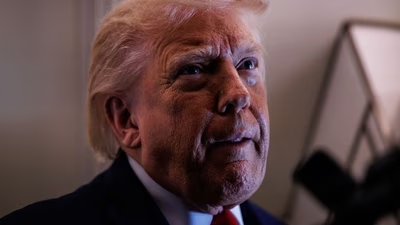
US President Donald Trump on Friday said Iran has not yet agreed to a deal with the United States to end the ongoing war because its leaders are “strong” and “proud”, though he maintained that Tehran would eventually have to come to the negotiating table.

Trump claimed Iranian leaders were struggling to accept the position they now find themselves in after months of conflict. “They’re strong, they’re proud, there are things they never thought they’d be doing that they’re going to have to do. They’ve got no choice, and it takes a little while,” Trump told US media outlet NBC News.
The comments came as the war between the United States and Iran entered its fourth month last week. While both sides agreed to a ceasefire in April and have extended it several times since, recent exchanges of strikes near the Strait of Hormuz have raised fresh concerns about the stability of the truce and long-term peace. Track US-Iran war live updates.
Trump says Iran facing a new reality
Trump argued that Iran’s leadership was finding it difficult to adjust to the setbacks it has suffered during the conflict.
“They can’t believe that are in a situation where they are virtually decapitated… They have 47 years of getting away with whatever they wanted. This should have been done a long time ago. This should have been done by other Presidents or by other countries,” he said.
His comments came as efforts to secure a broader peace agreement appeared to be making little progress.
What is holding up a deal?
Washington and Tehran have been engaged in largely indirect negotiations aimed at securing an interim agreement that would halt the fighting while leaving more contentious issues, including Iran’s nuclear programme, for future talks.
But a breakthrough has remained elusive.
Tehran is seeking access to billions of dollars in oil revenues, sanctions relief on crude exports, an end to the US blockade on its ports and leverage over the Strait of Hormuz. Iran has effectively blocked the strategic waterway during the conflict, disrupting one of the world’s most important oil shipping routes.
In a sign that diplomatic efforts are continuing, Pakistani Interior Minister Mohsin Naqvi arrived in Tehran on Saturday carrying what Iranian state media described as a “special letter” from Pakistan’s army chief and prime minister to Iran’s supreme leader, Ayatollah Mojtaba Khamenei. Naqvi was also expected to meet Iranian foreign minister Abbas Araqchi.
Fighting continues as talks remain stuck
Despite ongoing negotiations, the two sides exchanged military action over the weekend. The US military said its forces struck Iranian coastal radar sites in Goruk and on Qeshm Island in the Strait of Hormuz early Saturday after intercepting drones that it said threatened maritime traffic. Later, US Central Command (CENTCOM) reported shooting down two additional Iranian attack drones in the area.
Iran’s Revolutionary Guards, meanwhile, said they retaliated by targeting US bases in Kuwait and Bahrain. Kuwait’s military said it engaged seven ballistic missiles that crossed over residential areas, causing property damage but no casualties, reported Reuters.
In Bahrain, warning sirens sounded and authorities urged residents to seek shelter. Both Kuwait and Bahrain condemned the attacks.
Iran later claimed it had struck US bases in both countries with ballistic missiles. The US military, however, said six missiles were intercepted and a seventh failed to reach its intended target.
The conflict began after the US and Israel launched military operations against Iran on February 28. In response, Tehran targeted Gulf states hosting US military bases and sharply curtailed shipping through the Strait of Hormuz.