
High-end luxury sports car makers, like the rest of the auto industry, are starting to figure out how big demand is for electric vehicles.
Lamborghini has said there is nearly no market for electric supercars. But fellow luxury carmaker Ferrari is pressing ahead with an EV, although it has also downsized its EV plans.
The global electrification push has put automakers in every segment in a bind as they try to figure out how invest in the technology favored by some overseas regulators, while pleasing customers who are either skittish or uninterested in EVs.
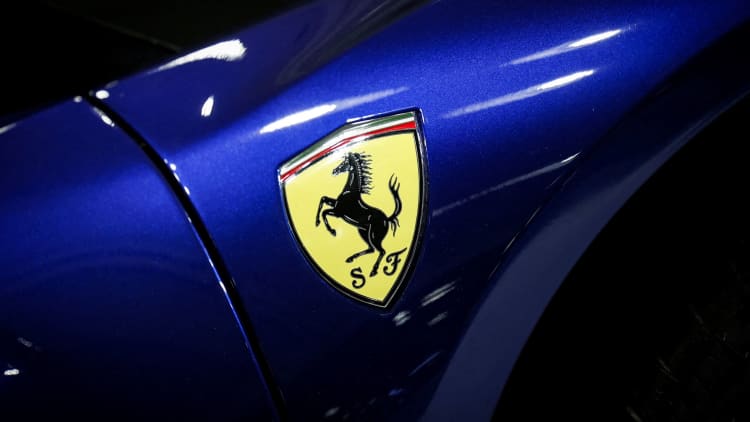
Ferrari doesn’t have an EV on the market yet, but its first model, called Luce, is expected to be open for orders later this spring.
The automaker, which is publicly traded, only sells about 14,000 cars per year, but its market value is greater than the combined assets that make up Lamborghini’s parent company, German auto giant Volkswagen Group. that’s in large part because Ferrari vehicles carry high price tags, starting in the low hundred thousand dollar range and running up into the millions.
“Ferrari has been one of the most successful companies in Europe, period,” said RBC Capital analyst Tom Narayan. “Not even in autos, just in general. It’s been a smashing success.”
Ferrari has backed off some of its EV ambitions. At its capital markets day in October, the company said it now expects EVs to make up 20% of its sales — cutting a previous target in half. And it’s still going to make internal combustion vehicles, including its famous 12-cylinder engines.
“I just think what Ferrari is doing is just hedging its bets and trying to cater to a customer demographic that definitely exists,” Narayan said, “while at the same time satisfying its core constituency, which is the DNA of Ferrari, its internal combustion engine cars. It can kind of walk and chew gum at the same time.”
‘Emotional connection’
Part of what makes luxury brands so powerful is their ability to get customers to spend six to seven figures on a single car, analysts said. But that means customers can be particular about what they want and automakers have to pivot.
In late February, Lamborghini boss Stephan Winkelmann said in an interview with UK paper The Times that the ‘”acceptance curve” for battery-powered cars in Lamborghini’s target market was flattening and “close to zero.'”
The reason for this, Winkelmann said in the interview, was that EVs don’t deliver the “emotional connection” that gas-powered supercars do.
Lamborghini told CNBC that the brand’s original product roadmap planned for the introduction of a fully electric version of its Urus SUV, followed by a fully electric fourth model line, named the Lanzador.
“However, following extensive analysis and ongoing dialogue with dealers and customers, it became clear that the pace of adoption of pure BEV [battery electric vehicle] vehicles has slowed considerably, particularly within the luxury super sports segment, where demand remains very limited,” the company said.
Instead, the Lanzador and the Urus will continue to be hybrid, like the rest of Lamborghini’s lineup, the company said.
Karl Brauer, executive analyst for iSeeCars, and a supercar owner and tester, said he agreed with Winkelmann’s assessment.
“It was nice that Stephan admitted that,” Brauer said. “A lot of people won’t admit that, but a lot of these CEOs know there’s no market for these pure EV, high-end supercars.”
A lot of what makes a Ferrari exciting, he said, is the way it stirs a person’s senses: the look of it, the sound and feel of the engine and the smell of the exhaust.
Electric cars can “look cool” and accelerate extremely quickly, often better than any gas vehicle, he said, but much of what makes an internal combustion Ferrari compelling is missing.
The fact that Ferrari is moving toward EVs while Lamborghini is pulling back could also have something to do with the fact that Ferrari is an independent company while Lamborghini is a division of a much larger automaker, Narayan said.
“Lamborghini is very tailored and specific,” Narayan said. “They can be because VW Group is a behemoth that sells to all kinds of different customers. But Ferrari is completely on its own, and it has to be as broad based as possible.”
But Narayan said he does think there is a market for a Ferrari EV.
“I don’t know if they know that how strong demand will be,” he said. “That’s what they’ll find out. But as long as they can get 500 to 1,000 people per year to buy an electric Ferrari, which doesn’t seem like that Herculean of a task, it makes sense they can penetrate that segment of that market.”