As globalization moves beyond the circulation of goods toward deeper industrial integration, a new question is emerging for the fashion industry: how can the sector secure a meaningful seat at the global table?
The answer increasingly lies not in export volume alone, but in supply chain integration, local collaboration, sustainability standards and long-term strategic value.
More from WWD
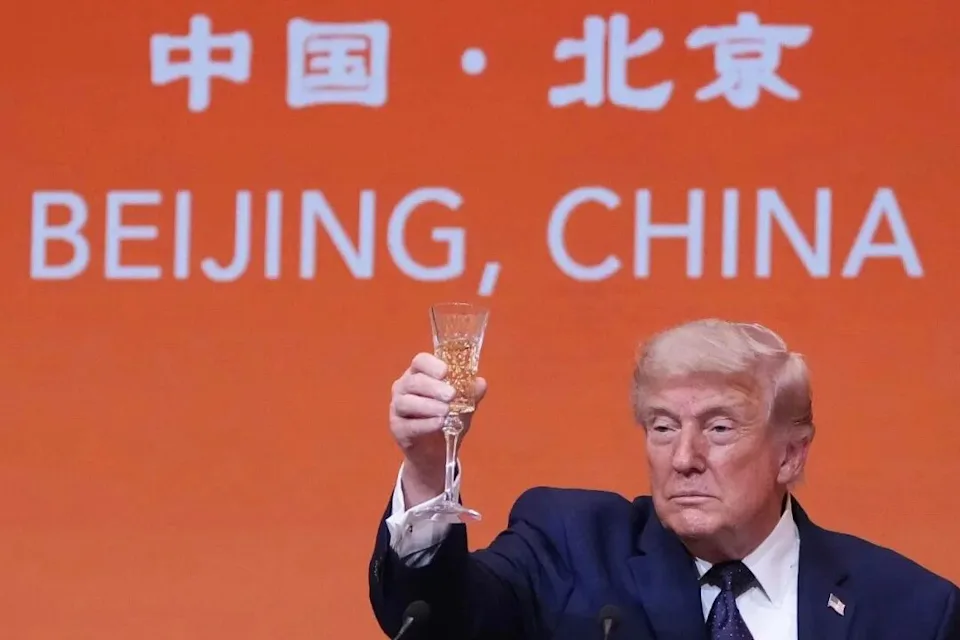
During U.S. President Donald Trump’s recent visit to China — his first major trip to the country of his second term — a closely watched business delegation featuring some of the world’s most influential corporate leaders offered an unusually clear signal about the direction of global economic relations.
The delegation included Apple chief executive officer Tim Cook, Elon Musk, BlackRock chairman Laurence D. Fink, Blackstone chairman Stephen Schwarzman, Boeing Commercial Airplanes president and CEO Stan Deal and, in a late addition that drew significant attention, Nvidia founder Jensen Huang.
The message was clear: the next phase of globalization is no longer centered solely on trade flows or manufacturing costs. It is increasingly about industrial interdependence, technological collaboration and supply chain resilience.
Chinese state media reinforced that narrative. A May 14 report from Xinhua News Agency highlighted the optimism of U.S. executives toward the Chinese market, while China Central Television quoted Huang describing China as “a unique market.”
The symbolism extended beyond diplomacy.
During the same trip, Cook — who has visited China more than 20 times since 2012 and is expected to step down as Apple CEO later this year — notably shifted his language around China’s role in Apple’s business. Rather than describing China merely as an “important market,” he referred to both Made in China and the Chinese consumer market as “irreplaceable.”
That distinction matters. It reflects how multinational corporations increasingly view China not simply as a manufacturing base but as an essential node within a broader global industrial ecosystem.
Just days earlier, another event quietly illustrated the same shift from trade toward deeper integration.
On May 8, Shanghai’s 2026 “Shanghai Summer” International Consumption Season held its global promotion event in Barcelona’s Port Vell district, organized by the Shanghai Municipal Commission of Commerce and the Shanghai Information Office. Companies including China Eastern Airlines, UnionPay International, ZhiYuan Innovation and luxury brand Man Lou Lan participated as part of celebrations marking the 25th anniversary of the sister-city partnership between Shanghai and Barcelona.
The event signaled a broader evolution in China’s international engagement from transactional trade relationships toward longer-term collaboration built around culture, tourism, consumption and shared economic development.
Beyond Trade: A New Globalization Narrative
The composition of the May 14 business banquet in Beijing revealed how dramatically the logic of globalization has changed.
Unlike Trump’s 2017 China visit — when internet entrepreneurs dominated the conversation — this year’s attendees were largely companies deeply embedded in global industrial supply chains.
Among them:
Wanxiang Group, which operates auto parts facilities across 26 U.S. states;
Fuyao Glass, employing more than 2,000 workers at its Ohio plant;
Lens Technology, a key supplier to both Apple and Tesla;
Lenovo, Haier, Hisense, Xiaomi and ByteDance, all representing sectors where Chinese companies now hold significant global influence.
The common denominator was not export scale alone, but long-term local integration, industrial collaboration and supply chain significance.
Trade figures underscore that shift. According to China’s General Administration of Customs, the country’s total trade reached $2.32 trillion in the first four months of 2026, up 18.2 percent year-over-year, despite ongoing geopolitical tensions and mounting supply chain concerns globally.
Increasingly, analysts in China view the next phase of great-power competition not as a battle over tariffs, but as competition around advanced manufacturing ecosystems, industrial standards, technological integration and supply chain coordination.
For fashion, that shift carries major implications.
Fashion’s Globalization Model Is Being Rewritten
For decades, much of fashion’s globalization strategy followed a relatively simple formula: outsource manufacturing, optimize costs and distribute products globally through retail channels.
That model is now under pressure.
Today, global trade governance is increasingly shaped by sustainability requirements, supply chain traceability, carbon reduction targets, compliance standards and digital transparency.
The fashion industry can no longer operate purely through OEM logic or tariff arbitrage.
As companies such as Wanxiang and Fuyao demonstrate, globalization is increasingly about embedded participation — building local operations, integrating into regional ecosystems and contributing long-term industrial value.
Fashion is beginning to split into two distinct trajectories.
On one side is companies still trapped in low-margin OEM manufacturing for overseas brands.
On the other is companies developing global influence through brand building, supply chain innovation, sustainability leadership and operational integration.
Several Chinese fashion and apparel companies are already moving decisively into the latter category.
Anta Group has emerged as one of the clearest examples. Through its management of Fila Greater China and ownership of Amer Sports — parent company of brands including Arc’teryx and Salomon — Anta has evolved into the world’s third-largest sportswear group, combining global acquisitions with integrated R&D and supply chain capabilities.
Shenzhou International, meanwhile, has become the world’s largest vertically integrated knitwear manufacturer, supplying brands including Nike, Uniqlo and Adidas through a highly digitized and increasingly sustainable production network.
Shein represents yet another model: leveraging China’s flexible manufacturing ecosystem and real-time data systems to create a globally scaled fast-fashion platform capable of responding rapidly to consumer demand. Shein also recently integrated itself further into the global fashion ecosystem with the acquisition of the U.S. brand Everlane, which was founded as a DTC company based on the concept of radical transparency of its supply chain.
At the same time, major Chinese textile and apparel groups are accelerating overseas manufacturing expansion.
Orient International Holdings has established a major sweater production base in Ethiopia, while Guangdong Textiles Import & Export Co. Ltd. now operates more than 500 garment factories globally, with supply chain networks spanning throughout Africa, Southeast Asia and Latin America.
Companies including Jiangsu Guotai International Group and Jiangsu Sunshine Group have built manufacturing operations in Egypt to strengthen regional supply chain coordination and tariff advantages for European and U.S. markets.
These companies are no longer functioning simply as suppliers. They are becoming ecosystem participants and, increasingly, ecosystem builders.
The Next Seat at the Table
The next decade of globalization will likely be defined less by tariff negotiations and more by coordination, integration and shared standards.
For fashion, the implications are profound.
Companies dependent solely on low-cost manufacturing will face mounting pressure from sustainability regulation, compliance requirements and rising geopolitical complexity.
At the same time, the restructuring of global trade systems creates a rare opportunity for Chinese fashion companies to move from followers within the global system to active co-builders of it.
The critical question is no longer whether Chinese fashion companies can manufacture for the world — it is whether they can help shape the systems, standards and narratives that will define the next era of globalization.
And increasingly, that conversation is already underway.
Editor’s note: China Insight is a monthly column from WWD’s sister publication WWD China looking at developments and trends in that all-important market.