Recent history tells you that you are only ever one bad result away from losing your job as Real Madrid coach.
Optimism filled the air when Xabi Alonso returned to the Bernabeu, and his early record could hardly have gone any better — winning all but three of his first 20 matches across all competitions after taking over before last summer’s Club World Cup. Madrid were five points clear at the top of La Liga in November.
But the 44-year-old left his position on Monday, following a 3-2 defeat by Barcelona in the Supercopa de Espana final in Jeddah, Saudi Arabia, on Sunday, with Real Madrid reserve-team manager (and former Liverpool and Madrid team-mate) Alvaro Arbeloa replacing him.
Despite only trailing defending champions Barca by four points in the league, and being in a strong position to progress in the Champions League, Alonso’s departure came after a long period of speculation over his position. There were differences in the dressing room, as well as difficulties on the pitch.
Alonso is meticulous in the way he operates. It was that detailed, system-oriented style that brought him such success in Germany with an invincible Bundesliga title-winning campaign with Bayer Leverkusen in 2023-24.
In truth, Alonso was on a hiding to nothing ever since he took the job last summer. He is known to be a “project manager” who was beginning to instil his ideas into a younger squad, but results will always be the priority in the Spanish capital. The dial could barely have been moved without sufficient time to fully implement those ideas, but the shadow of dissatisfaction from players and the club’s hierarchy proved to be too much.
The lifespan of a Madrid manager hinges on political factors. Coaches who succeed are often those who can manage those above and below them, as opposed to the strength of their tactical ideals.
Still, some intriguing wrinkles in Alonso’s game plan are worthy of further exploration. Here is a review of his time in the Bernabeu dugout.
Alonso had been building his tactical plan in flight from the moment he arrived in Madrid — tasked with laying the foundations of his ideas during the expanded Club World Cup in the United States last summer.
Experimentation in shape, formation, and personnel during competitive games was his only realistic option, as Madrid lacked a genuine pre-season to trial ideas or build up their physical conditioning before a typically congested fixture schedule.
It is difficult to determine whether it is due to the lack of pre-season, but Madrid’s injuries did not help proceedings — particularly in defence, where Antonio Rudiger, Eder Militao, Dani Carvajal, David Alaba, Dean Huijsen, Ferland Mendy and Trent Alexander-Arnold have been notable absentees at various points in the first half of the campaign.
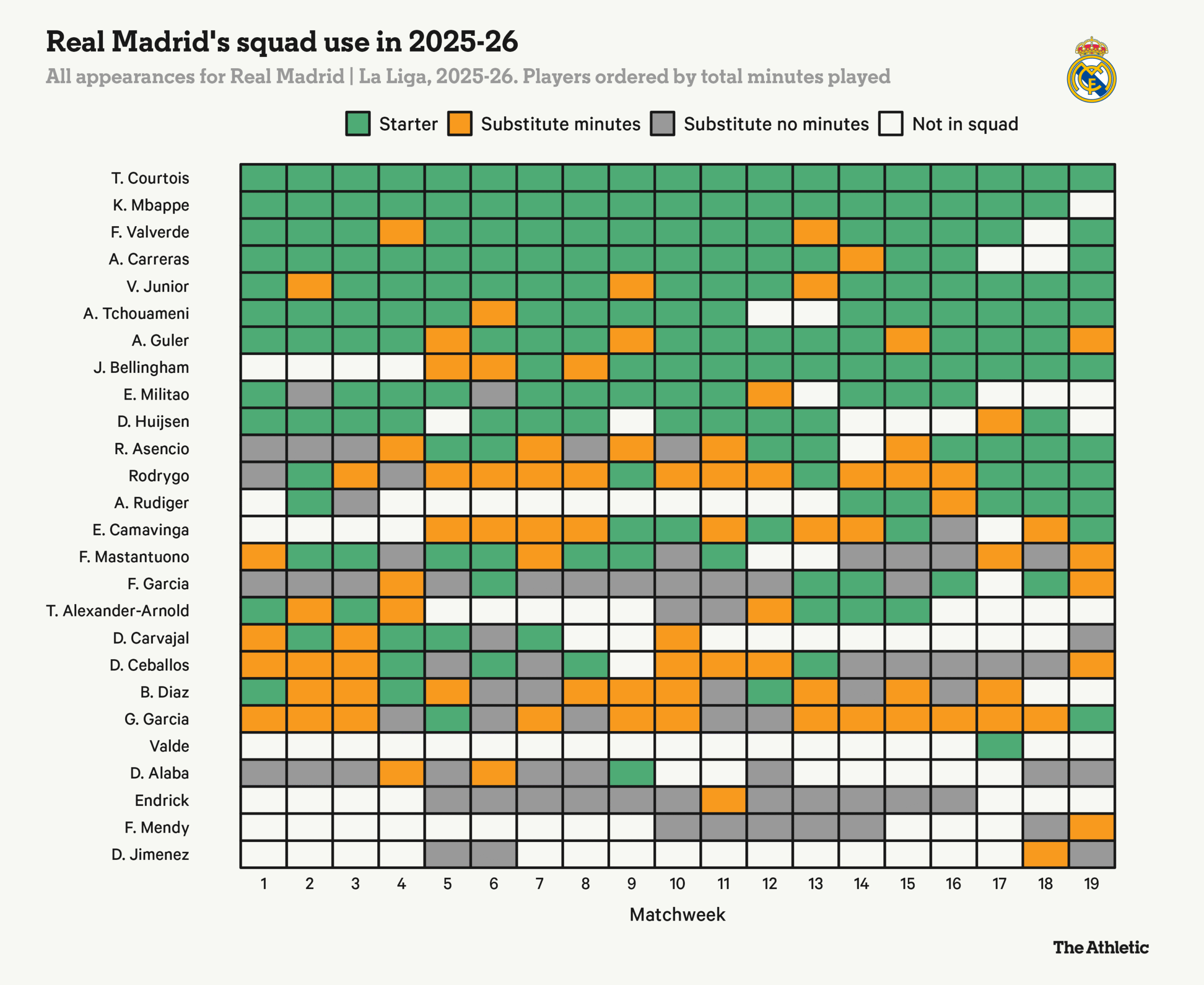
Whether through choice or circumstance, Alonso did not name an unchanged side in La Liga, making subtle tweaks across the side — with an average of 3.1 changes per game so far this league season. Using The Athletic’s measure of squad stability, Madrid come out as one of the least consistent in La Liga, when looking at their starting line-up and substitution minutes.

That lack of coherence could occasionally be seen on the pitch. Alonso experimented with multiple shapes and formations during his short stint as manager, in an attempt to get his best players in best positions while still maintaining a system that works in and out of possession.
During build-up, Madrid would often form a situational back three to help with ball progression and circulation — particularly during the absence of Huijsen and Alexander-Arnold, who possess a passing range that few others in the defensive line can offer.
The centre-backs would split, and midfielder Aurielien Tchouameni would drop into the defensive line to form a 3-2-5 or a 3-box-3 shape — not dissimilar to the shape Alonso had at Bayer Leverkusen with that invincible Bundesliga-winning team in 2023-24.
The example below against Alaves actually sees Kylian Mbappe and Rodrygo rolling inside as situational No 10s behind Vinicius Junior, but the principle is clear from the overall structure.

Throughout this season, Madrid’s build-up shapes have shown fluidity, allowing them to ask different questions of the opposition. For example, Tchouameni will also pull into the left half-space to get on the ball, with subtly different structures ahead of him — shaped more as a 3-5-2 against Athletic Club and a flat 3-4-3 against Real Betis.

One of the key differences this season has been the role of Arda Guler, who has been shifted from a right winger to a tempo-setting central midfielder within Alonso’s system.
The 20-year-old Turkey international has the creativity and technical skillset to unlock an opposition press, but his lack of positional understanding can come with risks. The same could be said for each of Madrid’s midfielders, with a tendency to push forward or drift wide, which can empty the midfield and leave space for the opposition to exploit in central areas.
While Guler profited from Alonso’s arrival, there was a feeling the manager did not got the best out of key players, including Jude Bellingham, Vinicius Jr, or the ever-selfless Federico Valverde. Star quality in both boxes has pulled Madrid through at times, but the dynamic in attack did not quite click.
Mbappe and Vinicius Jr have looked more coherent as a duo this season as they rotate between central and wide positions, but a continued skewed left-sided attack makes it clear where you need to focus your defensive attention as an opposition analyst.
A rotated cast of Franco Mastantuono, Rodrygo, Brahim Diaz and Valverde simply has not offered the same attacking potency on the right flank, with Alonso unable to pull Madrid away from their attacking imbalance that has been evident in recent seasons.

When you have the world-class threat of Mbappe, maybe that skew is acceptable.
A return of 18 goals in 18 league games shows just how in-form the France international has been this season, with only Real Mallorca’s Vedat Muriqi responsible for a higher share of their team’s total goals scored than Mbappe’s 42 per cent.
Still, when there is that much of a tilt to one individual, questions are naturally raised as to the wider team dynamics. Mbappe’s prolific scoring should not be seen as a negative, but if his goals are coming at the cost of wider attacking balance at the team level, then it can make it easier to nullify Madrid’s threat going forward.
Then the issue of Madrid’s out-of-possession approach rears its head.
“One thing that is clear to me is that we have to defend (with) all of us — all 11 players have to be involved,” Alonso said in a press conference before the Club World Cup.
“They have to come together and know how to press. Without that, it’ll be very difficult, and that’s why we’re all involved. Vini Jr, Bellingham, Valverde, Mbappe, those up top, the defence also has to push. The closer we are, the better distances we will have. The first thing I said: we have to improve the gaps and how we attack and defend.”
At the team level, there has been a collective improvement in Madrid’s ability to recover possession high up the pitch. Their 5.4 possessions won in the attacking third per 90 minutes is topped only by Athletic Club — up notably from 3.8 per 90 last season.
As shown below against Girona, in a 1-1 draw on November 30, Alonso’s side have been good at going man-for-man in their press, not just regaining possession but using it as an attacking tool. No La Liga side has had more shot-ending high turnovers than Madrid’s 41 this season.

When not pressing high, Madrid retreated into a 4-4-2 shape that was similar to their time under Carlo Ancelotti — with Mbappe and Vinicius Jr as the pair at the top of the defensive structure.
The early signs suggested that both were making more of a concerted effort to undertake their defensive duties, but the intensity to regain possession faded as the season wore on. Bad habits from last term set in, with little pressure on the ball to cut off opposition attacks at the source.
An example of this is shown below, in the 2-1 win at Alaves on December 14. Midfielder Antonio Blanco receives the ball with no Madrid player near him, allowing him to play a searching pass over the top of the defensive line. Alaves score from this simple sequence.

Striker Gonzalo Garcia has shown the tenacity out of possession that is befitting of his 21-year-old enthusiasm, but his low volume of minutes means this has not been an established pattern over the season. Gonzalo scored a perfect hat-trick against Real Betis in a rare start at the beginning of January after finishing as the surprise top scorer at the Club World Cup, the start of which Mbappe missed through illness.
While Vinicius Jr and Mbappe might argue they are better served staying high to pounce on a Real Madrid counter-attack, a lack of intensity in the forward line often has a knock-on effect deeper in the field — where team-mates are required to make big jumps out to the opponent that they simply cannot make up.
Attacking freedom was a key trait that Madrid’s squad were afforded under Ancelotti, but the lack of compactness in or out of possession can be a problem. Individual quality will prevail more often than not, but there have still been occasions this season where Madrid have looked horribly vulnerable — which was a negative trend Alonso was keen to arrest at the beginning of the campaign.
Still, Alonso would be well within his rights to point out the process was working in Madrid, when looking at each side’s expected goals difference — which outlines the quality of chances created and conceded — per 90 minutes.
This is typically a good proxy for where teams deserve to be in the league table, with Madrid putting up numbers that see them out-create the opposition by one goal per game — the highest in La Liga.

Stick with that output across a season, and it might have suggested — not guaranteed — that the process would end in silverware. Sadly for Alonso, we will never know now.