When you buy through links on our articles, Future and its syndication partners may earn a commission.
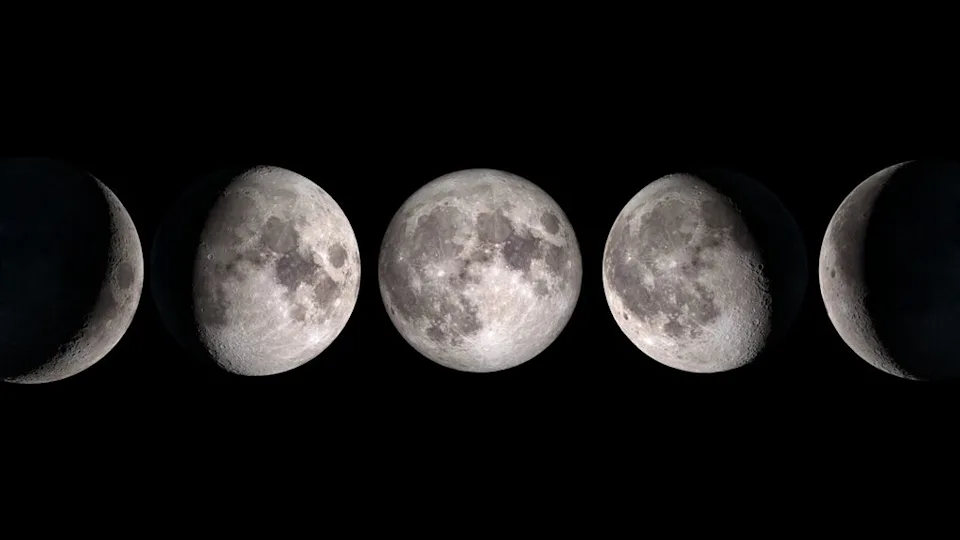
A NASA graphic showcasing the phases of the moon. | Credit: NASA’s Scientific Visualization Studio
If you stand outside the old Corn Exchange in Bristol, you’ll see a clock with two minute hands above the entrance. One hand is set to London time, the other to Bristol’s — ten minutes behind. The lag is because the sun reaches its peak over the second city a little bit after the first.
Of course, when it comes to scheduling anything with bounds beyond one city, having two poses an issue. This is why, in 1840, the British company Great Western Railway imposed what it called “Railway Time” across its whole network of trains, establishing Greenwich Mean Time as the first standardized time. And it’s still the time zone used in the U.K. today. However, when several towns refused to adopt the time established by the Royal Observatory in Greenwich, the solution was to use two minute hands instead of one. And so the three-handed clock came to be.
That compromise could soon repeat itself in a less likely location: the moon.
The U.S. and China, the two largest space powers, disagree on what time it is on the moon. That’s a problem because experts say satellites from one country will be unable to coordinate with spacecraft from the other during future space missions — which could risk accidents.
The White House has tasked NASA with establishing Coordinated Lunar Time (LTC) as a universal time on the moon, which would set the standard for NASA’s LunaNet satellite system. But China has other ideas.
China’s Chang’e Program, named after the Goddess who flew from the Earth to the moon in Chinese folklore, is the only space program with active lunar relay satellites, Queqiao-1 and Queqiao-2. These relay satellites are the first basis of a moon-wide GPS system meant for future space missions could rely on, meaning they compete with NASA’s LunaNet — and because of the way GPS works, these satellites will need a standardized time situation. China is also the only space power to have landed spacecraft on the far side of the moon, where radio signals from Earth are blocked, proving it can coordinate landings without relying on commands from home.
In other words, while the U.S. surpasses China in terms of total space missions, the relay satellites could give China the edge when it comes to establishing the first lunar GPS system for future moon landings. China also hasn’t agreed to use LTC for this system, raising the prospect that timekeeping standards could diverge.
Moon Race 2.0
Last year, experts warned U.S. Senators that China is set to win the moon race — the 21st century race to secure lunar resources establish a human presence on the moon — unless space operations receive more funding. Scientists further pointed out funding issues that could impact U.S. leadership in the lunar arena and wavering political commitment to Gateway, the space station intended to serve the Artemis moon program.
Private space-faring companies are also looking to governments to set international standards before spending money on expensive equipment. If China sets the standards before the US, private companies might gear with investments for Chinese customers, giving the country the edge over competitors.
“If everybody has their own standards, the complication increases for the user and manufacturers,” says Bijunath Patla, a theoretical physicist at the National Institute of Standards and Technology (NIST). “So there is a chance of making some mistakes, errors, and interchanging, and then having a mishap.”
GPS works by having satellites broadcast time signals. If the clocks on the satellites disagree, even by a microsecond, the GPS positioning can shift by hundreds of meters. In an emergency landing, that difference could prove expensive, or even fatal in the case of a human spaceflight mission.
A visualization showing some of the main tenets of NASA’s Artemis moon program. | Credit: NASA
If you take out the cellphone in your pocket, or look at the right-hand corner of your laptop to check the time, the precise time has been coordinated by hundreds of atomic clocks.
Atomic clocks created by NIST measure the oscillation of microwaves, the upwards and downwards swings of energy. Cesium atoms in the clocks absorb microwave energy only when oscillations reach 9,192,631,770 cycles per second.
Because all cesium atoms are the same, every atomic clock measures the exact same second as every other atomic clock. Their invention led to the universal standard of time we use today, superseding the time set by the Royal Greenwich Observatory in the 1800s.
International Atomic Time developed from the atomic clock, set by NIST’s optical “lattice clocks” and “cesium fountain clocks”, with the recently invented “nuclear clock” set to make the standard even more precise by ticking according to the fluctuations of thorium-229 nuclei.
The time on our screens comes from over 80 countries working with their own atomic clocks to work out the time. The U.S. Naval Observatory is one of these, submitting the time of its atomic clocks in Washington D.C. and Colorado to an international timekeeping organization in France.
Based in a suburb of Paris, the International Bureau of Weights and Measures (BIPM) collects the time from dozens of scientific labs across the world and uses the input from their atomic clocks to produce the weighted average time, what we call Coordinated Universal Time (UTC).
BIPM sends back corrections to each country, which recalibrate their own clocks to UTC. Countries beam these corrections to their satellites, which then transmit the standardised time to cell towers. The result appears on our phones.
But while our timekeeping methods are universal, time itself is not.
The Long March-8 Y3 carrier rocket carrying the relay satellite Queqiao-2 blasts off from the Wenchang Spacecraft Launch Site on March 20, 2024 in Wenchang, Hainan Province of China. | Credit: Luo Yunfei/China News Service/VCG via Getty Images
Spacetime
If the international atomic standard had been running since the Big Bang, NIST claims, it would not have gained or lost a single second since the universe began.
The way we experience time depends on gravity. The gravity we feel on Earth is determined by the mass and radius of our planet. Away from the Earth’s gravity, spacetime behaves differently.
If one identical twin stayed on Earth, but the other travelled to a black hole, where matter is compressed, then both would experience time differently. Should the twin in the black hole take an atomic clock, and somehow survive, they would return to Earth to find that their twin had died, along with everyone they knew. Hundreds of millions of years would have passed by, according to the clock that remained on Earth, whereas their atomic clock would have ticked away only a short time.
“That person’s time is being slowed down by gravity, their time is ticking slower,” says Patla. “It’s the same thing with the Earth and the moon. The clocks really tick faster.”
A view of how spacetime is warped around massive bodies. This has implications for how time is experienced. | Credit: NASA
Because of the physics of spacetime, coordinating missions with satellites away from the Earth’s gravity gets increasingly difficult.
On the moon, clocks run around 56 microseconds faster than clocks on Earth. While everyone agrees on the math, not everyone agrees on who should wind the clock.
Because of the difference, space powers need to agree to convert the discrepancy into UTC, or an equivalent that works on satellites coordinating space missions. Without agreement, engineering equipment that relies on GPS could diverge, and missions could prove dangerous in the years ahead, particularly with the projected increase in space landings.
Aiming to land a crew on the moon by 2030, the Chinese space agency plans to establish a moon base by 2035, from which asteroid mining operations or future missions to Mars could be prepared. Atomic clocks on Mars tick about 477 microseconds faster per day, leading to suggestions of a Mars time zone. But Patla says a separate time zone for Mars may prove too complicated.
About time
Almost all space powers are targeting the south pole of the moon, where loads of frozen water presumably found there can be converted to hydrogen to use as rocket fuel for future space missions. Exiting the moon is less fuel-consuming than exiting the Earth’s atmosphere, though assembling rockets on the moon has never been attempted.
But the south pole of the moon is scarred by impact craters and jagged mountains, which could make landing there more risky. In a historic moment, India was the first nation to land a spacecraft there in 2023 — and hundreds of launches from various countries are scheduled over the coming decades to achieve the same feat. As these launch attempts start to happen, converting between differing satellite times in an emergency could prove dangerous.
Luckily, there’s more collaboration between the agencies than some might suspect. NIST has check-ins with China’s Purple Mountain Observatory, which according to Patla are purely advisory, so the two countries can better coordinate their activities in space.
China has announced its own mathematical framework for timekeeping, the Lunar Time Ephemeris (or LTE440), which could complement NASA’s Lunar Time, building towards a more robust conversion between the two countries. The math and physics are not in dispute, Patla adds, a fact that should give policymakers some comfort.
“Most of the world uses UTC, and so there is an incentive for everybody to take the best route to get there,” says Patla. “If we want to have a lunar economy and if we want to have a sustained presence on the moon, then the standards would be helpful to link moon time to Earth time.”