Shortly after the International Football Association Board (IFAB) annual general meeting in Cardiff last weekend, its technical director, David Elleray, made an announcement.
“We have agreed today that we need to now look, after 10 years, at VAR (Video Assistant Referees),” Elleray, a former Premier League referee, told reporters. “What do we want from VAR in the future? How do we develop it for the benefit of the game?”
It felt like football’s existential question, and it will require significant time to address — two years, according to Elleray. Yet given the divisiveness that VAR has stoked since it was first greenlit at IFAB’s conference in 2016, even that timeframe might be optimistic.
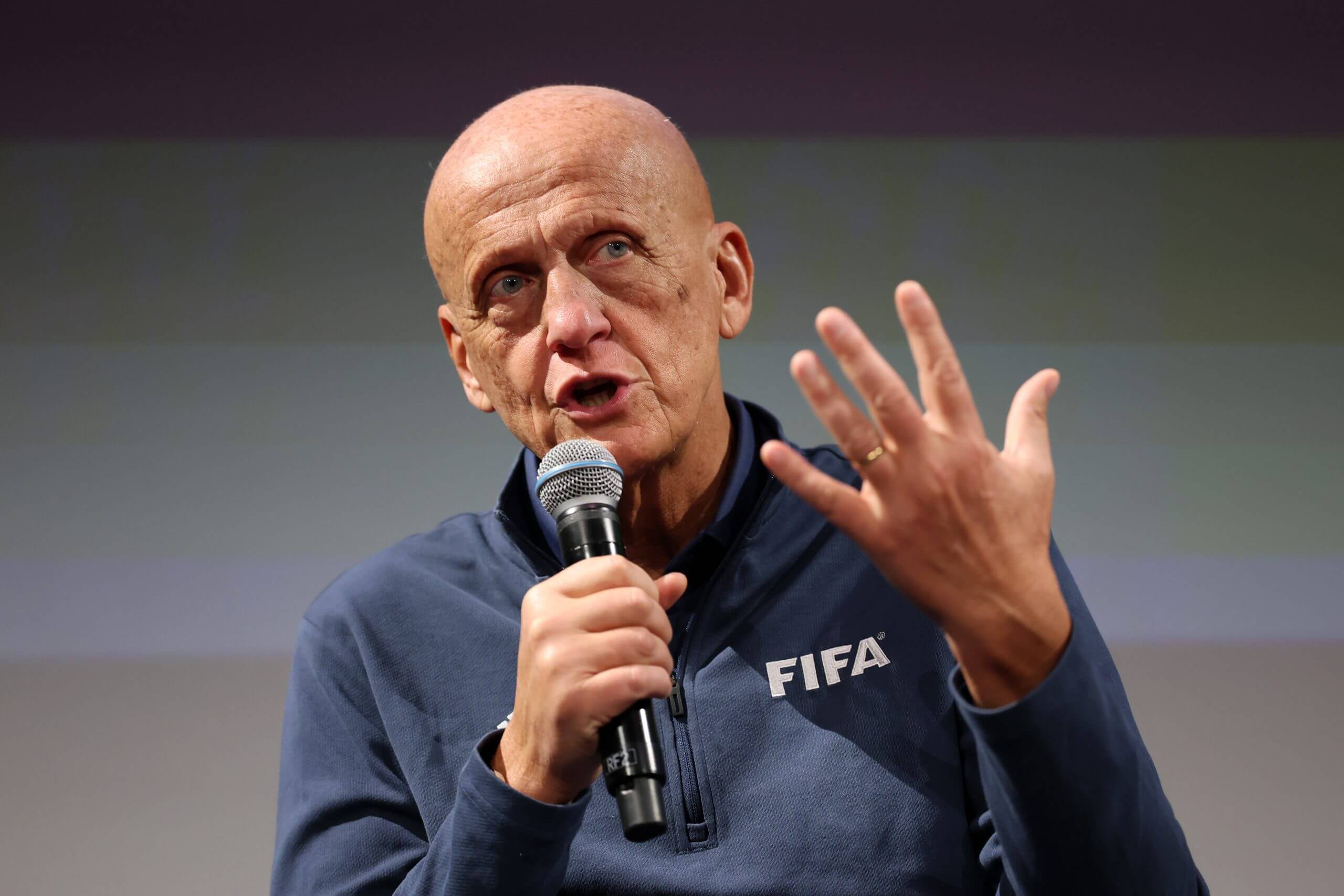
Elleray and Pierluigi Collina, who is a colleague of Elleray’s at IFAB and chairman of the FIFA Referees Committee, were united in the view that VAR has improved football, but that it still has deep imperfections, hence the need for a review.
“In Italy, we say that in every wonderful marriage, there is a crisis after seven years,” said the 2002 World Cup final referee Collina, sitting alongside Elleray, on Saturday. “So it might be possible that people fell in love with VAR, and then after some years, as with your wife, you have a small crisis.”
Pierluigi Collina is still married to VAR (Dan Mullan/Getty Images)
It might be a stretch for some to ever recall VAR’s honeymoon period, but the sense of crisis, one that Collina raised unprompted, is building as the World Cup looms ever closer, with dissenting voices proposing everything from root-and-branch reform to abolition.
The latter remains impossible owing to the continued stakeholder support for VAR, but there is undoubted scope for improvement. Fans, particularly those who are routinely in stadiums, bemoan the delays, the marginal offsides, and the poor communication. There is a romantic longing for something that VAR has taken away.
“We look back with rose-tinted glasses, but sport has to embrace technology,” Jon Moss, the former Premier League official and now head of referees for Football Australia, tells The Athletic. “People think VAR should be perfect. It never will be because football isn’t.”
So the question now is two-fold: how to convince the army of doubters that the shift will eventually be for the greater good, and how can the system be improved?
VAR was always football’s big risk. A sport moulded and defined by human judgement for more than a century, for both good and bad, had initially resisted the crutch of technology in the years when FIFA was led by Sepp Blatter. Only when his position crumbled, paving the way for Gianni Infantino to assume football’s most powerful position, did things begin to change.
“Today we have taken a historic decision for football,” Infantino said at the IFAB AGM in 2016. “We are listening to football and applying common sense.”
If only it had been that simple. This modern world of VAR began, in earnest, with the 2018 World Cup in Russia. There had been extensive trials staged in Holland, Australia and the U.S., and the results had convinced FIFA to take the plunge.
The big leagues followed on what was a successful first showing at the World Cup, where Infantino claimed accuracy of decisions had climbed from 95 per cent to 99.2 per cent over the course of the tournament. Serie A and La Liga adopted it in 2018-19, the Premier League in 2019-20.
And it has had many clear successes, correcting countless obvious mistakes while also helping to eliminate foul play.
“It clears up clear, factual errors, which would ordinarily sit very uncomfortably with people,” says Graham Scott, the retired Premier League official who was central to VAR’s launch in English football. “But there’s also the unseen stuff. We’ve lost the on-field elbow from the game. The number of red card tackles has diminished because players are more careful. You don’t get free hits because you’re on the blind side of the ref.”
VAR quietly does lots of what it promised to do, in domestic, European and international football. Yet it is a long way from providing universal satisfaction. Every poor, slow or pernickety decision undermines the good, depicting VAR as needlessly intrusive and a hindrance to the spectacle.
“It’s been a longer journey than I expected,” adds Scott. “We had people in from rugby union and rugby league, who warned us it was going to take a long time. We thought football would learn from other sports and do it quicker.
“But there are two things there; it hasn’t learned from other sports or taken lessons on board. My take on that is that football has a superiority complex and feels it doesn’t need to take on things from sports considered less important.
“But football is also all about subjectivity, continual play, theatre, drama. It’s not a succession of line calls like in tennis, or based upon technology, like cricket, which people accept as accurate. It’s decision after decision after decision. And some of those will entirely divide fans. The expectations for VAR to solve problems, coming up with correct decisions almost every time, are unrealistically ambitious.”
These are not image problems unique to one competition.
On the same afternoon that IFAB was expanding VAR’s remit to include interventions for second yellow cards and incorrectly awarded corners, Burnley manager Scott Parker was bemoaning the sadness of it all after seeing two marginal calls rule out two goals in a 4-3 defeat to Brentford in the Premier League. “I think football is better without VAR,” he told reporters afterwards.
Others have shared that view in Serie A in the past month. Inter’s 3-2 win over Juventus in the Derby d’Italia was overshadowed by a “clearly wrong” dismissal of defender Pierre Kalulu, whose second yellow card would have been overturned under the new VAR scope being introduced next season. Collina, at the IFAB AGM, called that particular incident a “nightmare”.
Spain’s La Liga also runs into frequent problems. A VAR breakdown at the end of August left officials unable to check a controversial penalty decision that brought Lamine Yamal a goal in Barcelona’s 1-1 draw with Rayo Vallecano.
The Bundesliga, too, commonly sees protest banners from fans. “Football with VAR is like horse racing with donkeys,” was one from Augsburg supporters last month.

Banners at Augsburg decrying VAR (Christian Kaspar-Bartke/Getty Images)
Opening the door to VAR has resulted in what UEFA’s head of refereeing, Roberto Rosetti, last month called a shift towards “microscopic” interventions. “I believe that we forgot the reason VAR was introduced,” Rosetti said at UEFA Congress last month. “We forgot a little bit. Everywhere.”
According to data seen by The Athletic, the Champions League, in particular, has seen VAR intervene almost once in every two games this season and is broadly on a par with Serie A. The Premier League, by comparison, sees a VAR review once every four games, with England’s top flight encouraging video officials to step in when absolutely necessary.
Timings, though, can often be a bugbear. Premier League games can be covered by as many as 30 cameras, with each angle available to broadcasters assessed if needed. Semi-automated offside technology (SOAT) was introduced to speed up the process. Still, teething problems caused an eight-minute delay during Bournemouth’s FA Cup tie with Wolverhampton Wanderers last March.
“You can make all the improvements, but if you intervene at the wrong time or take five minutes for a decision, then the credibility has gone,” says Moss. “That’s the reality.”
VAR’s problems are layered, but can often begin with poor communication. Football has struggled badly in its VAR messaging, reaching decisions in faraway TV booths before a final decision is relayed. Laws have been relaxed to allow a referee to announce his final decision and reasoning over a stadium’s public address system, but it remains a flawed process.
Not until in-house productions release the on-field communications for contentious calls in the days and weeks that follow, such as the Premier League’s monthly television show Mic’d Up and Tiempo di Revision (Revision Time) in Spain, is the curtain pulled back a fraction.
That, for now, is as far as IFAB wishes to go.
“We had Wayne Barnes (the now-retired English rugby union referee) come to see us when VAR was coming in,” says Scott. “He gave a very good presentation at a training camp about how rugby union referees had started with making decisions behind closed doors and delivering that to the stadium as a fait accompli.

Wayne Barnes spoke to Premier League referees about how to use VAR (Michael Steele/Getty Images)
“He said that didn’t work and changed to what they do now (talking through the decision-making process). It was transformative, with people buying into decisions even if they might not always agree with them. He was very direct, ‘I’m telling you guys, this is what you’ve got to do’.
“He left the room and we were told straight away that we couldn’t do that because FIFA wouldn’t let us. Until that changes, we’re going to keep having a problem.”
Extensive training, Moss believes, would be beneficial. He points to rugby union, where an official talks through the review process in real time, with fans inside the stadium and at home hearing every word.
“Not everyone is articulate and it would be a challenge for some referees,” he says. “The Premier League were probably ready to do the stadium announcements a year earlier than they did, but they couldn’t get the referees up to speed.
“Now it’s very descriptive. You have refs that are fidgety and it’s uncomfortable. They’re still getting used to it. But if we’re going to sell it, let’s do it properly.
“If you could hear all of the audio, people might understand more. That’s the theatre of it, rather than someone going to a screen, coming back and giving a short explanation. You’ll still have disagreements because there are subjective calls in football all the time. That’ll never go away.”
The most radical overhaul of VAR would be a pivot towards Video Football Support (VS). The very different model was initially conceived as a means of introducing technological support in competitions and countries lacking the resources to roll out VAR.
The onus is on a head coach to challenge any decision (covering goals, penalties, red cards and mistaken identity) they believe to be wrong, twirling their finger in the air to begin a process that takes the referee to a pitchside monitor to review an incident. There is no VAR involved in games, only a review operator.
Trials, including in this season’s Malta Premier League, have seen two challenges given to each team, broadly mirroring the coach’s challenge in the NBA and the captain’s challenge established in rugby league.
Moss has seen it first hand, with VS trialled in the Australian Championship in the past 12 months. “It’s similar to VAR and there are only certain things you can challenge on, but that worked really well,” he said. “The clubs loved it. With the concept of captain’s calls, you’re giving the power back to the clubs. You’re still going to get subjective calls, but I went to see the New York Knicks and I didn’t know they had coach’s challenges.
“We were in Madison Square Garden and the lights flashed with coaches challenge. Then he comes across, looks at the screen with a headset, and then says ‘Denied!’ and he gave it to the coach with how he delivered it. It was great drama.”

The NBA has long used a coach’s challenge system (Lachlan Cunningham/Getty Images)
Scott also sees the appeal. “I’d go to the challenge system that FIFA is trialling,” he says. “I think it would help with the dynamic between referees and club managers. That would spin it back to the managers.”
IFAB, though, is yet to be convinced. There are doubts over the speed of the process, with an on-field referee tasked with going through a number of different replays at a pitchside monitor, potentially bringing lengthy delays. Given that a successful appeal would see the challenge retained, there could theoretically be a large amount of stoppages. Hail Marys could also be thrown by a team with challenges to burn late in games.
Elleray also raised the most unpalatable of the unintended consequences. “If all the challenges have been used and there’s been a major error, which decides a match, that can’t be corrected,” said Elleray on Saturday, urging those in front of him not to get “overexcited” by the trials.
Elleray, predictably, bangs the drum for VAR 10 years after IFAB gave it the green light. He cites the improvements in speed and increased awareness of its best uses. He also accepts that the faults are magnified.
The AI graphic explanations shown, such as when Burnley’s Jaidon Anthony’s shoulder was offside ahead of crossing for Zian Flemming to score against Brentford, do little to win fans over when goals are chalked off. Increasing the 5cm grace in the Premier League’s measurement of offside is one option, but the decisive lines still need to be drawn somewhere.
“The laws weren’t made with technology in mind,” said Moss. “You wouldn’t have seen some of these incidents with a naked eye. Now technology is there, you can show it was offside, but no one wants that to be offside. VAR is just following the laws of the game. They’ll have to make amendments in how forensic SAOT can be.
“It’s still early days for VAR and I still believe it’s a good thing. The systems aren’t perfect yet, but football isn’t willing to accept what other sports have done.”
And will it ever? A conclusive answer will not be found on a pitchside monitor.
