By
·
Illustration by
·
July 10, 2025
When Hong Kong’s live music scene ground to a halt under Covid-19 restrictions, a pay-what-you-want vegetarian cafe became an unlikely magnet for after-hours drinking and pipe dreaming. Black Window opened in July 2021 in one of the city’s poorest areas as a DIY collective of around 20 people. In addition to serving plant-based food, the space hosted workshops and reading groups; its clientele was disproportionately stacked with local musicians.
This was in part thanks to Leung Wing-lai, aka Ah Lai, co-founder of Black Window and frontman of 20-plus-year indie mainstays An Id Signal. “Ah Lai is a very instrumental figure within the Hong Kong scene,” says Jason Cheung of post-punk band David Boring, a Black Window regular. Over a string of late-night meetups, Cheung exchanged ideas about music with Ah Lai and Sum Lok-kei, aka Rocky Sum, founder of the post-hardcore-inflected indie band Wellsaid and DIY label Sweaty & Cramped.
For Sum, Black Window was “a very local, very community-based place,” an increasingly important hub as more and more people from the music scene left Hong Kong. The exodus began with the 2019 protests that roiled the city and was exacerbated by the COVID-19 pandemic. “That atmosphere was very important to me personally because it was just fucking depressing everywhere,” Sum reflects. “So that got us thinking: What can we do if we get out of [the pandemic]? And the answer was to form a collective, to start doing things in a more collective manner.”
Black Window shuttered in early 2025, partly due to rent pressures and partly to outward migration. But the seed planted over countless lockdown beers continues as UN.TOMORROW, a DIY music collective that launched with a two-day festival in 2024 and has since developed a label arm. Across its catalogue, UN.TOMORROW is carefully assembling artifacts from Hong Kong’s chronically under-documented indie scene, creating a breadcrumb trail of liner notes for future artists and fans to piece together.
While Cheung and Sum are the most active core members of UN.TOMORROW, Ah Lai is also a key member of the collective, and An Id Signal’s recent album exemplifies the label’s mission of documenting Hong Kong’s underground scene. “He’s a social activist, and he provided a lot of our narrative, the sense of community within the Hong Kong scene,” Cheung says of Ah Lai, noting that in addition to his band, Ah Lai was also an instrumental figure in the early years of seminal Hong Kong underground music venue Hidden Agenda. “He has a good understanding of what happened in Hong Kong before, in the present, and probably in the future, so it’s really important to have him with us,” says Cheung.
Before this year’s The Path Where Grief and Joy Intersect 悲喜交集的路綫, An Id Signal’s last album had been quietly released more than a decade ago. Early on, UN.TOMORROW was committed to ensuring that the band’s latest effort received proper packaging and promotion. “We knew that they’d been working on this recording for years, but it was just nowhere to be seen,” Cheung recalls. “We talked to them and said, ‘Hey, are you actually putting it out?’ It would be a great release for our first year.”
Besides Cheung, Sum, and Ah Lai, the UN.TOMORROW collective includes Jojo Wong, another core member of Black Window; Medius Chung of Zenegeist, a Facebook music fan page that’s evolved into events promotion; Mike Chen, a scene veteran known for booking money-losing Hong Kong debuts for now-indie-famous bands from the region, like Taipei’s Sunset Rollercoaster and Shijiazhuang’s Omnipotent Youth Society; and Tang Lok To, a visual artist and graphic designer responsible for the cover art on several label releases, including An Id Signal’s. “This group helps us pull out and gives a better horizon, a wider perspective for how things should be,” Cheung remarks, adding that it’s important to include “different positions of the scene within the group.” Besides diversity of perspective, the peer group format also generates benign pressure to “finish your shit,” Sum adds. “People will be asking you at the meetings. It’s a very good catalyst to have this team of people push each other and to make sure that we do finish our projects.”
UN.TOMORROW’s first label release was a live recording by Wong Hin-yan, a musician with social activist roots who’s best known today for scoring work by Hong Kong indie filmmakers like Jun Li. A prolific and idiosyncratic local figure, he built a custom home studio and has developed “very weird recording techniques that only work for himself,” says Cheung. After seeing a live reinterpretation of Wong’s work by jazz collective Fountain de Chopin during the pandemic, a buzzed Cheung offered to release a recording of the event, before UN.TOMORROW had even launched. Wong followed up, and the collective followed through with a gatefold double album featuring artwork by collective member Tang. The vinyl was pressed in the UK and shipping cost a fortune, but the decision to package the music so carefully was intentional, says Cheung, praising the finite and focused experience of listening to a physical medium over streaming. “Logistically, a fucking nightmare,” laughs Sum, “but we still got to do it.”
Alongside working with active veterans in the Hong Kong scene, UN.TOMORROW are curating a lineage of important, but underheard Hong Kong bands via archival releases. “We want to mark them on the timeline,” says Cheung. Sum adds, “The bands that I grew up listening to in Hong Kong, I want them to still be listened to in the future.” One influential recording that UN.TOMORROW has re-released is The People by LIFE WAS ALL SILENCE. The prog-y experimental rock band released the album locally on CD, but never promoted it online. Sum convinced band member and prolific Hong Kong music producer Jay Tse, who produced both Sum and Cheung’s early projects, to give it a proper re-release. LIFE WAS ALL SILENCE also played Assembly, the two-day festival in March 2024 that marked UN.TOMORROW’s official launch.
Cheung’s band David Boring played Assembly, and is in the final phase of recording a long-awaited followup to their 2017 debut, Unnatural Objects and Their Humans. Booking live events is a collective strength for UN.TOMORROW—Sum’s label Sweaty & Cramped is known for its fervid, “no-stage” shows—but it’s one they flex sparingly. Besides Assembly, they recently threw a 600-cap release party for An Id Signal’s new album, and plan to roll out future events, but only when an urgent need arises. “Events in Hong Kong are very expensive… Expensive to put up and expensive to go to,” Sum laments. Aside from the evergreen Hong Kong issue of expensive rent, and the scene members who’ve moved away since 2019, the Hong Kong government recently increased the cost of artist visas, leading touring acts to skip it for shows in neighboring Chinese cities Shenzhen and Guangzhou. Sum describes the economic and practical difficulty of putting on live shows as one in a “pool of self-limiting factors” that keeps the Hong Kong indie scene relatively muted and isolated.
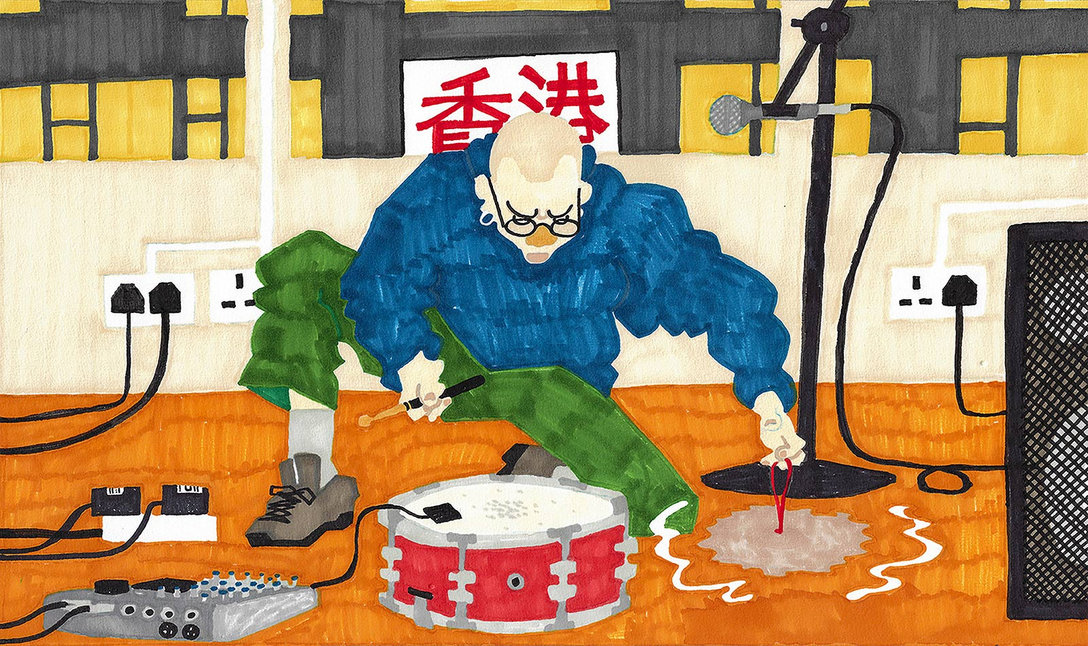
One portion of Hong Kong’s live music landscape that’s stayed active is the city’s noise scene, which overlaps with UN.TOMORROW in a few places. This release for percussionist Brian Chu is one example, mastered by experimental scene lynchpin Nerve. Small gigs at Nerve’s 20α space and “guerilla-style” shows in industrial warehouse venues—“That’s part of our culture here,” Sum notes—kept a flame burning throughout the protest and pandemic years. Given noise limitations and lockdown restrictions, many musicians who used to play in bands moved toward lower-footprint performance setups, a trend captured on several UN.TOMORROW releases. “People shift to solo stuff, they do experimental stuff, they do electronics, they DJ,” Cheung notes. “In that sense, there is a really vibrant experimental and noise scene in Hong Kong right now, but the scale is really, really small.”
UN.TOMORROW’s next phase will involve working with younger and less established local artists, as well as continuing in their early efforts of building a regional touring and distribution network across Hong Kong, Taiwan, China, and Southeast Asia—“especially with the U.S. economy and the trade wars,” Cheung says. “The U.S. trying to do this shit is the best excuse for Asian communities to look into our immediate surroundings instead of looking always to the U.S. as the standard-bearing thing for music,” Sum adds. One forthcoming example is RESTLESS WATERS, an EP for the trio of Cheung, Lilly (an alias of Ah Lai’s), and Brian Chu that will be co-released later this year with Taipei DIY punk label Twin Peaks Records.
While there may be more archival releases in the pipeline as well, UN.TOMORROW is ultimately less about legacy than it is about presence. “I’m not sure if it’s the case for people outside of Hong Kong, but we always have a notion for nostalgia,” Cheung reflects. “We always like to look back very fondly at things, but when they were around, we didn’t pay much attention to them, or do much to support them. And we don’t really want that to be the case with what’s happening here at the moment. Especially after the pandemic, after 2019, we wanna put things in time capsules from the time when they actually happened.”