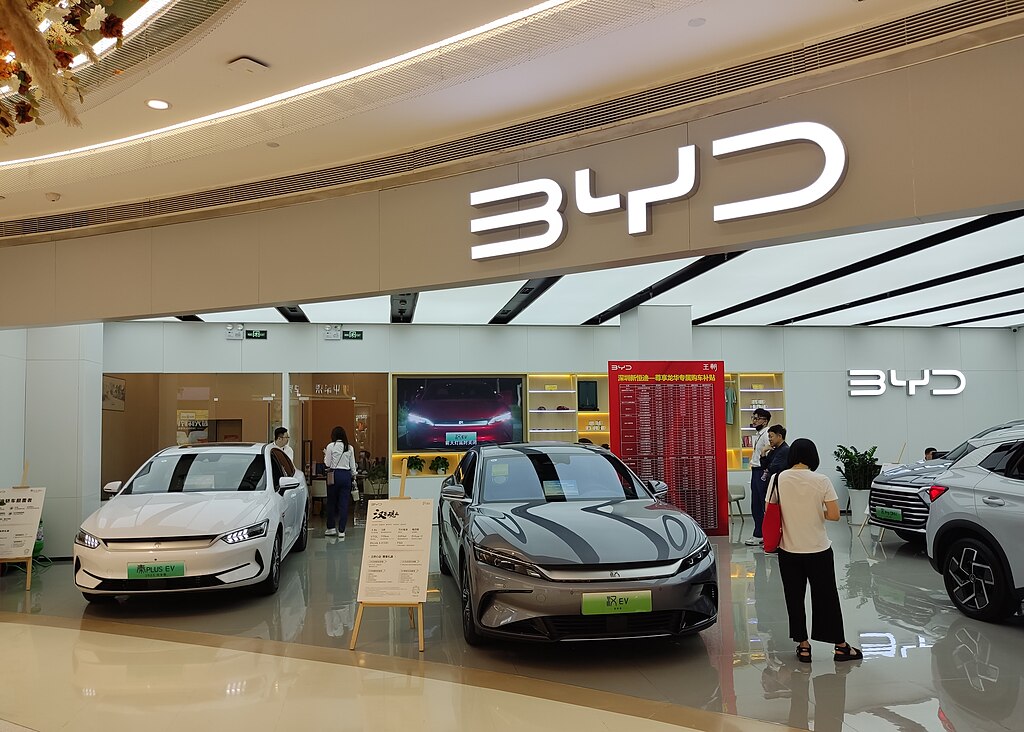
On October 7, 2025, The BBC reported that Chinese automotive giant BYD announced that the UK has overtaken all other international markets to become its largest outside China, following an 880% year-over-year sales surge in September.
UK Leads International Market Surge for BYD
The company sold 11,271 vehicles in the UK last month, with the plug-in hybrid version of its Seal U SUV driving the majority of those sales. The record-breaking month coincided with data from the Society of Motor Manufacturers and Traders (SMMT) showing that UK electric vehicle (EV) sales hit an all-time high in September.
The UK’s decision not to impose tariffs on Chinese EVs, unlike the European Union and the United States, has made it an attractive market for BYD, which competes aggressively on price against Western rivals. The company’s market share in the UK climbed to 3.6% last month.
BYD’s UK general manager, Bono Ge, said the brand’s outlook in Britain is “hugely exciting,” noting that the automaker recently opened its 100th retail outlet and plans to introduce several new hybrid and electric models in the coming months.
According to the SMMT, nearly 73,000 pure battery EVs were sold in September, while plug-in hybrid sales grew even faster. The Kia Sportage, Ford Puma, and Nissan Qashqai topped sales charts, while Chinese entries, the Jaecoo 7 and BYD Seal U, also ranked among the UK’s top 10 bestsellers.
Despite the surge, petrol and diesel vehicles still accounted for more than half of new car registrations.
Tariff Walls: The UK’s Open Market Advantag
Meanwhile, the EU has imposed tariffs of up to 45% on Chinese-made EVs to counter what it describes as state-subsidized competition, and the US maintains high import barriers on Chinese brands.
Globally, BYD continues to outpace Tesla, Jaguar, and BMW in total sales, even as growth slows in its domestic market.
In July, the UK government introduced £650 million in EV purchase discounts to accelerate adoption—offering up to £3,750 per vehicle for models from brands like Nissan, Peugeot, and Vauxhall. However, Chinese-made cars are excluded due to concerns over manufacturing emissions, a move BYD has criticized as damaging to the UK’s long-term EV market competitiveness.

Exploring BYD’s Electric Vehicle Lineup: Innovation, Range, and Affordability
Chinese automaker BYD (Build Your Dreams) has rapidly evolved into a global leader in electric mobility, offering a growing lineup of EVs and plug-in hybrids designed to meet diverse driver needs. From compact SUVs to spacious family cars, BYD’s vehicles combine advanced battery technology, impressive range, and accessible pricing, helping it rise to the top of markets like the UK and Europe.
BYD SEAL U (All-Electric SUV)
The BYD Seal U is a fully electric five-seat SUV built for comfort, efficiency, and long-distance driving. It comes with two battery options—a 71.8 kWh pack with around 420 km of range and an 87 kWh pack that delivers up to 500 km (WLTP). Powered by a 160 kW motor, it offers smooth acceleration and strong efficiency. Fast charging capability allows the Seal U to go from 30% to 80% in under 30 minutes. Inside, it offers a spacious cabin, large cargo area, and a standard heat-pump system for better energy management in colder climates.
BYD SEAL U DM-i (Plug-in Hybrid)
The Seal U DM-i is a dual-mode hybrid that combines electric and petrol power for maximum flexibility. Depending on the trim, its electric-only range reaches up to 125 km, ideal for city driving, while the combined hybrid system can produce up to 238 kW of total output. This makes the Seal U DM-i suitable for longer trips while still delivering excellent fuel economy and low emissions.
BYD ATTO 3 (Compact Electric SUV)
The Atto 3 is BYD’s most popular global model—a compact electric SUV built on the company’s advanced e-Platform 3.0. It features a 60.48 kWh Blade Battery offering a range of about 420 km and can charge from 30% to 80% in around 29 minutes using DC fast charging. The Atto 3 accelerates from 0 to 62 mph in roughly 7.3 seconds and is known for its eye-catching interior, user-friendly technology, and high safety ratings.
BYD’s Competitive Edge
- Blade Battery Technology: BYD’s cobalt-free lithium iron phosphate (LFP) Blade Battery offers superior safety, long lifespan, and stable performance, even under extreme conditions.
- Integrated Powertrain: The brand’s “8-in-1” electric drivetrain integrates key systems to enhance efficiency and reduce weight.
- Design and Practicality: BYD vehicles prioritize interior space, modern infotainment, and smart driver-assistance features.
- Hybrid Flexibility: Models like the Seal U DM-i provide a bridge between traditional and fully electric driving.
BYD’s Road Ahead
As BYD expands its presence in Europe and the UK, new models are expected to join its lineup—including sedans, crossovers, and commercial vehicles. With a focus on innovation, affordability, and reliability, BYD is shaping up to be one of the defining players in the global shift toward electric mobility.
The EV Tax Credit Cut Couldn’t Have Come at a Worse Time for America
The U.S. decision to roll back the federal $7,500 electric vehicle (EV) tax credit couldn’t have come at a more critical or damaging moment. As the global EV race accelerates, China is pulling ahead, Europe is doubling down, and America risks falling behind just as its automakers were starting to catch up.
For years, the federal credit helped offset the higher upfront cost of EVs, making them accessible to more consumers and helping U.S. manufacturers scale production. But with that incentive gone, electric models from Ford, GM, Rivian, and Tesla suddenly look thousands of dollars more expensive—just as interest rates remain high and EV sales growth is beginning to slow.
Meanwhile, China’s automakers are expanding rapidly. Companies like BYD, now the world’s largest EV maker, are flooding global markets with well-built, affordable electric cars and hybrids. Thanks to massive state investment, vertically integrated supply chains, and aggressive innovation in battery technology, Chinese EVs are often priced far below their Western competitors.
Europe, too, is continuing to support its clean transportation transition, offering purchase subsidies, expanding charging networks, and protecting local industry through selective tariffs. The U.S., by contrast, has abruptly removed one of its most effective tools for fostering EV adoption—undermining both consumer confidence and industrial competitiveness.
The timing couldn’t be worse. Global demand for EVs is reaching a tipping point, and automakers are racing to secure market share. Electrified vehicles now make up 43% of global auto sales as of Q1 2025, up from just 9% in 2019.
Without sustained federal support, U.S. manufacturers face an uneven playing field, higher costs, and reduced incentive to invest in next-generation battery plants and supply chains at home.
If America wants to lead in clean energy and advanced manufacturing, it must recognize that the EV revolution is not just about cars, it’s about economic security, global influence, and the future of industry. Pulling back now risks handing the steering wheel to China for good.
This article originally appeared on EVInfo.net and has been republished with permission by Guessing Headlights.