Trump’s maximalist design preferences are the stuff of legend. His penthouse apartment in Trump Tower is a rococo calamity with gold as far as the eye can see. When he purchased Mar-a-Lago in 1986, the mansion was already considered, in the words of the Chicago Tribune, a “monument to Roaring ’20s ostentation.” His love of gold and marble was at least partially influenced by his first wife, Ivanka, who served as his chief interior designer in the 1980s. The then-power couple were intimately involved in the minutia of his then-expanding portfolio. A 1984 feature in The New York Times, published as Trump prepared to open the first of his doomed Atlantic City casinos, said the two made “thousands of decisions, from picking all the wallpapers, curtain backings and braid for the doormen’s uniforms to menus and doorknobs.”
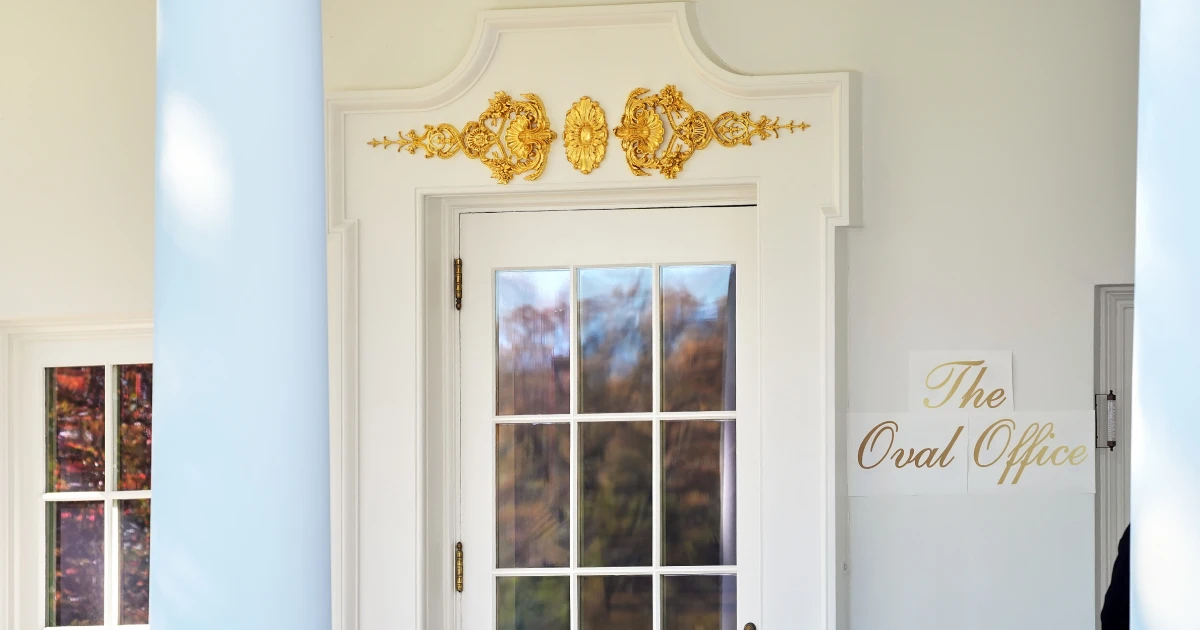
The decades have not lessened that trend, even as more urgent matters should draw his attention. The Wall Street Journal reported in April that Trump flew in his “gold guy,” who worked on Mar-a-Lago, to add the gold molding that now encircles the Oval Office. And based on renderings he’s showed to journalists, we can only assume that the planned White House ballroom will be afforded similar treatment. White House press secretary Karoline Leavitt told reporters last month that her boss’ “heart and his mind is always churning about how to improve things here on the White House grounds. But at this moment in time, of course, the ballroom is really the president’s main priority.”
The president’s aurum-plated predilections have long been a punchline for others. In 1990, the Baltimore Sun reported that a new line of hotels in the region would provide “luxury of a very different type than the Donald Trump model.” The chain will “offer luxury by inference,” the hotel’s general manager said. “It is achieved through attention to total comfort, rather than by gold fixtures and lots of fake marble in the bathrooms.”
It’s becoming harder to maintain that fiction, though, as low-income Americans get particularly pummeled by Trump’s policies.
That hasn’t stopped Trump from peddling his vision of luxury to the masses. When asked how he was moving the wildly expensive condos at Trump Tower in 1984, he simply told the Times: “You sell them a fantasy.” It’s a mantra that was regurgitated in his (ghostwritten) “Art of the Deal” and in his second act as a pop culture phenomenon when hosting “The Apprentice.” Through all his ventures, including the presidency itself, Trump has attempted to sell would-be supporters on the dream that they could be just as rich as him if they only followed his lead. As Northwestern marketing professor Tim Calkins told The Washington Post shortly after the 2016 election that Trump “capitalized on the power of the Trump brand, which people associate with and aspire to luxury, wealth and celebrity.”
It’s becoming harder to maintain that fiction, though, as low-income Americans get particularly pummeled by Trump’s policies. While these voters supported Trump in both his GOP primary bid and general election victory last year, they’ve gotten the short end of the stick since then while the wealthy have prospered. As the shutdown has continued, he’s heaped blame on Democrats while doing little to reassure his supporters who against all evidence to the contrary hoped that he wouldn’t slash their federal benefits.
The divide between Trump’s fantasy and economic reality is already beginning to show up in polling. Last month, a poll from The Economist/YouGov found that only 35% of Americans making less than $50,000 a year approved of his job performance while 59% disapproved. That’s a marked shift from their September survey, in which he had a 40% approval rate among that demographic and a 55% disapproval rate. Similarly, a more recent poll from CNN/SSRS released Monday found 69% of low earners disapproving of Trump’s performance with only 31% lauding his work.
As of Thursday morning, the White House has given no indication whether the signage outside the Oval Office will be permanent — but given the new “Presidential Wall of Fame” that Trump has installed just a few steps away with similar lettering, the odds seem good. The reshaping of the building in his own image serves as a gold-leafed reflection of his desire to alter the country to suit his own selfish whims. But while the tacky signage and metallic gleam may be easily removed, the pain that the countries needy are currently feeling as the president dithers over marble tiling will be much harder to heal.