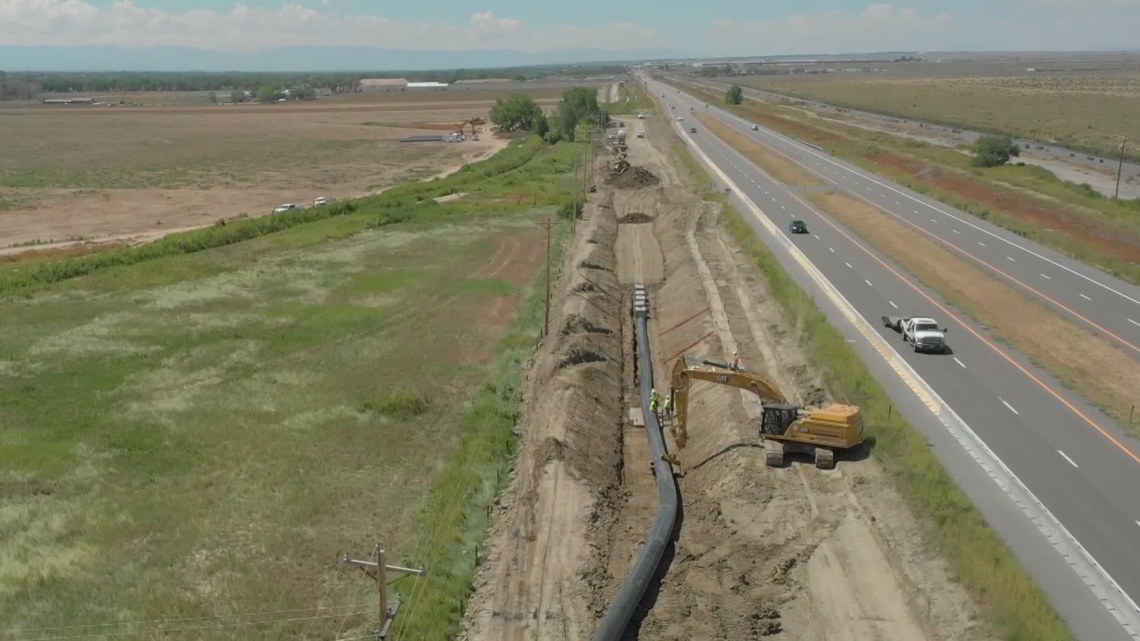
There is enough money that’s already been allocated to continue construction for two or three more years. That’s enough to complete about half the project.
COLORADO, USA — President Donald Trump’s veto of funding for the Arkansas Valley Conduit has thrown the future of a clean water pipeline into uncertainty for rural southeastern Colorado communities that have waited decades for the project, though construction continues with existing funds.
The water district building the pipeline has approximately $500 million in funding already appropriated by Congress before Trump’s veto of a bill that would’ve provided a federal loan to finish the project. The House voted on whether to override the President’s veto, but House Republicans sided with Trump and blocked it. There’s enough funding to continue work for two to three more years on the nearly $1.4 billion project, according to Bill Long, president of the Southeastern Colorado Water Conservancy District.
“We still have funding for construction,” Long said. “This legislation was really important, mostly for the second half of the construction of the conduit.”
The project has spent or is obligated to spend about $257 million and has another $250 million yet to be contracted, Long said. That will carry construction roughly halfway through the pipeline route, potentially reaching towns like Manzanola, Rocky Ford or Swink, depending on how contracts unfold.
“Is it Manzanola? Is it Rocky Ford? Is it Swink? It’d be somewhere in that neighborhood,” Long said. “Depending on how our contracts come back will depend upon where we actually get to physically.”
Rocky Ford Mayor Duane Gurule said the pipeline could reach his city by 2027 or 2028 under current projections.
“I look at it as a big slap in the face for rural southeast Colorado,” Gurule, a Democrat, said of the veto.
While Rocky Ford’s water meets state and federal standards, “it’s still not the cleanest. It still doesn’t taste the best,” he added.
The town of Fowler will likely be the next to get clean water from the conduit.
“Yeah. I’ve definitely been hearing about it my whole life,” said Shawn Swope, Mayor of Fowler, who is also from there.
Fowler has a water treatment center that makes the water in the area safe to drink. That wouldn’t be necessary anymore if the Arkansas Valley Conduit were completed.
“We haven’t been overly reliant on the pipeline, and we’ve pursued other avenues as well,” said Swope. “Obviously, there’s a lot of room to improve, and we’d like to make the water better, but just getting back into state standards was a big step for us.”
Communities farther east face greater uncertainty. Las Animas relies on an expensive reverse osmosis system that produces significant waste byproduct. Without the pipeline, the town would need to build a sewer treatment plant costing upwards of $40 million as a long term solution, according to Richard Elliott, the city’s director of public works.
“If it does not make it here, it’s going to cost the city quite a bit of money,” Elliott said. “We don’t have that money.”
Project leaders are working with Colorado’s Congressional delegation to attach funding for the conduit to another piece of legislation in Washington, which they view as the best chance to secure the necessary money, though it could significantly delay completion.
“We’re confident because they’re confident between now and the end of the year, there will be a piece of legislation that they could attach this to that would successfully pass,” Long said. “That’s what we’re counting on.”
The Arkansas Valley Conduit would pump clean water from Pueblo to communities along the pipeline route. Gurule emphasized that regional cooperation will be essential.
“It’s going to take all of us working together to make this happen,” the Rocky Ford mayor said.
Despite setbacks, local officials remain hopeful.
“I think in the long run it’ll still get pushed forward,” Elliott said.
“I’m still optimistic because we need the project,” Long said. “After 20-some years, we’re not giving up. We will not give up.”