Opinion

The Pentagon said that Russia’s invasion of Ukraine could succeed in three days. Today the war enters its fifth year.
What have four years of non-stop violence taught us about the realities of today’s world?
First is that a nation can only be assured of survival through power. For most of the postwar era, the US reserved the use of war unto itself and opposed the use of armed force by its enemies. Allies could expect protection. America might have been a predator, but it was our predator.
Barack Obama abandoned that policy when he decided to allow Vladimir Putin to annex parts of Ukraine in 2014 – and keep them. Putin drew the logical conclusion. So did other ambitious dictators. They all saw historic opportunity for themselves in the face of historic American weakness.
Xi Jinping accelerated sharply his program of island-building and territorial acquisition from his neighbours in the South China Sea in 2014. Kim Jong-un intensified his drive to build and deploy nuclear weapons. And Putin mounted his full-scale assault on Ukraine on February 24, 2022.
The US briefly rediscovered its hegemonic DNA under Joe Biden. He led NATO in timid support of Ukraine – just enough to prevent Russia from prevailing, not enough to allow Ukraine victory.
When Donald Trump replaced Biden, he surrendered even this token effort to preserve American dominance over its enemies. Trump withdrew US support for Ukraine. He allows Putin, Xi and Kim to pursue their ambitions unchecked.
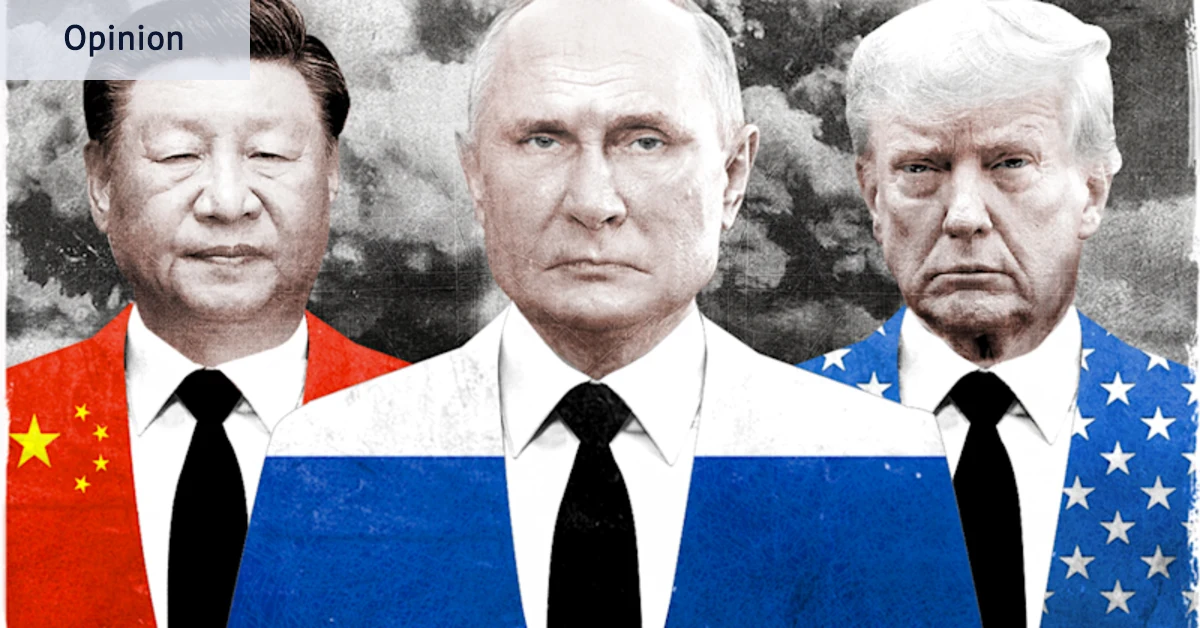
Trump has not restrained the predators; he has joined them. The US, Russia and China are now engaged in a continuous expansion of their countries’ borders.
Trump claims Canada and Greenland as US territory. The border of Europe is now under daily renegotiation on the battlefield in Ukraine. Xi intensifies China’s military intimidations of Japan, the Philippines, Taiwan and others. The People’s Liberation Army Navy task group that circumnavigated Australia last year was asserting an expansion of China’s reach and ambition. Beijing has not withdrawn its list of Fourteen Grievances against Australia.
The law of the jungle applies. If national survival depends solely on power, how has Ukraine managed to endure against the odds for so long? Russia was ranked the world’s No.2 military power before the invasion and Ukraine a distant 25th, according to Global Firepower.
This suggests a Russian cakewalk. And it helps explain why the Pentagon was so wrong. The conventional analysis of a nation’s power has proved wrongheaded. Ukraine’s commanding source of power has been its willpower, the sheer determination to stand and survive.
“The most important factor today is the morale of both armies and the capabilities of their commanders to lead their troops,” writes Russian academic Vladislav L. Inozemtsev, director of the Moscow-based Centre for Research on Post-Industrial Studies, a non-profit research outfit, “and not so much the number of tanks and artillery systems.” Napoleon famously remarked that “the moral [sic] is to the physical as three is to one”.
This is about much more than a country’s standing army. Neither Russia nor Ukraine has been able to deploy its professional army alone. Without reservists and civilians, neither could have continued. Ukrainians rushed to volunteer, though Kyiv soon had to resort to conscription. Russian will to fight was feeble from the outset. It routinely uses so-called “blocking troops” – soldiers positioned behind Russian lines for the purpose of shooting any of their own personnel trying to retreat.
An army is not an organism apart from its society. It is an expression of its people, their patriotism, the cause they fight for. Generals can help bolster morale, but they cannot order it; societies foster it. And political leaders must mobilise it. Volodymyr Zelensky inspired his country from the very outset. Offered a quick escape, he replied: “I need ammunition, not a ride.” He tours frontlines. Putin hides from the front and tells mad, conflicting tales of why Russians must die for his fanciful vision of empire.
The intangible of willpower may be necessary, but it’s not sufficient to prevail. Material goods are essential, too. But not in the way we are accustomed to believing. “Don’t look so much at the number of tanks in an army, but rather at the elements that create those tanks,” writes strategist Phillips P. O’Brien in his wise new book War and Power: Who Wins Wars – and Why.
In Australia’s case, its military hardware – including tanks – is an expression of its near-total dependency on the US, which has been an asset but, as Canada and others have realised, can be a liability, depending on the whims of Washington.
“For a state to have power,” writes O’Brien, professor of strategic studies at University of St Andrews, “it must have economic/technological strength. It needs not only to make stuff, but to make the most complex and advanced stuff in large amounts.” He adds: “You cannot fake economic/technological capabilities, nor make them up on the spot.”
Australia, belatedly, has just begun to produce missiles here. Vastly more self-reliance is required. It’s expensive, but not as expensive as defeat. Canberra also has diversified some of its suppliers – Japan is building the Mogami-class frigates for Australia, for instance – even as it has intensified its US alliance through the AUKUS marriage.
Another glaring lesson from Ukraine is that allies are essential to survival. In its case, Europeans in particular. Allies also are indispensable to Russia, which would have collapsed without China’s fiscal and tech support. This, certainly, is a lesson Canberra has learnt as it forges deeper relations with partners including Japan and Indonesia.
Australia, realistically, can’t and won’t operate without American systems, but it can be more selective, treating the alliance as an a la carte affair rather than a set meal.
A fourth lesson is durability. Ukraine has had to endure for gruelling years and maybe will for more years to come. Nations need to plan on “prevailing at the end of a draining marathon rather than an intense opening sprint” as Iskander Rehman of Johns Hopkins writes in his book Planning for Protraction. Ukraine’s greatest problem today is its people’s exhaustion.
Fifth, Ukraine illustrates the central truth that, for a nation to endure against a larger predator, it depends on the support of its entire self and all its people, not just its military and a few industries.
The Albanese government three years ago accepted the need for a “whole of nation” resilience and warfighting posture, harnessing all elements of national power, as set out in its Defence Strategic Review. But that’s where it remains.
Which brings us to the final lesson from Ukraine. It believed Putin when he denied any intention to attack. It should have been better prepared. The lesson: listen to a predator’s strategic narrative of greatness, not his tactical denials that your country will be sacrificed to it.
Peter Hartcher is international editor.
 Peter Hartcher is political editor and international editor of The Sydney Morning Herald and The Age.Connect via email.