As soon as President Donald Trump last evening mentioned attending argument in the birthright citizenship case in Trump v. Barbara today, some Supreme Court reporters were dubious. After all, he had floated the idea of attending the big tariff case in December before deciding against it (or being talked out of it).
And his own comment contained a hedge. “I’m going,” he said. “I think so. I do believe.”
But by about 10 p.m. last night, the White House released his schedule for today, which included: “10:00 AM THE PRESIDENT attends Supreme Court Oral Arguments.”
The schedule also includes this:
“12:30 PM THE PRESIDENT participates in an Easter Lunch.” Trump may or may not realize how long arguments in big cases have been taking.
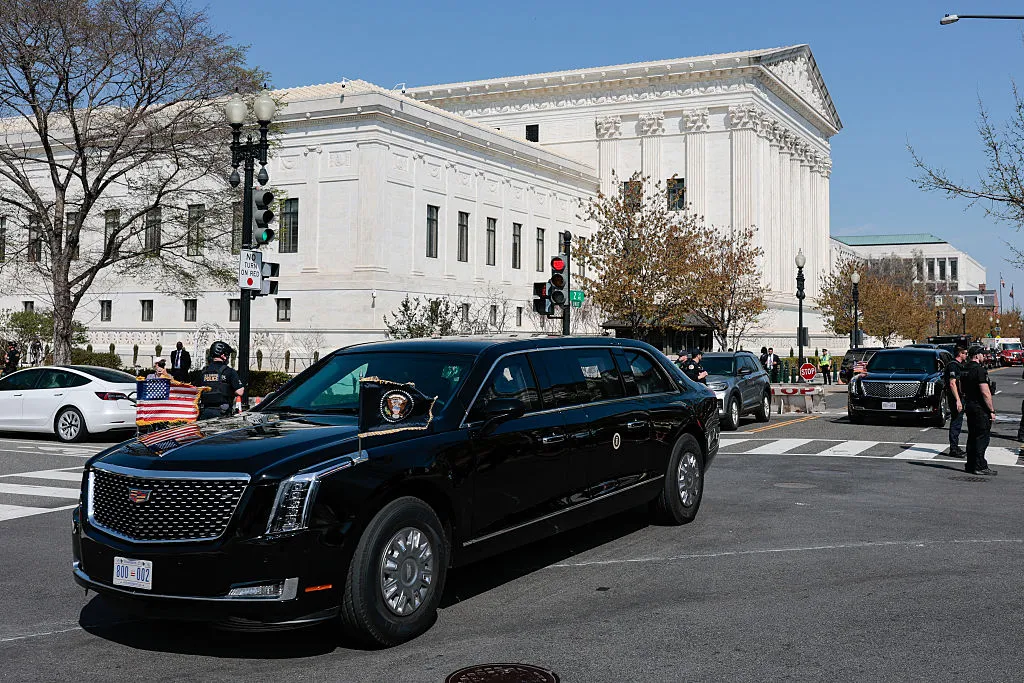
This morning, at the court, his attendance looks a little more likely. Security is tightened, with a clear presence of Secret Service agents. (It is perhaps a paradox of modern Washington that while the “Secret” Service is known for its plainclothes protective details and big black SUVs, it also has marked vehicles that say in big letters, “United States Secret Service.”)
As argument time approaches, the White House press pool reports indicate that Trump is indeed on his way. There is a vibrant discussion in the press room about where he will sit, as some in his administration have suggested there is a special or dedicated chair for any president in the VIP section of the courtroom. When Trump and other presidents have come to the court for the investiture of a new justice, they typically sit in that section, in the first chair closest to the bench.
I boldly make two predictions to my colleagues. One is that Trump will be seated in the public gallery, not in the VIP section. It would just seem inappropriate for the president to get a special seat for a case directly involving him and a challenged policy of his. But as a party, it would be perfectly normal for him to be here and sit in the public gallery, even if he is believed to be the first sitting U.S. president to attend an argument. (As Sarah Isgur pointed out on the Live Blog, former President William Howard Taft attended many arguments, but as chief justice after his time in the White House – and in a different building.)
My other prediction is that Trump will leave soon after U.S. Solicitor General D. John Sauer finishes his main presentation. I will be on the nose on the first prediction and within seven minutes of right on the second, but I’ll get to that.
When reporters are led up to the courtroom, we’re hoping for a moment that sometimes happens, when VIPs such as cabinet members are escorted right across the area where we enter the courtroom. But it is not to be today.
Inside the courtroom, the first face I recognize is John Eastman, the legal scholar who, as Politico recounted this week, was big on the legal theories behind ending birthright citizenship for undocumented immigrants and temporary visitors even before his role in seeking to overturn the results of the 2020 presidential election. As it happens, the California Supreme Court was scheduled to consider this afternoon Eastman’s petition for review of a recommended disbarment for his role in “attempts to actively undermine the results of an election to the most powerful office in the United States,” as the State Bar Court of California Review Department put it.
Eastman is sitting in the second or third row of the public gallery.
Nearby, with no direct connection, are two liberal legal scholars who have had a lot to say about the birthright citizenship case. Martin Lederman of Georgetown University Law Center is in the second row, and Akhil Reed Amar is a row or two behind him. Amar filed an amicus brief in support of the respondents, the class of children who would face a loss of automatic birthright citizenship under Trump’s Jan. 20, 2025, executive order that is finally before the court on the merits. (Amar and his brother Vikram also wrote several SCOTUSblog posts, including ones offering sharp questions for Sauer, who will defend the executive order, and American Civil Liberties Union National Legal Director Cecillia Wang, who will argue for the respondents.)
At 9:47 a.m., Trump arrives in the courtroom. (Reporters hold a quick discussion to confirm the time, as the court’s clocks can be hard to read and smart watches are not allowed.) There is no announcement from the marshal, as there is when the president arrives for an investiture, and no other fanfare. Trump takes a seat in the front row of the public gallery on the south side of the courtroom. (And I feel like I have won bingo, or something.) With him are Attorney General Pam Bondi, Secretary of Commerce Howard Lutnick, and White House Counsel David Warrington.
Reporters in the press section strain to get a view, but they get a scolding if they stand. Before the justices take the bench, Trump evidently decides that sitting at the far end of his row is unacceptable and he moves to the other side of the front row of that south side section. (There is room in the front row nearest to the press section, and we would be glad to have him there, but we are, again, not so lucky.)
I soon spot ACLU Executive Director Anthony Romero, who this morning had issued a statement that said, “If President Trump wishes to come to the Supreme Court to watch the ACLU school him in the meaning of the Constitution and birthright citizenship, we will be glad to sit alongside of him in that very court.” Romero is not right alongside the president, but just two rows back and directly behind him. (By the way, the ACLU informed me last week that none of the parents of the three children born last year who are class representatives for the provisionally-certified plaintiff class will be here today.)
There was some question about whether the president’s presence would delay the argument or affect it in other ways. The answer to the first is no, as the justices take the bench one minute early today. On the second issue, it does strike me that questioning is a little restrained.
Throughout this two-week sitting, which finishes today, the justices have been throwing some pretty sharp rhetorical elbows at each other. Last week, during Flowers Foods Inc. v. Brock, Chief Justice John Roberts tried several times to interrupt a lengthy stream of questions to counsel from Justice Sonia Sotomayor before finally getting the floor and telling the lawyer, somewhat tartly, “I’ll just ask one or two questions.”
And yesterday, in Pitchford v. Cain, after Justice Ketanji Brown Jackson had questioned the assistant to the U.S. solicitor general about why the United States was even participating in this state case about habeas and race in jury selection, Justice Amy Coney Barrett asked the federal lawyer, in a friendly fashion clearly meant to counter Jackson, whether it was “unusual for the United States to appear as an amicus when we have a constitutional question before us that affects the United States in litigation?”
On Wednesday, on the other hand, the justices were exceedingly polite with each other, deferring to interruptions by saying, “You go ahead.” “No, you go ahead.” It is impossible to say, of course, whether this has anything to do with Trump or the significance and potential impact of the case on so many.
Trump, despite his reputation for restlessness, sits calmly during the argument (at least to the extent he stuck around). He clasps his hands in his lap, and very rarely moves in his seat. He is next to Warrington, but I did not witness him whispering any questions and comments (except at the very end). My notebook includes these entries:
“10:12 Trump leans forward briefly.”
“10:20 Still sitting with hands folded.”
“10:47 Trump turns and looks our way! Seems to catch the eye of Devin Dwyer of ABC News.”
“11:15 Trump talks to person next to him [Warrington, before we confirmed who it was]. Seems to be thinking about leaving.”
That final prediction also turned out to be correct.
At 11:20 a.m., the president motioned a bit to those around him before standing up to leave, through the nearest vestibule and set of columns on that south side of the courtroom. (Again, I claim partial or near bingo! And it looks like Trump will make his Easter lunch.)
Trump will have some things to say later, including a short if inaccurate post on Truth Social.
The rest of the courtroom remains packed and the argument goes on without any sense of disturbance or ruckus. The court proves it can handle with aplomb an oral argument visit by the president involved in many of the biggest cases to come its way.
Just the same, the justices likely would be fine if the president doesn’t make a habit of it.
Cases: Trump v. Barbara (Birthright Citizenship)
Recommended Citation:
Mark Walsh,
Trump attends birthright citizenship argument,
SCOTUSblog (Apr. 1, 2026, 5:17 PM),
https://www.scotusblog.com/2026/04/trump-attends-birthright-citizenship-argument/

