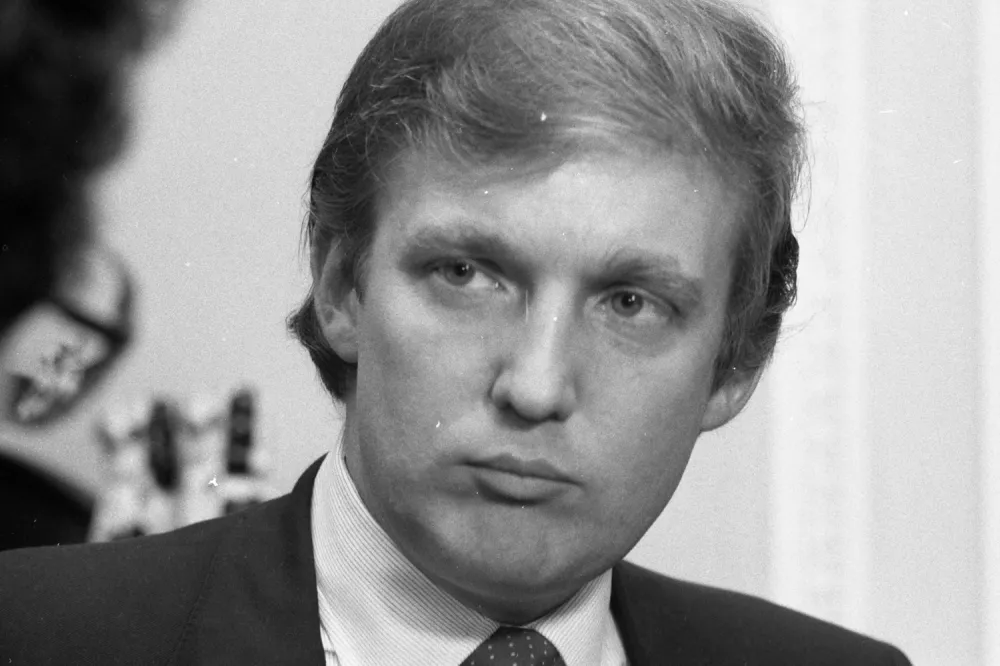
In 1984, a young, suave Donald Trump, rising to prominence as a New York real estate magnate, was profiled by the Washington Post. Though the glittering Trump Tower, his model wife, and his growing name recognition all garnered column inches, he told the reporter over lunch that he had a grand new obsession: negotiating a new set of nuclear arms control treaties between the United States and the Soviet Union, ushering in a golden era of cooperation. “Nothing,” he told another reporter in 1985, “matters as much to me now” as the nuclear question.
That story would be a fitting bookend to a career in which President Trump, now in his 70s, finally ushered in a new, modern era of arms control. Instead, both in his first administration and his current term in office, the president has presided over the slow, lingering decay of the last remnants of Cold War and post-Cold War arms control, culminating last week with the effective death of the New START deal with Russia.
In 1984, a young, suave Donald Trump, rising to prominence as a New York real estate magnate, was profiled by the Washington Post. Though the glittering Trump Tower, his model wife, and his growing name recognition all garnered column inches, he told the reporter over lunch that he had a grand new obsession: negotiating a new set of nuclear arms control treaties between the United States and the Soviet Union, ushering in a golden era of cooperation. “Nothing,” he told another reporter in 1985, “matters as much to me now” as the nuclear question.
That story would be a fitting bookend to a career in which President Trump, now in his 70s, finally ushered in a new, modern era of arms control. Instead, both in his first administration and his current term in office, the president has presided over the slow, lingering decay of the last remnants of Cold War and post-Cold War arms control, culminating last week with the effective death of the New START deal with Russia.
Contrary to some of the heated rhetoric, it’s not necessarily the end of the world that classic, Cold War-style arms control is going away. As we move into a more multipolar world—particularly given the rise of China and the proliferation of new, more exotic weapons systems—bilateral treaties between the United States and Russia based on numeric caps are limited in their utility.
Yet Trump was right, even back in the 1980s. A world with no arms control is a terrifying prospect: a more dangerous, volatile world prone to arms racing and brinkmanship.
Fortunately, the death of New START does not have to mean the death of arms control. What is needed most in this messy multipolar nuclear era is a president with the vision of his younger self, who sees the value in letting loose U.S. negotiators and policymakers to lay the groundwork for the next generation of arms control.
Back in 1984, the threat of nuclear war was omnipresent. President Ronald Reagan had come into office at the start of the decade, promising to get tough with the Soviet Union and inaugurate a major military buildup. But by 1983, his heated rhetoric, combined with the Able Archer exercise—a glorified Pentagon war game—had led to a war scare, with the Soviets spooked into thinking that a U.S. nuclear attack was possible. Reagan himself was chastened by this near-miss, contributing to his subsequent steps to seek de-escalation with the Soviet Union.
Trump, then 38, was reflecting the zeitgeist of the time when he worried about the threat of nuclear war. And his penchant for self-promotion—and for self-aggrandizement—was already well-developed. “Some people have an ability to negotiate,” he told the Post. “It’s an art you’re basically born with. You either have it or you don’t. … It would take [me] an hour-and-a-half to learn everything there is to learn about missiles.”
Though Trump was not the one to negotiate it, the early 1980s did mark the start of a golden age of arms control. Following on from successful meetings between Reagan and new Soviet leader Mikhail Gorbachev, the United States and the Soviet Union negotiated the Intermediate-Range Nuclear Forces Treaty (INF) and laid the groundwork for the Strategic Arms Reduction Treaty (START I), signed in the final days of the USSR. Cooperation on arms control, including on questions of loose nukes in the former Soviet republics, continued in following years.
The last two decades have seen the slow decline and decay of much of that late Cold War architecture. Even the Obama-era New START deal with Russia, renewed for five years by the Biden administration, has now lapsed—though the parties may continue to abide by its restrictions for some period of time.
This slow decay of what had been a mostly comprehensive set of arms control treaties was driven by a number of factors. For one thing, the passage of time has added significant pressure on all sides. America’s nuclear arsenal is ancient; it has been clear since the 2000s that a program of nuclear modernization and replacement is needed. That process has been contested and politically fraught; policymakers are often easily persuaded that more nuclear weapons are better, that treaties are simply ways for other countries to disguise their own cheating, and that their political opponents are weak negotiators who failed to get a good deal.
These political dynamics killed the only other significant post-Cold War arms control achievement of recent decades: the Obama administration’s nuclear deal with Iran. The search for a “better deal” led the first Trump administration to abrogate it in 2017; that better deal has not emerged. But the death of arms control is not simply a Republican problem. Policymakers on both sides of the aisle have for years ignored the problem of arms control, hoping that momentum would bring a solution that didn’t require tough choices.
It’s also true that New START and comparable treaties were lacking in certain areas: They didn’t cover certain classes of weapons and couldn’t handle new technologies like Russia’s nuclear-powered cruise missile. There were compliance questions: Russia and China have both routinely pressed at the edges of existing arms control agreements in ways that either violate them or exploit loopholes, depending on your point of view. The administration announced last week, for example, that China engaged in low-yield nuclear testing in violation of the spirit of the Comprehensive Nuclear Test Ban Treaty. That’s accurate for certain definitions of “test.” Sadly, the treaty itself does not define “test.” The Russians, meanwhile, routinely challenged the terms of New START.
The big problem, though, is China. China’s nuclear deterrent has been a factor for the United States for decades, but strategists had long treated it as a “lesser included case,” with a low number of warheads more on par with France or the United Kingdom. Today’s China has improved its technology and begun a massive buildout of its arsenal, with the Department of Defense estimating it could reach 1,000 warheads by 2030. For strategists, this offers new and challenging twists on old questions of nuclear doctrine: Can the United States deter two adversaries at once? Do existing arms control agreements with Russia constrain America’s ability to modernize its arsenal as needed?
In such circumstances, the winning side is often the one most skeptical of arms control. Such critics argue that new treaties need simply to include China. But with the Chinese largely uninterested in questions of arms control—at least until they get closer to parity with Russia and the United States—a requirement for arms control to be trilateral is mostly a poison pill. This offers the disturbing prospect of an increasingly multipolar world in which states are unchained from any limitations on their nuclear arsenals, just as we are entering a period of more intense global great-power competition.
And yet, the prospect remains for a new, more effective era of arms control. It will likely not look like the old version, with its rigid treaties and caps on deployed weapons. It may focus less on weapons themselves and more on adjacent issues, such as limitations on offensive cyber-capabilities, the use of artificial intelligence in the nuclear space, or space and anti-space capabilities. It may also look more like the early Cold War: fewer high-level, verifiable treaties between the superpowers, and more of what the nuclear scholars Heather Williams and Ulrich Kühn call “behavioral arms control”—great-power agreements that focus on risk reduction, transparency, and crisis mitigation.
The same year as that first Post profile, the New York Times reported that Trump had been worried about “nuclear holocaust” ever since his nuclear physicist uncle had explained it to him. “His greatest dream,” the newspaper wrote, “is to personally do something about the problem.” That same impulse seems to lie behind his efforts to reopen communications with Russia, to build bridges with China, and even the abortive attempt in his first administration to negotiate an end to the North Korean nuclear program.
None of this is to say that Trump would be soft on arms control. His proposed Golden Dome, a multilayered missile defense system, would create significant obstacles to any nuclear pact with Russia or China. He has often spoken of his desire to rebuild America’s military might—and even proposed a staggering $1.5 trillion military budget. It would be challenging for any U.S. president to reach any new agreements on arms control, a process that could take years if done well.
But as we enter this new era of unbounded nuclear development, what is needed is not nitty-gritty technical details or specifics of weapons systems. It’s a willingness to engage, to unleash American negotiators to talk to their counterparts in Moscow, Beijing, and elsewhere, so that they can figure out the art of the possible. We need policymakers who share the intuition that arms control—a world with more constraints on nuclear development—is in America’s interest, as well as the world’s.
Trump understood that as a young man. He could do so again.

