A stock doesn’t necessarily need to be a component of the S&P 500 index (SNPINDEX: ^GSPC) to be worth owning. Inclusion in the well-known barometer of the U.S. equity market, however, is still a great sign that a company has grown into a well-established name with real staying power. It also doesn’t hurt that being added to the index dramatically increases a stock’s institutional ownership, which is bullish in its own right.
To this end, there’s one curious company that’s not yet a part of the S&P 500, but very well could be before the end of the year. That company is artificial intelligence (AI) robotics outfit Symbotic (NASDAQ: SYM).
Will AI create the world’s first trillionaire? Our team just released a report on the one little-known company, called an “Indispensable Monopoly” providing the critical technology Nvidia and Intel both need. Continue »
Here’s what you need to know about it.
Industrial robots are nothing new. The advent of artificial intelligence (AI), of course, has allowed robotics to enter a whole new era … one in which they can operate autonomously without sacrificing accuracy or precision.
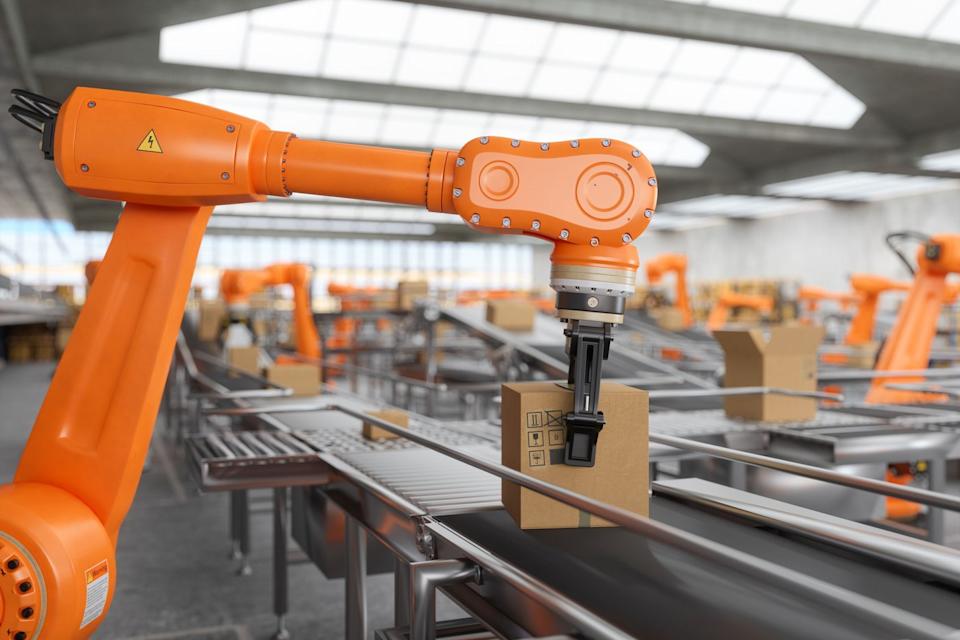
Symbotic is one of the few names in the business that has seamlessly melded the two technologies into one. Its robotic arms, conveyer belts, and self-driving carrying carts can fully automate warehouses.
And they have. While retailer Walmart is its biggest customer (not to mention developmental partner and major shareholder), Albertsons, Target, and others are also using its tech. Symbotic sold and serviced $2.2 billion worth of robotics last year, up 25% year over year.
Although it’s still technically operating in the red, there’s a light at the end of the tunnel, so to speak. An outlook from Precedence Research suggests the worldwide AI robotics industry is set to grow at an average annual pace of nearly 21% through 2034, when it will be worth nearly $50 billion per year. Symbotic is well positioned to capture at least its fair share of this growth, which should be more than enough to push it out of the red and into the black well before the end of this time frame.
That’s what investors seem to be counting on, anyway, pushing this pre-profit company’s market cap up to more than $30 billion right now.
Inclusion in the S&P 500 isn’t just a matter of market cap, of course. Standard & Poor’s hand-picks the index’s constituents to ensure they’re also a fair, collective cross-section of the American economy’s most resilient companies at any given time.