After 67 people died in a midair crash in Washington, D.C., last year, government and industry officials pledged action to prevent similar tragedies.

More than a year later, they are at loggerheads on a major potential fix that could cost $50,000 per airplane.
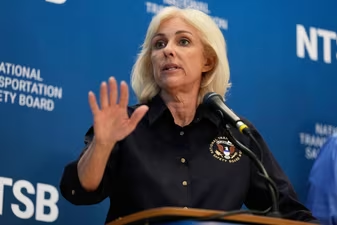
A recent flashpoint came in a closed-door meeting in early May between National Transportation Safety Board Chairwoman Jennifer Homendy and Federal Aviation Administration chief Bryan Bedford, according to people familiar with the matter.
Under discussion were 33 safety recommendations Homendy’s agency made for the FAA, including requiring planes to have technology that allows pilots to see other aircraft on cockpit screens. In its crash investigation, the NTSB determined such equipment could have helped an American Airlines regional jet and an Army helicopter avert a collision.
But while Bedford expressed support for giving pilots more tools to see nearby aircraft, he maintained that the FAA wouldn’t impose its own mandate without action from Congress, the people said.
Homendy told Bedford the FAA’s overall response sounded like “F— you” to the NTSB’s recommendations, according to the people.
Bedford then told Homendy she should control her emotions. Homendy responded: “I am angry because people died.”
An FAA spokeswoman said Bedford respects Homendy and shares the common goal of preventing another midair collision. Homendy said she had tremendous respect for Bedford and other administration officials and actions they have taken in response to the NTSB investigation.
The early May meeting reflected tensions that often flare up over safety improvements following aviation tragedies. Safety benefits aren’t often clear-cut, and the realities of costs, testing and supply-chain bottlenecks can slow changes. The politics around Ronald Reagan Washington National Airport—a busy airport serving the nation’s capital and favored by lawmakers for its convenience—are particularly fraught, and families of crash victims have been vocal advocates for safety fixes.
FAA and NTSB officials met the following week to continue discussing the safety recommendations, what Homendy described as “a very productive meeting.”
Surveillance systems
The technology known as Automatic Dependent Surveillance-Broadcast, or ADS-B, allows aircraft to receive signals from other aircraft broadcasting their locations. The NTSB has pushed for the technology to be required on aircraft in the U.S. for about 20 years.
The FAA eventually mandated that aircraft broadcast signals via what is known as ADS-B Out, which are commonly monitored by air-traffic controllers and flight-trackers. But the agency stopped short of mandating the system known as ADS-B In, which allows aircraft themselves to pick up the signals.
Some major U.S. airlines already have ADS-B In installed on aircraft. American Airlines added the system to its more than 300 Airbus A321 aircraft starting in 2019, as a way to improve safety and air-traffic efficiency, the carrier said. The airline is working to roll out the technology on its fleet of about 400 Boeing 737s.
All new United Airlines wide-body aircraft come with the system installed, and a company spokesman said the carrier was examining how to roll it out on other jets.
Hill clash
On Capitol Hill, lawmakers for months have been wrangling over mandating the cockpit-system technology, with competing bills from both chambers of Congress. The Senate’s mandate would generally be more prescriptive on retrofitting aircraft, while the House’s version would allow more flexibility in how to comply.
Each bill has its supporters in the aviation industry. The Air Line Pilots Association, a major aviator union, has backed the Senate version, which President Jason Ambrosi said would more quickly get needed safety technology integrated into cockpits.
The Association of Value Airlines favors the House bill. Jonathon Freye, the trade group’s executive director, said discount carriers are concerned about the cost and time it may take to retrofit fleets. Cheaper options could be faster to roll out, he said, and other cockpit technologies in development could be more effective at preventing midair collisions.
“We’re facing an urgent desire to make the improvements now,” Freye said. “That’s where some of that tension comes from.”
When the Senate bill was up for a vote in the House earlier this year, Sen. Ted Cruz, the Texas Republican who chairs the Senate Commerce Committee, made an unusual visit to the lower chamber to personally push House members to support the Senate’s bill, according to people familiar with the situation.
The ADS-B In retrofits might not be compatible with hundreds of planes in the U.S. commercial fleet, according to Bedford, the FAA administrator. For those with cockpit systems that can be retrofitted, industry officials said it could cost as much as $50,000 or more per aircraft.
One option, he said, is for the technology to be added to pilots’ tablet computers mounted in cockpits. “There are very affordable ADS-B In solutions that we could implement I think voluntarily very quickly,” Bedford told reporters.
Homendy said the NTSB would like to see elements of both bills passed into law but worries the legislation might stall.
“What I fear is that we’re going to end up on the anniversary of this midair collision calling for action because there’s been no movement,” she said.
Write to Andrew Tangel at andrew.tangel@wsj.com