It’s 9 a.m. on a Saturday in Ann Arbor and sidewalks are already packed full. The streets smell faintly of beer and breakfast sandwiches and music spills from porches lined with students dressed in maize and blue. The outfits are just as loud as the speakers: striped overalls, cowboy boots and hand-cut University of Michigan T-shirts. These outfits represent a message: This isn’t just a football morning but, rather, a ritual, and to dress the part is to prove you belong.
The ritual of dressing for campus isn’t confined to football Saturdays, however. On any weekday, a stroll through Central Campus tells its own story. I constantly find myself matching with every girl around me, from our navy Longchamp Le Pliage shoulder bags to our denim jackets to the fast-fashion tops purchased last-minute on Edikted for a party. What students wear is about more than just covering the body. It’s about navigating a culture where image, affordability and individuality collide in complex ways.
At the University, campus fashion trends — whether the game day uniform or the rise of second-hand shopping — circulate quickly, adapting to what feels current while still carrying old markers of belonging. There is a bigger story, however, behind every striped overall or thrifted crewneck. Who can afford to keep up with these trends, and at what cost when it comes to sustainability? How do students negotiate the pressure to look a certain way, especially within social groups like Greek life, where the expectation is to match with your peers? And what does our appetite for short-lived trends say about how we consume, both as students and as a culture?
To understand how deeply fashion culture runs at the University, I only have to look in my own closet between what I do have and what I don’t yet wish I did. This past summer, my sorority sent out multiple clothing orders with a variety of game day outfits, and I wanted to buy every single one. I love the idea of fitting in and representing a group that I feel proud to be a part of, but I couldn’t afford to buy a single one of the merch sets. I was lucky enough to receive my favorite set as a birthday gift, but I definitely still feel twinges of jealousy when I see girls casually wearing $50 tanks that I couldn’t bring myself to buy. It comes as no shock that I felt this pressure to fit in within Greek life. This is a common phenomenon that warrants a vast array of resources. I know that “no” is always a valid response. And yet, even if it almost feels humiliating to admit, I sometimes wish I could just pull together the money to be able to purchase and wear the uniform.
The clearest example of this uniform can be seen at the Big House nearly every Saturday in the fall. Students don’t just throw something on. They plan outfits in advance, swap clothes with friends and value the time they take preparing for the game day experience. Of course, people in Greek life have their matching outfits, but we aren’t the only ones who think that outfits are important to game days.
Engineering freshman Campbell Clark talked about the excitement that surrounds game day outfits.
“It’s fun getting ready and (outfits) add to the excitement of game day. Seeing everyone decked out in UMich gear adds to our school’s community.”
That shared ritual turns fashion into part of the anticipation, a way of heightening the stakes of the day while also weaving students, especially freshmen, into the larger fabric of U-M tradition.
Finding U-M gear adds another dimension to campus shopping culture. Rally House is always an option, but you might find yourself spending upward of $100 on a plain sweatshirt with the word “MICHIGAN” printed on the front in bold letters. There are other options that, although they may also be pricey, might be better for overall sustainability and consumption within our town.
Shane Perlin, co-owner of University Vintage, touched on the unique quality of vintage merch pieces.
“If people are paying a high price point, they want a really unique item.”
Although prices might be high at popular vintage shops, you are paying for uniqueness, quality and a chance to protect the environment. Clothes that have already lasted 20+ years and are still in good condition show their strength of production compared to modern clothes that are typically made with no regard for durability yet are still sold for the same price. Vintage clothes become a type of investment, both in the context of style and sustainability.
Buying secondhand from vintage shops like University Vintage is important not only for our town, but for the world. When more than half of all greenhouse gas emissions are embodied in what we consume, it becomes critical to take steps to lower that rate of consumption, an easy way to do so being by shopping secondhand. Perlin further explains how people can do their own part to be sustainable by selling their clothes to University Vintage to be repurposed and sold again. This is a huge part of what sets vintage shops apart from other secondhand retailers. Yes, people can donate their clothes to Goodwill, but at places like University Vintage, they can make money and know that their quality items will be passed on to a new generation of people who represent something that they care about: the University of Michigan.
Price doesn’t always have to be a worry with vintage clothes, either. Engineering junior and owner of uofmvintage Will Pinto says, “Jerseys, particularly baseball ones at the start of football season, are among the fastest sellers, yet I’ve kept them priced at $50 when in great condition.”
He also described to me other standard prices he keeps, which were all very competitive in comparison to other shops and platforms. Pinto says he hopes to keep expanding his business and continue to prioritize offering the best pieces at the most accessible prices. At the University, we are lucky enough to be surrounded by a large number of innovative students, and they are often just a five-minute Internet-dive away.
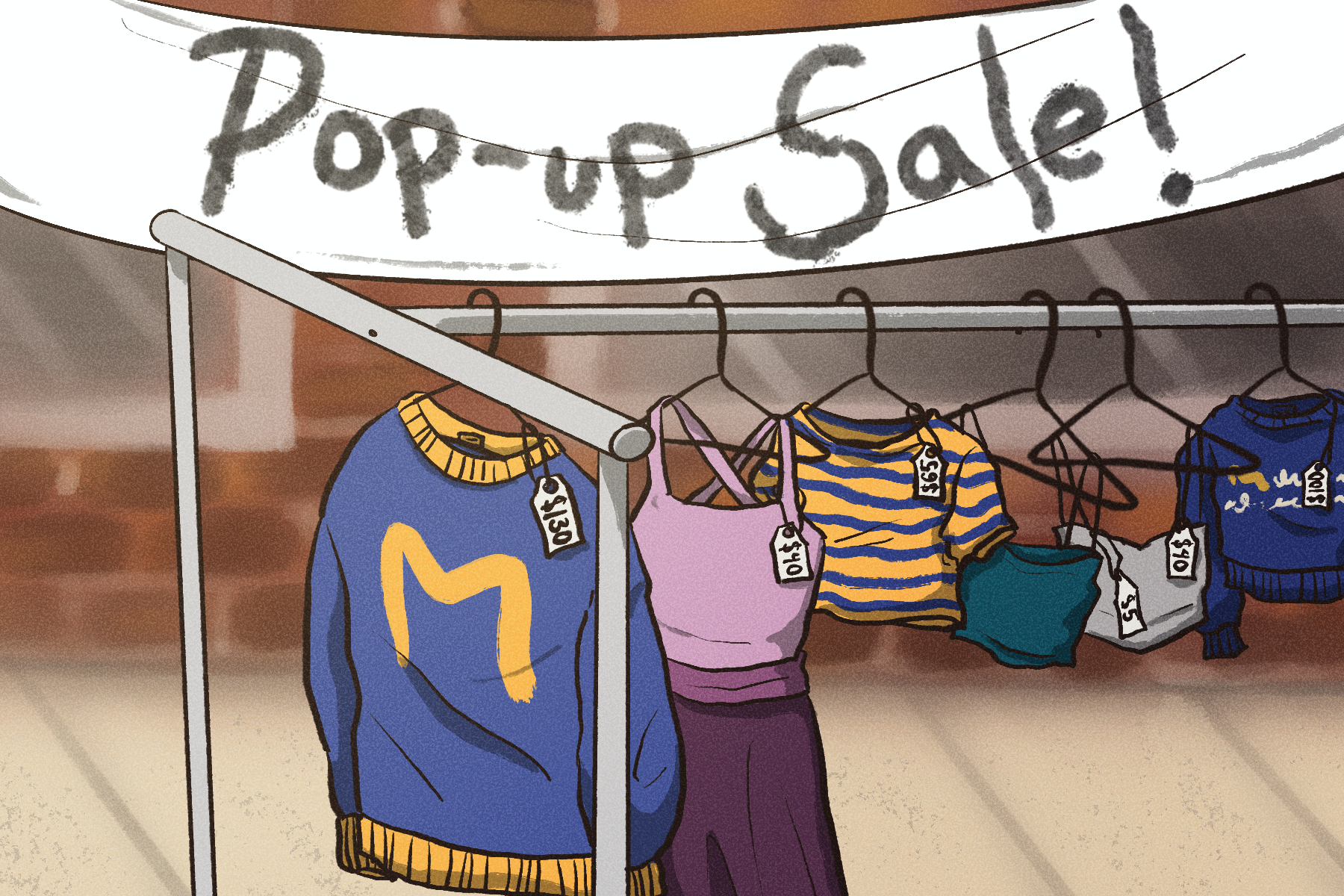
School gear is just another piece of a much bigger U-M fashion ecosystem, though. Two more expensive cases are the Dairy Boy pop-up on State Street last spring and the Parke “Back to School” mockneck — conveniently in the colorway “Denim + Maize” — that recently came out. In each case, you get one single sweatshirt for more than $100, simply branded with a popular name colored in blue and yellow. Despite the price and lack of forethought behind them, however, people were lined up for the Dairy Boy pop-up hours before it started, and I have seen at least one blue-and-maize Parke sweatshirt every day since getting back to Ann Arbor. It’s obvious that not every person can afford to stand in line for hours on a weekday to buy a $100+ sweatshirt, but their visibility still sets a standard. When these popular brands seem to come with bragging rights, the hype surrounding them builds, and so does the pressure to drop the money on their products to fit in.
I am grateful for the clothes that I do have, but I am always itching to buy more, which is hard when trends turn expensive. To combat that throughout my freshman year, I turned to sewing. My first semester, I hadn’t brought my sewing machine with me, as I assumed that a school with a large art department would be a school with available sewing supplies for its students. However, I spent weeks trying to find a sewing machine to use and was constantly denied access to the sewing machines within the Stamps School of Art & Design. By the time I did find a sewing machine to use (which sits in Shapiro Undergraduate Library’s Design Lab and requires a reservation), I had already caved and brought my personal sewing machine to school after Thanksgiving break. From that point on, I used sewing to DIY my way into Michigan fashion culture. What started as a practical workaround quickly became a metaphor for the lengths I, and so many students, go to just to keep up. Every time I threaded a needle or cut into old fabric, I felt like I was piecing myself into a culture that can otherwise feel exclusionary. Sewing gave me a sense of control in a space where style often comes with a price tag and, while it didn’t erase the pressure, it offered me a way to participate in trends on my own terms.
Sewing also built me a wardrobe of clothes that truly fit my body. So many campus trends, especially game day and going-out styles, center on cropped tank tops, tight skirts and pieces designed for very specific body types. For students who don’t feel like they fit that mold, the choice becomes complicated. They can either wear the clothes and risk feeling uncomfortable or opt out and risk feeling excluded. The culture of matching outfits, particularly in Greek life or among friend groups, magnifies this, as not fitting into the clothes can feel synonymous with not fitting in at all. The excitement of sharing a look or putting an outfit together often masks the fact that not everyone enters the conversation from the same place. Sewing gave me a way around that — it allowed me to make and alter clothes that worked with my body instead of against it. I created pieces that let me feel like myself without forcing myself into a trend’s narrow silhouette. This may not be the answer for everyone, and it surely didn’t completely dissipate the pressure I felt to fit in. Body image isn’t always about what you wear; it’s about the constant comparison to how others look in the same clothes. Creating clothes that fit you can be nice, but not when it feels like other people look better in the same clothing. Those comparisons only intensify as popular styles are picked up and replicated until they feel inescapable.
Fashion at the University doesn’t just appear; it circulates. Trends move quickly across campus, often faster than anyone’s closet can keep up with. A single item can go from obscure to sold out within a matter of weeks thanks to the many channels students use to spot and share styles. Instagram stories — whether they be at tailgates, after nights of going out or even just a school-day outfit — act as an informal lookbook, where one person’s jeans or ribbon hairstyle gets screen-shotted and copied by dozens of others. TikTok hauls — whether from thrift stores or Shein — turn into shopping lists for others who want to recreate the same looks. Where students get the clothes for these looks varies widely, however. Some lean on fast fashion sites like Princess Polly or Edikted for quick, affordable pieces they don’t mind discarding after a handful of wears. Thrifting, on the other hand, whether at Goodwill or at a vintage boutique, offers uniqueness and credibility in the realm of sustainability. Add in Depop, in-sorority exchanges and local Instagram resale accounts, and fashion becomes both communal and competitive. Buying a $10 thrifted skirt doesn’t always replace buying a $50 boutique skirt; it sometimes merely adds to a closet already overflowing with options. What makes these trends powerful is not just where they come from, but how quickly they spread and how visibly they mark belonging.
The culture of consumption on campus inevitably raises bigger questions. The first is affordability. A single game day wardrobe can easily climb into the hundreds of dollars: a U-M sweatshirt for $80, custom sorority tanks for $40, blue and yellow sneakers for more than $100. Add in “going-out” tops, seasonally-appropriate jackets and the occasional must-have pop-up piece like Dairy Boy, and the costs multiply quickly. What starts as a few spirited outfits can spiral into an entire closet makeover. For many students, this pressure is less about personal taste and more about staying in tune with the campus aesthetic. Not every student has the resources to keep up, but the pressure to belong is rarely priced with flexibility. Some students manage through hand-me-downs, borrowing from friends or finding dupes, while others are excluded from the ritual of dressing in sync. The tension is not unique to the University of Michigan, either: College students in general spend nearly $10 billion on clothing and accessories per year, which spreads out to about $160 per student. Once you add school gear and other one-time clothing items on top of that price, it can quickly skyrocket.
Sustainability is an exciting factor in the heart of campus fashion as it attempts to provide some type of answer to the problem of affordability. Thrifting and DIY projects offer students a way to be creative while also reducing waste. Vintage finds can have a second or even third life and save 8.41 pounds of carbon emissions and 88.9 gallons of water per purchase. Sewing or altering clothes also adds a personal touch that makes each piece feel unique. Secondhand shopping isn’t perfect by any means since it’s still possible to treat thrifting with the same “wear once” mindset that drives fast fashion. Buying five thrifted tops for one semester of parties is hardly less wasteful than buying five fast fashion tops if they both end up in the trash or sitting in the back of a closet in the end. But overall, the act of re-wearing and valuing clothes outside of fast fashion cycles pushes students towards more thoughtful consumption. The quick turnover of styles on campus can create pressure, but the growing popularity of secondhand fashion shows that sustainability isn’t just an abstract idea.
Fashion on campus offers more than a glimpse into what students wear; it reveals how consumption shapes belonging. It highlights who can afford to play along and who cannot. At the same time, though, it demonstrates resilience and adaptability. Borrowing, swapping, thrifting, selling and buying secondhand all complicate the narrative of unchecked consumerism. These practices suggest that while the culture pushes students toward constant consumption, counter-currents exist. They reflect creativity and resourcefulness, which each resist the idea that participation must come with a high price tag or a certain look.
The duality of pressure and possibility underscores why clothing on campus can be more than just surface-level. In some ways, a borrowed sweatshirt or a thrifted jacket carries as much symbolic weight as the latest release from a popular pop-up brand, even if it’s harder to track. In the end, student fashion is best understood as a negotiation between conformity and individuality. Although the streets are full of the maize-and-blue uniform on Saturdays, beneath the sameness lie stories about community, affordability, sustainability and self-expression. Fashion becomes both a mirror of campus culture and a reminder of the different paths that people have to take to get to the same destination.
Statement Correspondent Lola Post can be reached at lolapost@umich.edu.