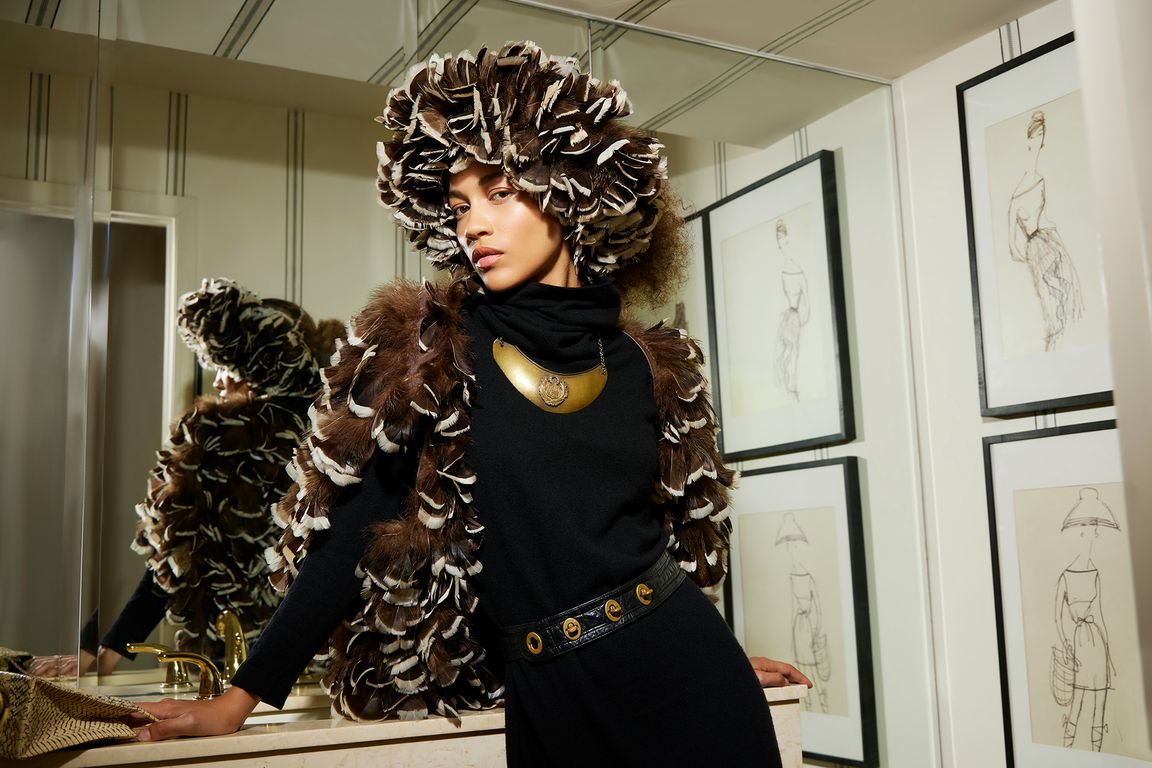
Editor’s Note: The Cashin collection represented in the photos that accompany this story are from the personal collection of Stephanie Lake. Some are duplicates of clothing contained in the UCLA Library Special Collections archive. They are meant to represent Cashin’s design aesthetic, and are not the items housed at UCLA.
Bonnie Cashin might just be the most influential designer you’ve never heard of. The bright ponchos of the 1960s and ’70s? Cashin. The original Coach tote bags with brass toggles? Cashin. The midcentury layering crazes of jackets atop sweaters atop vests atop tunics and the rest? All Cashin.
Miki Bulos, the performing arts curator at UCLA Library’s Special Collections, calls Cashin “a designer’s designer.” Despite the ubiquity of her designs, Cashin never achieved the fame of her peers. A combination of her personal dedication to designing for the regular modern woman, creating utilitarian sportswear, traveling the world, evolving her designs and pursuing amorphous, “unpatentable” shapes forged a different kind of future for her. Instead of slingshotting her designs to magazine covers and runways, Cashin indulged in Hollywood costume design, screenwriting and ready-to-wear lines. The products of her storied career are endlessly imaginative.
“This is a dogleash buckle. This was if you needed to hike up your skirt,” Bulos says, describing just one piece among a sprawling spread of preserved items from Cashin’s archive. “Her whole story was that she needed to come down the stairs with her canapes for a party, so she would hike up her skirt and lock it into place with dog leash buckles.” An innovator indeed.
Click below to take a vivid tour through some of Bonnie Cashin’s groundbreaking designs — and learn how much she influenced what we wear today.
After Cashin’s death in 2000, UCLA Library Special Collections received unexpected news: Part of Cashin’s considerable archive would be coming to Westwood. The UCLA collection includes more than 300 boxes of books, papers and drawings, along with reams of original garments made out of silk, nylon, wool, leather and paper. Seeing even a sliver of the collection leaves you obsessed with Cashin, her ethos, her practicality and her natural artistry.
Cashin remains relatively unknown both in the fashion zeitgeist and in fashion academia. That’s about to change.
“The variety of the physical artifacts of her collection — including things on paper, designs, essays, photography — is abundantly represented in the library’s digital collections, with more than 7,000 items,” says Chris Gilman, digital curriculum program coordinator at UCLA Library. These cultural riches are described at the item level, searchable and categorized by genre to ensure the utmost usability. That comes in handy for courses such as Spring 2024’s “Advanced Topics in Digital Humanities: Digital Curation,” in which students explored ways to learn from and present elements of the Cashin archive.
Of all the materials in the digital collection, Gilman says, “the most interesting are the swatches. These are pages that have images, writing and a sample of fabric. They exemplified Bonnie Cashin’s own design process.” Profound thinker that she was, Cashin was not only concerned with the texture and color of the fabric, but, Gilman says, “she almost always had some principle at stake on any one of these individual swatch pages — she exemplified them in an illustration, with arrows and boxes and captions.”
The biennial Cashin Lecture Series, presented by the Library, focuses broadly on the general creative process and will be formally relaunched in 2026. Its initial installment will spotlight the designer herself, aiming to relaunch Cashin as the artist she was. Including everything from her experimental designs, ready-to-wear, costume design, writings and musings, photographs and personal papers, the series will draw from those 300 archival boxes to produce curated presentations of specially chosen materials and garments. Special Collections curators, faculty and guest lecturers will all be a part of the series as they aim to illuminate and contextualize one of fashion’s greatest female pioneers. But, Bulos says, the lecture series has a grander ambition than just exposure to Cashin.
“My purpose is to take the collection to people who are potentially new scholars on Bonnie Cashin,” says Bulos. “Our goal is to make this available, stabilize the material enough, make sure it can be handled by the public and hope that they are inspired to write new scholarship and histories, make new art and produce culture.” Think of it as fashion’s American Idol: finding the next great scholar to become passionate and write about this unsung cultural icon. But there’s a greater search for the Special Collections team as well: For everyone coming to the lecture series, Bulos has one word — create.
“Dive deep. Find the treasures. Design a frock. Write a paper. Make a film,” she says is her message to those who will come to study the collection. “These are the raw materials for you to go out and create more culture.”
Read more from UCLA Magazine’s Fall 2025 issue.