Key Points
-
Tesla’s Q1 vehicle deliveries were up 6% on a year-over-year basis but down 14% from last quarter’s performance.
-
Tesla is facing pressure from Chinese competitors.
-
BYD is posting stronger market share results than Tesla, and Nio is posting stronger growth.
- These 10 stocks could mint the next wave of millionaires ›
Tesla (NASDAQ: TSLA) published its latest update for vehicle production and deliveries before the market opened this morning, and the report suggested ongoing headwinds for the company’s core electric vehicle (EV) business. While the company produced 408,386 EVs last quarter, it posted only 358,023 vehicles in the quarter — falling short of the average analyst estimate’s call for 370,000 vehicles delivered in the period. Notably, a previous report from the company had estimated that it would deliver 365,645 vehicles in Q1.
Tesla’s Q1 deliveries were actually up 6% year over year from the 336,681 vehicles it delivered in the prior-year period. On the other hand, deliveries were down roughly 14% on a sequential quarterly basis. While sales seasonality is likely a driving factor in the decline from Q4’s delivery level, the company’s EV business still appears to be facing some significant demand issues.
Will AI create the world’s first trillionaire? Our team just released a report on the one little-known company, called an “Indispensable Monopoly” providing the critical technology Nvidia and Intel both need. Continue »
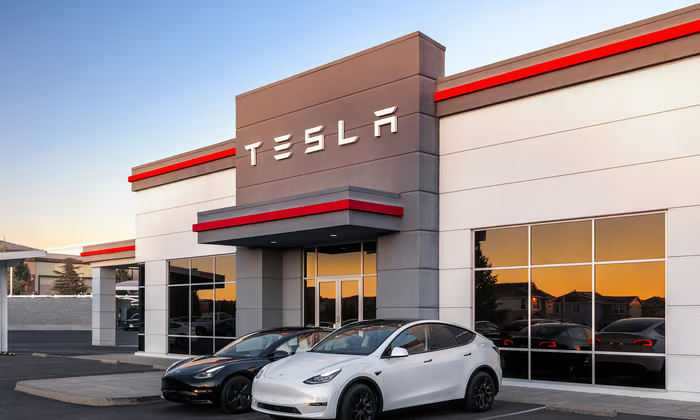
Image source: Tesla.
In particular, growth for Chinese EVs appears to be having an impact on Tesla’s performance. Should EV investors who are concerned about Tesla’s uneven performance in the auto industry shift their bets to China-based industry leaders?
The bull case for Tesla stock has shifted away from EVs
When it comes to performance in the EV market, Chinese leaders BYD and Nio have been posting numbers that exceed Tesla’s on different fronts recently. Growth for these rivals is likely having a significant impact on Tesla’s vehicle sales.
For example, a recent report suggests that China-based auto leader BYD exported more than 321,000 vehicles in this year’s first quarter alone. This figure includes hybrid vehicles in addition to pure EVs, but it still sets up a stark difference in delivery performance. Notably, the company’s deliveries outside its core domestic Chinese market came in at roughly 90% of Tesla’s total worldwide deliveries for the quarter.
Counting all of its geographic markets, BYD delivered 300,222 vehicles in March alone — coming in at roughly 84% of Tesla’s total deliveries across this year’s first quarter. On the other hand, BYD’s deliveries were actually still down 20.5% on an annual basis — an indication that the Chinese EV giant is not immune to macroeconomic trends and increased competition.
On the other hand, Nio commands a much smaller percentage of the global EV and hybrid market but has been seeing much stronger growth lately. The company delivered 35,486 vehicles in March — representing an annual increase of 136%. Meanwhile, the company delivered 83,465 vehicles across this year’s first quarter — good for annual growth of roughly 98%.
If EV investors are prioritizing market share or growth, there is a case to be made for investing in either BYD or Nio over Tesla depending on those respective priorities. On the other hand, a potential investment in either of these Chinese EV industry leaders also comes with some geopolitical and macroeconomic risks not associated with Tesla.
For better or worse, the outlook for Tesla’s stock performance has become increasingly divorced from the company’s core EV operations. The bull case for the stock largely hinges on potential successes for growth bets including robotaxi services and the Optimus humanoid robots. With that in mind, investors should weigh their expectations for those growth bets when deciding whether other EV stocks including BYD and Nio might be more suitable buys.
Don’t miss this second chance at a potentially lucrative opportunity
Ever feel like you missed the boat in buying the most successful stocks? Then you’ll want to hear this.
On rare occasions, our expert team of analysts issues a “Double Down” stock recommendation for companies that they think are about to pop. If you’re worried you’ve already missed your chance to invest, now is the best time to buy before it’s too late. And the numbers speak for themselves:
- Nvidia: if you invested $1,000 when we doubled down in 2009, you’d have $455,872!*
- Apple: if you invested $1,000 when we doubled down in 2008, you’d have $48,676!*
- Netflix: if you invested $1,000 when we doubled down in 2004, you’d have $515,294!*
Right now, we’re issuing “Double Down” alerts for three incredible companies, available when you join Stock Advisor, and there may not be another chance like this anytime soon.
*Stock Advisor returns as of April 2, 2026.
Keith Noonan has no position in any of the stocks mentioned. The Motley Fool has positions in and recommends Tesla. The Motley Fool has a disclosure policy.
The views and opinions expressed herein are the views and opinions of the author and do not necessarily reflect those of Nasdaq, Inc.