Key Points
The dawn of artificial intelligence (AI) roughly three years ago has had a profound impact on the face of technology. Many experts claim that the advances brought by generative AI are ushering in the Fourth Industrial Revolution. In recent months, however, investors have become concerned that a slowdown will eventually hit AI, as hype has outpaced reality.
Taiwan Semiconductor Manufacturing (NYSE: TSM), commonly known as TSMC, reports monthly sales numbers, and the latest figures are eye-opening, helping to dispel any concerns about an AI slowdown. Investors celebrated the news, lifting the stock to a new all-time high.
Where to invest $1,000 right now? Our analyst team just revealed what they believe are the 10 best stocks to buy right now, when you join Stock Advisor. See the stocks »
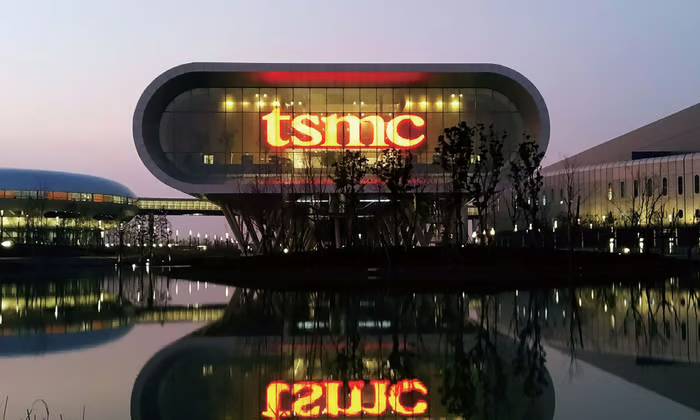
Image source: Taiwan Semiconductor Manufacturing.
Highest ever
For the month of January, TSMC reported net revenue of NT$401.26 billion (roughly $12.7 billion), which climbed 37% year over year and 20% month over month. This marked the company’s highest monthly revenue total ever, driven by ongoing demand for advanced AI chips.
TSMC is widely regarded as the most advanced semiconductor foundry and the world’s leading contract chipmaker. The company dominates the space, with an estimated 71% of the global chip market, and more than 90% share of the most advanced chips used for AI. Because of its extensive reach in the industry, TSMC is also widely viewed as a bellwether, providing insight into the broader state of AI.
TSMC makes advanced semiconductors for some of the world’s most high-profile companies, including Nvidia, Apple, Broadcom, and Advanced Micro Devices, among others.
The monthly sales results come on the heels of TSMC’s blockbuster fourth-quarter financial report. The company’s net revenue of $33.7 billion rose 26% year over year and 2% quarter over quarter, surpassing Wall Street’s expectations and the high end of management’s robust guidance. TSMC also saw expanding margins, as its gross margin of 62.3% and net profit margin of 48.3% hit their highest levels ever.
Management noted that chips for high-performance computing (HPC) have become the company’s principal breadwinner, accounting for 58% of revenue last year. To keep up with the demand, TSMC plans to spend as much as $56 billion on capital expenditures in 2026, up 40% year over year at the high end of its guidance. CEO C.C. Wei said 70% to 80% of the spending would be earmarked for advanced process technologies.
At 34 times earnings, TSMC stock is trading at a premium. Still, as the leading provider of chips powering the AI revolution, the company is well-positioned to ride these secular tailwinds to new heights. That’s why TSMC stock is a buy.
Should you buy stock in Taiwan Semiconductor Manufacturing right now?
Before you buy stock in Taiwan Semiconductor Manufacturing, consider this:
The Motley Fool Stock Advisor analyst team just identified what they believe are the 10 best stocks for investors to buy now… and Taiwan Semiconductor Manufacturing wasn’t one of them. The 10 stocks that made the cut could produce monster returns in the coming years.
Consider when Netflix made this list on December 17, 2004… if you invested $1,000 at the time of our recommendation, you’d have $439,362!* Or when Nvidia made this list on April 15, 2005… if you invested $1,000 at the time of our recommendation, you’d have $1,164,984!*
Now, it’s worth noting Stock Advisor’s total average return is 918% — a market-crushing outperformance compared to 196% for the S&P 500. Don’t miss the latest top 10 list, available with Stock Advisor, and join an investing community built by individual investors for individual investors.
*Stock Advisor returns as of February 10, 2026.
Danny Vena, CPA has positions in Apple, Broadcom, and Nvidia. The Motley Fool has positions in and recommends Advanced Micro Devices, Apple, Nvidia, and Taiwan Semiconductor Manufacturing. The Motley Fool recommends Broadcom. The Motley Fool has a disclosure policy.
The views and opinions expressed herein are the views and opinions of the author and do not necessarily reflect those of Nasdaq, Inc.