Quick Summary
- Liberty University warns students that Satan uses phones to ‘separate us from God.’
- University launches a 28-day ‘digital rest’ challenge to encourage students to disconnect from social media and devices.
- Participants receive a 54-page guide with Scripture readings and reflection prompts.

Amid growing concerns about smartphones’ impact on focus, mental health and spiritual life, Liberty University has rolled out a 28-day challenge throughout February, inviting students to step away from social media, online shopping, and entertainment to deepen their connection with God and others.
Coordinated by the Office of Spiritual Development, the university’s second annual Digital Rest initiative provides participants with a 54-page Digital Rest Guide featuring Scripture readings, devotionals and reflection prompts. Students are encouraged to log out of social platforms, delete nonessential apps, and engage with the guide daily on weekdays. The university also placed 300 Brick devices — tools that temporarily block social media access — in residence halls for student use.
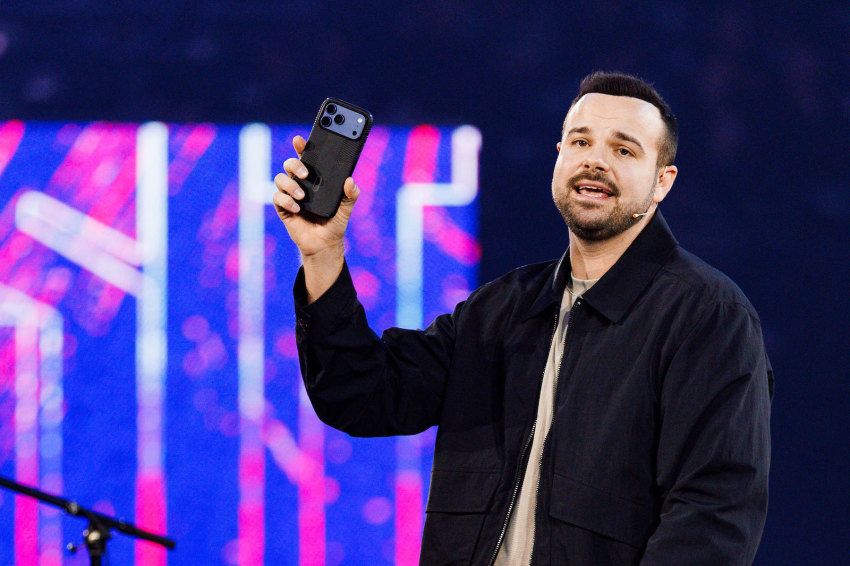
The program launched during the university’s Convocation on Jan. 30, with speaker Joey Odom, co-founder of digital wellness company Aro. Odom cautioned that excessive phone use can “choke out every good thing in our lives,” invoking Jesus’ parable of the sower in Matthew 13 to describe worries, pleasures and wealth as “thorns” exacerbated by social media.
“The deceitfulness of wealth and the constant comparison of our social media feeds is a reminder of what we don’t have, which opens up our hearts to the lie that we are incomplete without that wealth,” he said. “This is the thorn that chokes out truth.”
“We’re surrounded by digital thorns,” he added. “What it looks like to live differently is this: we have to stop bringing our phones to every moment of our lives. When we bring our phones into potential moments of fruit, we’re just bringing thorns to a fruit party. Don’t bring thorns to a fruit party. Get into the daily practice of spending time apart from your phone.”
He also warned that our mobile devices can be used by the enemy to “separate us, our mind, our will, our intentions, everything, from God,” adding, “But why would he waste a temptation on a capital-S sin like murder when simple distraction can do the trick? In the 1940s, the greatest distraction this brilliant man could think of was a deck of playing cards. If only that were our greatest distraction today.”
Unlike the mid-20th century, Odom explained, today there are roughly 10 million games accessible via our phones, in addition to TikTok, YouTube, and everything in between.
“So let me ask a question: How on Earth are we supposed to love the Lord our God with all our heart, with all our soul, with all our mind, and with all our strength? And then, once we nail that, love our neighbors as ourselves? This feels impossible.”
Vice President of Spiritual Development Joshua Rutledge tied the effort to mounting evidence on social media’s effects, referencing experts including authors Andy Crouch, Darren Whitehead, and Dr. Jonathan Haidt.
“In the last two years, there’s been so much research that demonstrates the real effects of prolonged social media usage on mental health,” Rutledge said in a statement provided to The Christian Post. “The enemy’s number one way to speak lies is through this phone. … That’s where so many people are spending their time. That’s where their eyes and their minds are. That’s where you’re going to feed lies, anxiety and fear. If you want to combat that with the truth of the Gospel, then you’d better figure out how to get through that wall.”
The initiative aligns with recent scientific findings on digital breaks: a December 2025 study led by Harvard Medical School associate professor John Torous examined a one-week voluntary social media detox among young adults ages 18 to 24.
After a two-week baseline tracking typical use of just under two hours per day on platforms like Instagram, Snapchat and others, participants who opted in reduced social media time to roughly 30 minutes per day, according to the study published in JAMA Network Open.
While total screen time stayed similar — possibly suggesting time was redirected elsewhere — the study found symptoms improved markedly: anxiety decreased by 16.1%, depression by 24.8%, and insomnia by 14.5%. For those with more severe baseline depression, the benefits were most pronounced, the study found.