Forex markets are closing out February in subdued fashion, with activity thinning as traders hold back from fresh positioning ahead of a heavy data calendar next week. Aussie remains the standout performer, supported by stronger-than-expected inflation data earlier this week, which reinforced expectations that the RBA will deliver another rate hike in May. Swiss Franc and Euro are also on the firmer side, reflecting a mild defensive undertone beneath the surface.
At the other end, Yen remains the weakest currency of the week. Bets for an April hike by the BoJ have receded amid political noise and mixed inflation signals. While some officials have kept March or April alive as possibilities, markets appear skeptical that tightening will come again that soon. Dollar and Loonie are also soft, though not under heavy selling pressure. Greenback is struggling to extend any rebound as risk sentiment stabilizes, while Canadian Dollar is cautious ahead of domestic growth data.
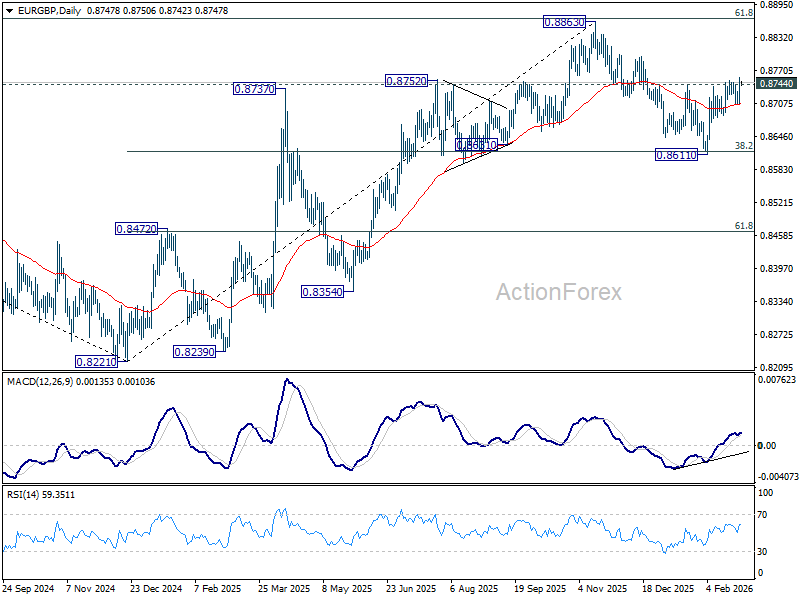
Sterling stands out as the notable underperformer today. The currency has fallen broadly and is attempting to break below its near-term range against Euro. There is no single headline driving the move, but expectations for a March rate cut by the BoE are continuing to build.
Political uncertainty may be compounding the pressure. The UK Labour looks set to lose the Gorton and Denton by-election, a constituency traditionally aligned with the party. A defeat there would deal another blow to Prime Minister Keir Starmer, who has faced mounting political headwinds since the start of the year. Some analysts speculate that a loss—particularly to the Green Party—could push Chancellor Rachel Reeves toward a looser fiscal stance in the upcoming Spring Statement, to regain left-leaning voters. That prospect, combined with easing expectations, weighs on Sterling.
Attention later today will turn to Canada’s GDP release. Monthly GDP is expected to rise 0.1% mom in December, with Q4 growth seen essentially flat. The numbers will be closely watched for confirmation that the economy is stabilizing rather than slipping.
The BoC is currently in an extended pause, having brought rates to 2.25% and signaled that easing may be complete. Market pricing reflects a broadly steady path from here. However, a surprise contraction in Q4 would challenge that narrative and revive speculation of a “fine-tuning” cut to cushion against a deeper slowdown.
In Asia, at the time of writing, Nikkei is up 0.14%. Hong Kong HSI is up 0.77%. China Shanghai SSE is down -0.17%. Singapore Strait Times is up 0.33%. Japan 10-year JGB yield is down -0.027 at 2.130. Overnight, DOW rose 0.03%. S&P 500 fell -0.54%. NASDAQ fell -1.18%. 10-year yield fell -0.031 to 4.017.
Subsidy effect pulls Tokyo core CPI down to 1.8%, but underlying inflation firms
Inflation in Tokyo eased further in February, with core CPI (ex-fresh food) falling to 1.8% yoy from 2.0% yoy. While slightly above market expectations of 1.7% yoy, the reading marks the third straight monthly slowdown and the lowest level since October 2024, slipping back under the BoJ’s 2% target.
The primary driver was a sharp drop in energy prices, which declined -9.2% yoy as the government’s temporary utility subsidies began to take effect. The program has mechanically dampened readings and was broadly expected to weigh on inflation for several months.
Beneath the surface, however, price dynamics remain more persistent. Core-core inflation (excluding fresh food and energy) rose to 2.5% yoy from 2.4% yoy, suggesting domestic demand conditions and wage-driven pricing remain intact. Headline CPI also ticked up modestly from 1.5% yoy to 1.6% yoy.
Japan’s industrial production rose 2.2% mom on auto strength, but forward signals soft
Japan’s industrial production rose 2.2% mom in January, marking the first increase in three months, though falling well short of expectations for a 5.5%. .
Production expanded in 13 of 15 sectors, with automakers posting a notable 9.1% gain amid solid demand for passenger vehicles both domestically and overseas. However, weakness persisted in production machinery, where output declined on softer demand for semiconductor-manufacturing equipment.
The Ministry of Economy, Trade and Industry maintained its assessment that industrial production “fluctuates indecisively”. Officials noted that companies remain wary of US tariff policy developments and the Chinese growth outlook, even if no direct impact was evident in the latest data.
Looking ahead, manufacturers expect output to dip -0.5% in February and -2.6% in March.
In contrast, retail sales surprised to the upside, rising 1.8% yoy against expectations of just 0.2%.
PBOC cuts FX risk reserve to temper Yuan strength, but downtrend in USD/CNH intact
The People’s Bank of China announced today that it will lower the foreign exchange risk reserve requirement for financial institutions purchasing foreign exchange via forwards to zero from 20%, effective March 2. The move reverses a September 2022 tightening measure that had been introduced to curb rapid Yuan depreciation and stem capital outflows.
At the time, the higher reserve requirement made it more costly to bet against the Yuan. Now, with the currency having surged to a near three-year high against Dollar, the adjustment signals a shift in priorities. The central bank framed the decision as support for enterprises in managing exchange-rate risks, while reiterating its commitment to maintaining the renminbi at a “reasonable and balanced level.”
Markets widely interpret the move as an attempt to slow the pace of rapid appreciation rather than to trigger depreciation outright. Yuan strength has been broad-based this week, reflecting improving sentiment around China’s trade positioning and a softer Dollar backdrop.
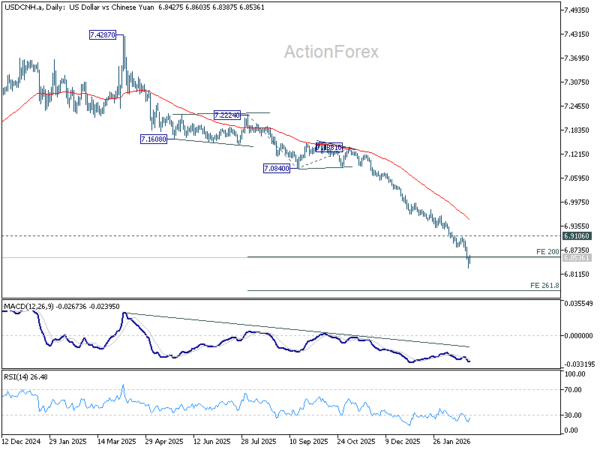
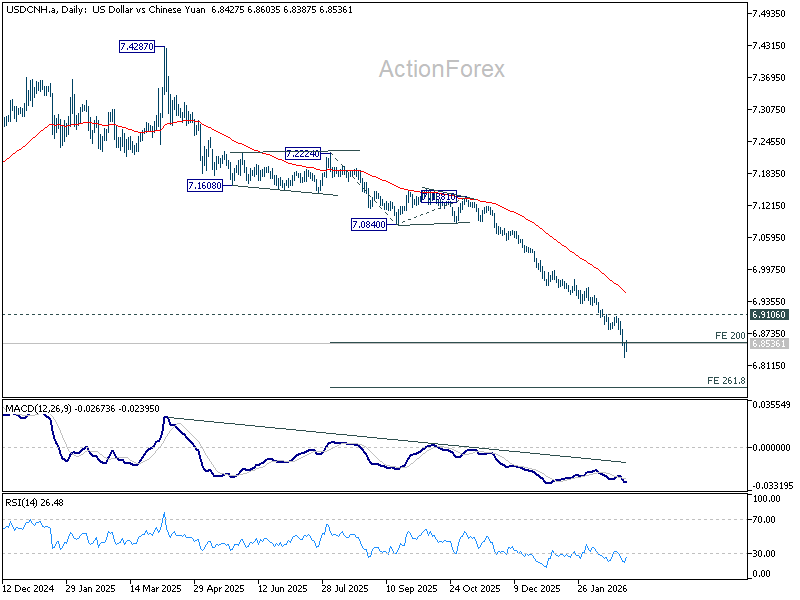
USD/CNH recovered mildly on the news, but the bounce has not altered the prevailing technical picture. The pair has broken through 200% projection of 7.2224 to 7.0840 from 7.1381 at 6.8613 this week, and there is no clear sign of bottoming. Technically, near-term outlook remains bearish as long as 6.9106 resistance caps rebounds. The next downside target lies at the 261.8% projection at 6.7758.
EUR/GBP Daily Outlook
Daily Pivots: (S1) 0.8718; (P) 0.8738; (R1) 0.8769; More…
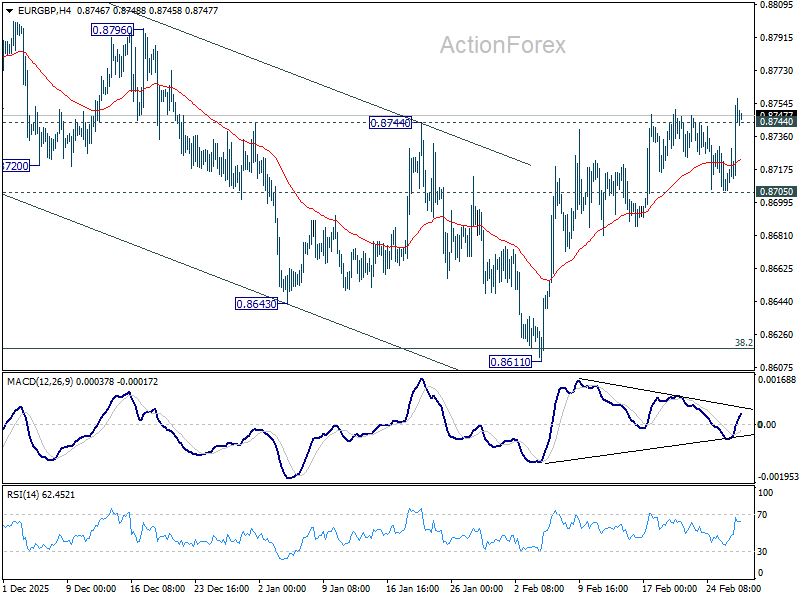
EUR/GBP’s rebound from 0.8611 is resuming and intraday bias is back on the upside. Sustained trading above 0.8744 resistance will solidify the case that fall from 0.8863 has completed as a correction at 0.8661. Further rise should then be seen back to retest 0.8663 high. On the downside, below 0.8705 support will turn intraday bias neutral again first. But near term outlook will stay bullish as long as 38.2% retracement of 0.8221 to 0.8663 at 0.8618 holds.
In the bigger picture, focus remains on 61.8% retracement of 0.9267 to 0.8221 at 0.8867. Rejection by this level will keep the rise from 0.8221 medium term bottom (2024) as a corrective move. Sustained trading below 55 W EMA (now at 0.8636) should confirm that this corrective bounce has completed. However, decisive break of 0.8867 will suggest that EUR/GBP is already reversing whole decline from 0.9267 (2022 high). That should pave the way back to 0.9267.