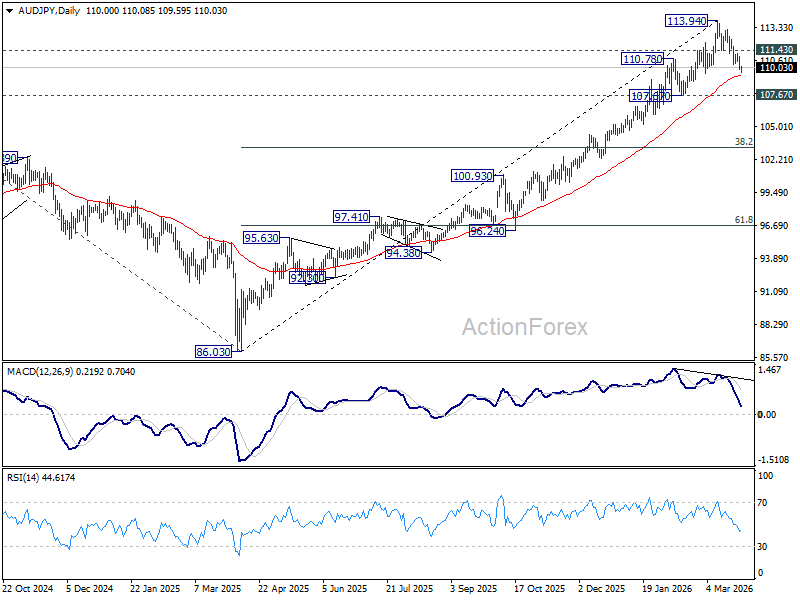
AUD/JPY’s selloff is accelerating as renewed risk aversion combines with a growing “stagflation trap” that is undermining the Reserve Bank of Australia’s hawkish outlook. While markets still price around a 72% chance of a May rate hike, surging energy and fertilizer costs are increasingly seen as a drag on growth rather than a simple inflation boost. As expectations begin to shift, the cross is at risk of a deeper medium-term correction toward the 103 region.
The broader backdrop is turning more defensive. Escalation risks in the Middle East remain elevated, with mixed messaging from US President Donald Trump—from ultimatums to extended pauses—failing to provide clarity. Rather than calming markets, the developments have prolonged uncertainty, keeping oil prices elevated and risk sentiment fragile.
This risk-off tone is weighing directly on the Aussie as AUD/JPY has emerged as one of the clearest expressions of this shift, with the pair among the biggest movers this week and downside momentum building.
At the same time, markets are reassessing the RBA’s policy path. The central bank’s March 17 hike was delivered on a narrow 5–4 split, already signaling internal divisions. While expectations for another hike in May remain firm, confidence in that outcome is becoming more fragile as new risks emerge.
The key issue is Australia’s heavy reliance on imported refined fuels. Sustained Brent prices above 100 are feeding through into higher transport and business costs, raising inflation while simultaneously weighing on growth—a classic stagflation setup. The fertilizer shock adds extra pressure. Australia sources over 40% of its fertilizer imports from the Middle East, particularly Urea. With disruptions around the Strait of Hormuz, Urea prices have surged more than 30% in March, sharply increasing input costs for the agricultural sector. This threatens to squeeze farm margins and reduce output, while pushing food prices higher.
Taken together, these dynamics are complicating the RBA’s policy calculus. Inflation pressures argue for tightening, but the growth hit from rising costs and uncertainty raises the risk that further hikes could exacerbate the slowdown. Some market participant could start to speculate whether the balance could tilt toward a pause in May.
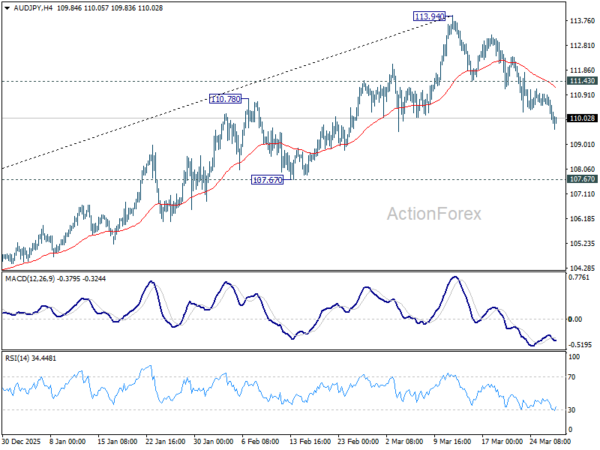
Technically, AUD/JPY is showing signs of a medium-term top, with bearish divergence visible in D MACD. The break of 110 level leaves it vulnerable, with immediate focus on the 55 D EMA (now at 109.31). Sustained trading below this level would open the door for a deeper pullback to 107.67 support next.
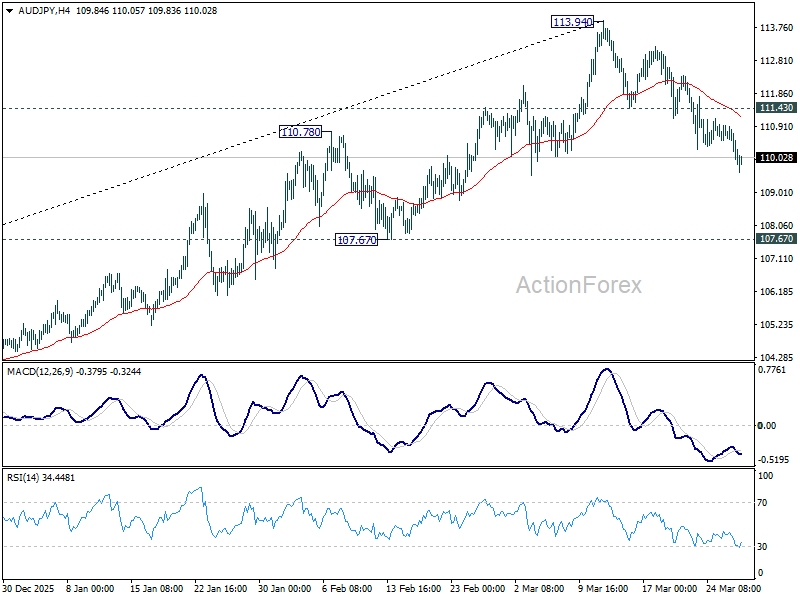
Decisive break of 107.67 will confirm that AUD/JPY is already correcting whole up trend from 86.03 (2025 low) and bring deeper decline to 38.2% retracement of 86.03 to 113.94 at 103.27.
Conversely, a strong rebound from current levels and a break above 114.30 would suggest the uptrend remains intact, though this scenario appears less likely as macro headwinds build.