While the government shutdown continues Friday, so do conversations among those in the military community about how to ensure service members and their families are taken care of.
“It is tough to be deployed and to know that there’s problems going on back home and you can’t do anything about it,” said Tracy Owens, a retired lieutenant commander in the United States Navy and now the senior programs manager for Support the Enlisted Project (STEP).
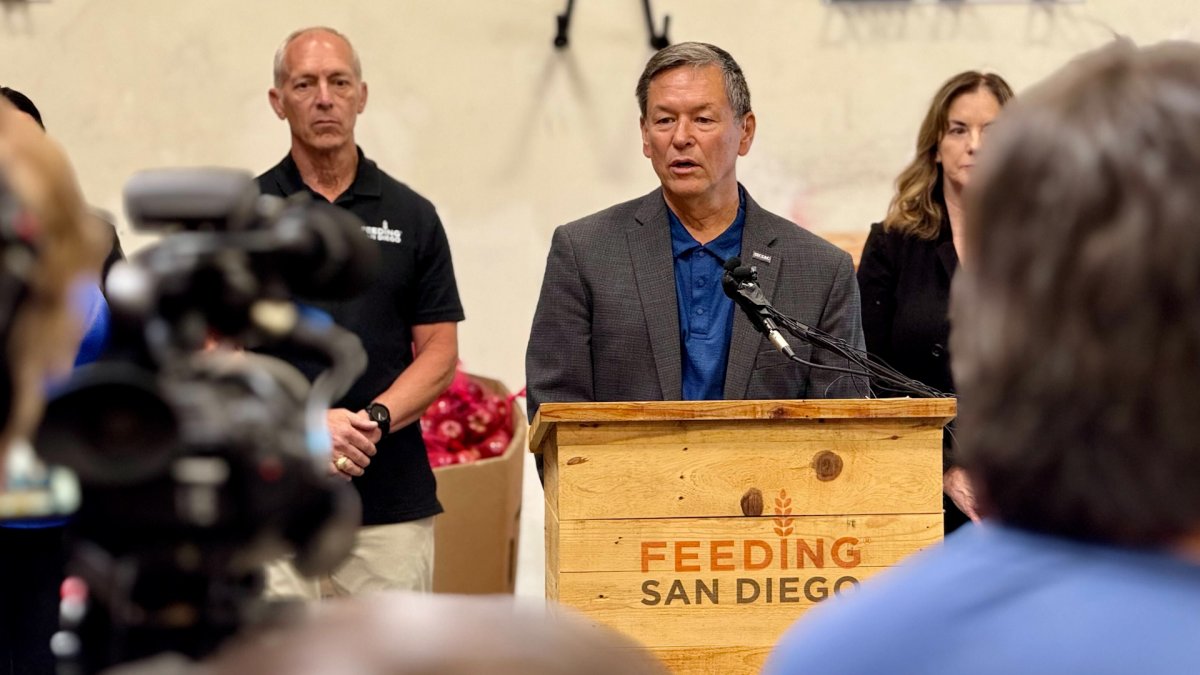
Owens, representing STEP, joined the leaders of Feeding San Diego, Zero8Hundred, the San Diego Military Advisory Council (SDMAC) and the Armed Services YMCA to announce assistance for military families during the government shutdown. The organizations explained they created an emergency action group about one year ago and have been planning for how to respond to this very situation.
Zero8Hundred and STEP both said case managers are standing by to help with financial and mental health, while Feeding San Diego said they have pre-organized four food distribution sites for when, and if, they are needed. However, they don’t anticipate the greatest need to hit until around two weeks after the shutdown began, if it continues.
“We need our service members to be able to concentrate on the mission and not be worried about their families back home,” Owens added. The group created a webpage for military families to access with information and resources to help them navigate this period of uncertainty.
Bianca Steele, a Navy wife and proud mom of two, shared with NBC 7 that her husband is a chief petty officer and has served for 19 years. He is based in San Diego, although in the past near-two decades, Steele estimated they have moved around one dozen times. For a portion of it, she managed to find a flexible job at a company that understood she would have unique needs as a military spouse, such as sudden moves, shifting priorities during deployment and child care. However, she recently parted ways with the company, and her husband is now the family’s sole provider.
“My first thought was budget, budgeting. Budgeting is obviously top of mind,” she said, “because the bills don’t stop.”
Steele continued to say that needing to be resilient in times of change like this one is part of being a military spouse and a military family.
“The impact is almost, like, here’s just another thing we have to deal with, you know. We have to deal with PCSing (Permanent Change of Station). We have to deal with deployments, dates changing, consistently changing. You know, you think your spouse is coming home at this time, and then it gets pushed back or they leave early,” she said. “Now, this is, you might get a pay check, you might not.”
While lawmakers in Congress struggle to compromise, military families are dealing with a lot of uncertainty. Many might not get a paycheck until the shutdown ends. NBC 7’s Dana Williams reports.
She echoed Steele’s point that when service members are training or deployed, ideally they do not need to be worried about what is happening at home.
“When people are not happy, healthy and secure, they are not going to be able to do those jobs well, and if those people are the people protecting our country, and they can’t focus on the jobs at hand, it’ll show in the work that they’re doing,” she said.
According to David Boone, the president and CEO of SDMAC, there are more than 110,000 active duty service members in San Diego County. That number is even greater when it comes to those working as government contractors.
“All kinds of things, from construction projects to maintenance to working on ships,” Boone said. “We have 370,000 employees in our region that are connected to Department of Defense funding. About 220,000 of that 370 are tied to contracts. The contract piece of this is $20 billion.”
Some of San Diego County’s largest government contractors in the defense sector are BAE Systems, General Atomics and Booz Allen Hamilton, according to the San Diego Regional Economic Development Committee.
That’s a lot of people who may be in limbo right now because of the shutdown, Boone said. However, “that entire 20-billion portfolio won’t come to dead stop”; he explained that some roles are essential and will continue, while others may be on pause.
Boone said if this shutdown continues, it could have an impact on the economy as a whole in the region because that would mean fewer people going to work each day, filling up at local gas stations or picking up local lunch. That’s on top of the need to stretch finances thin until backpay is available, but, fortunately, he said San Diego’s economy is diverse.
“We are diverse, absolutely, we are,” he said. “Having diversity so that you can weather these storms depending on what they are, sometimes it’s better on the private sector side, sometimes it’s better on the defense, but having that diversity leads to resilience in the economy.”
“I still have faith in the system. It’s just hard to be the ones affected by it,” Steele said.
She and Boone both said their message to elected leaders is to end the shutdown.

