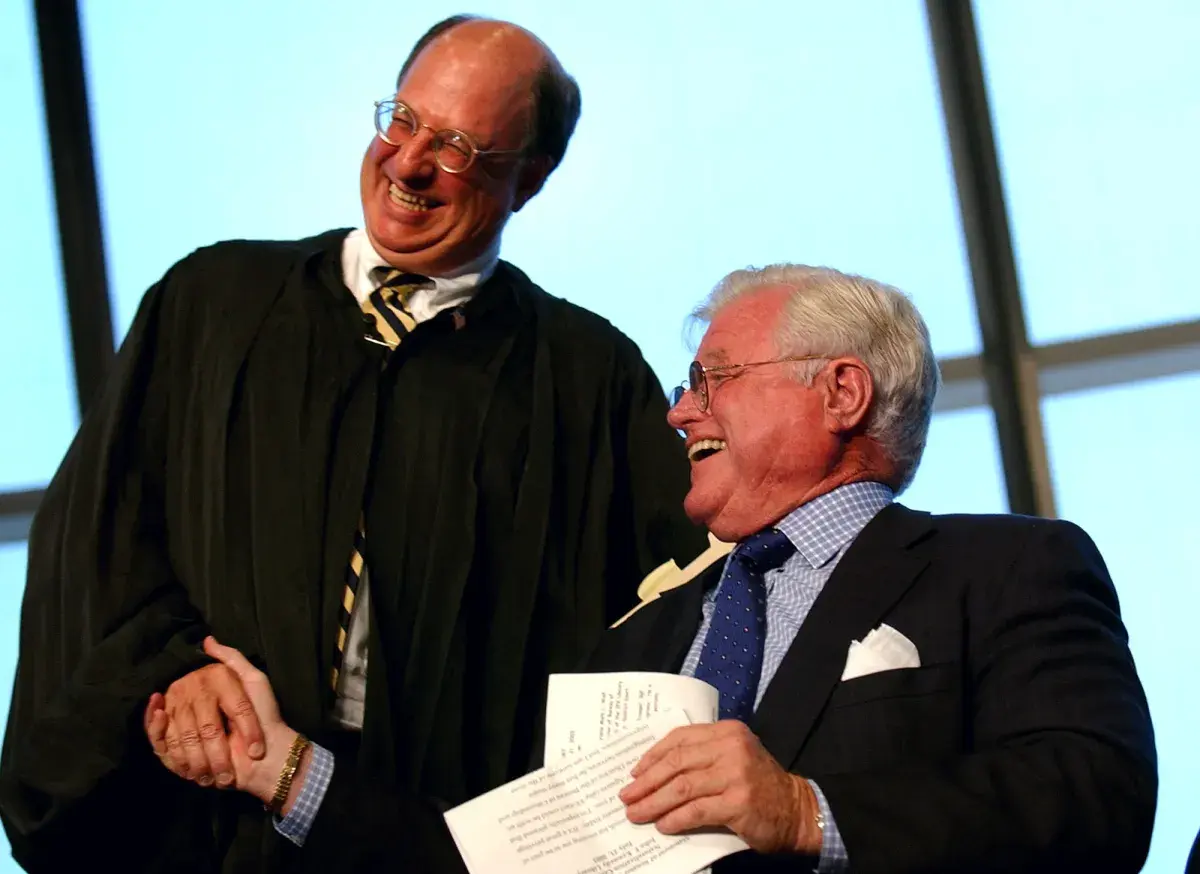
A federal judge appointed by former President Ronald Reagan has resigned from his lifetime position on Friday, issuing a scathing public condemnation of Republican President Donald Trump administration’s approach to justice and the rule of law.
Judge Mark L. Wolf, who served on the U.S. District Court in Massachusetts since 1989, announced his departure in a Sunday op-ed published by The Atlantic titled “Why I Am Resigning,” stating he can no longer abide by judicial restrictions that prevent him from publicly addressing what he characterizes as the administration’s systematic dismantling of the rule of law.
“The White House‘s assault on the rule of law is so deeply disturbing to me that I feel compelled to speak out. Silence, for me, is now intolerable,” Wolf writes.
On his commitment to protecting the rule of law after leaving the bench, Wolf wrote that he “resigned in order to speak out, support litigation, and work with other individuals and organizations dedicated to protecting the rule of law and American democracy. I also intend to advocate for the judges who cannot speak publicly for themselves.”
Newsweek reached out to the White House via email on Sunday for comment.
Why It Matters
Wolf’s resignation from the bench represents a rare break from judicial restraint by a Reagan-appointed judge, a figure typically associated with institutional conservatism and deference. His departure signals deep institutional concerns within the federal judiciary about prosecutorial independence, constitutional constraints, and the rule of law itself.
The judicial pushback extends beyond prosecution concerns to Trump’s executive orders themselves. Last month, U.S. District Judge Colleen Kollar-Kotelly, a Reagan appointee elevated by President Bill Clinton, blocked Trump’s attempt to require documentary proof of citizenship on federal voter registration forms, ruling the directive unconstitutional.
Kollar-Kotelly wrote that “the Constitution assigns responsibility for election regulation to the States and to Congress” and that “the President lacks the authority to direct such changes.” This marks the second time the 82-year-old judge has blocked Trump’s voting requirement changes, having done so in April as well. The judge’s repeated rulings demonstrate that concerns about executive overreach are not limited to prosecutorial decisions but extend to fundamental constitutional powers.
District Judge William Young in Boston, another Reagan appointee, issued a scathing 161-page ruling in October calling some Trump deportation policies illegal violations of First Amendment rights. Judge Karin Immergut in Oregon, nominated by Trump himself, also recently rejected Trump’s characterization of Portland as “war-ravaged,” concluding that the “president’s determination was simply untethered to the facts.”
What To Know
Wolf’s extensive career focused on fighting corruption and maintaining judicial impartiality. Beginning in 1974 during the Watergate crisis, he served as a special assistant to Deputy Attorney General Laurence Silberman. When President Gerald Ford appointed Edward Levi as attorney general in 1975 to restore confidence in the Justice Department, Ford directed Levi to “protect the rights of American citizens, not the President who appointed him.”
From 1981 to 1985, as deputy U.S. attorney and chief federal prosecutor for public corruption in Massachusetts, Wolf and his team secured over 40 consecutive corruption convictions, earning him the Attorney General’s Distinguished Service Award. As a judge, he presided over the prosecution of Boston mobster James “Whitey” Bulger and authored a 661-page decision detailing FBI misconduct that led to over $100 million in settlements to families of murder victims.
In his op-ed, Wolf accused Trump of directly instructing Attorney General Pam Bondi to seek indictments against three political adversaries—New York Attorney General Letitia James, former FBI Director James Comey, and California Democratic Senator Adam Schiff—despite investigators finding no proper legal basis for charges on the latter. James and Comey were later indicted.
On prosecutorial standards, Wolf writes: “What Nixon did episodically and covertly, knowing it was illegal or improper, Trump now does routinely and overtly. Because even a prosecution that ends in an acquittal can have devastating consequences for the defendant, as a matter of fairness Justice Department guidelines instruct prosecutors not to seek an indictment unless they believe there is sufficient admissible evidence to prove guilt beyond a reasonable doubt. Trump has utterly ignored this principle.”
He also highlighted the systematic dismantling of anti-corruption infrastructure, writing that Trump fired 18 inspectors general responsible for detecting fraud across federal agencies, eliminated the FBI’s public-corruption squad, and reduced the Justice Department’s public-integrity section from 30 lawyers to five. Wolf also details what he views as conflicts of interest involving Trump’s cryptocurrency venture and alleged improper financial arrangements with oil executives at Mar-a-Lago.
Additionally, Wolf raised concerns about Trump’s border czar Tom Homan, writing that Homan was reportedly recorded accepting $50,000 in cash in an FBI undercover investigation in exchange for promises to use his future position to benefit a company seeking government contracts. Wolf notes that after Trump took office, the investigation was shut down, with the White House saying there was no “credible evidence” of criminal wrongdoing.
Wolf also mentioned the president’s executive orders, writing that “a good number are, in my opinion, unconstitutional or otherwise illegal.”
“Trump’s administration also has deported undocumented immigrants without due process, in many cases to countries where they have no connections and will be in great danger,” Wolf continued. “Although many federal judges have issued orders restraining the government’s effort to implement those executive orders, some appear to have been disobeyed by members of the Trump administration. Trump has responded by calling for federal judges to be impeached, even though the Constitution permits impeachment only for ‘high crimes and misdemeanors,’ such as treason and bribery.”
What Happens Next?
Wolf’s resignation will not create a judicial vacancy as he became a senior judge in 2013. However, his public advocacy signals intensified judicial scrutiny of Trump administration actions.