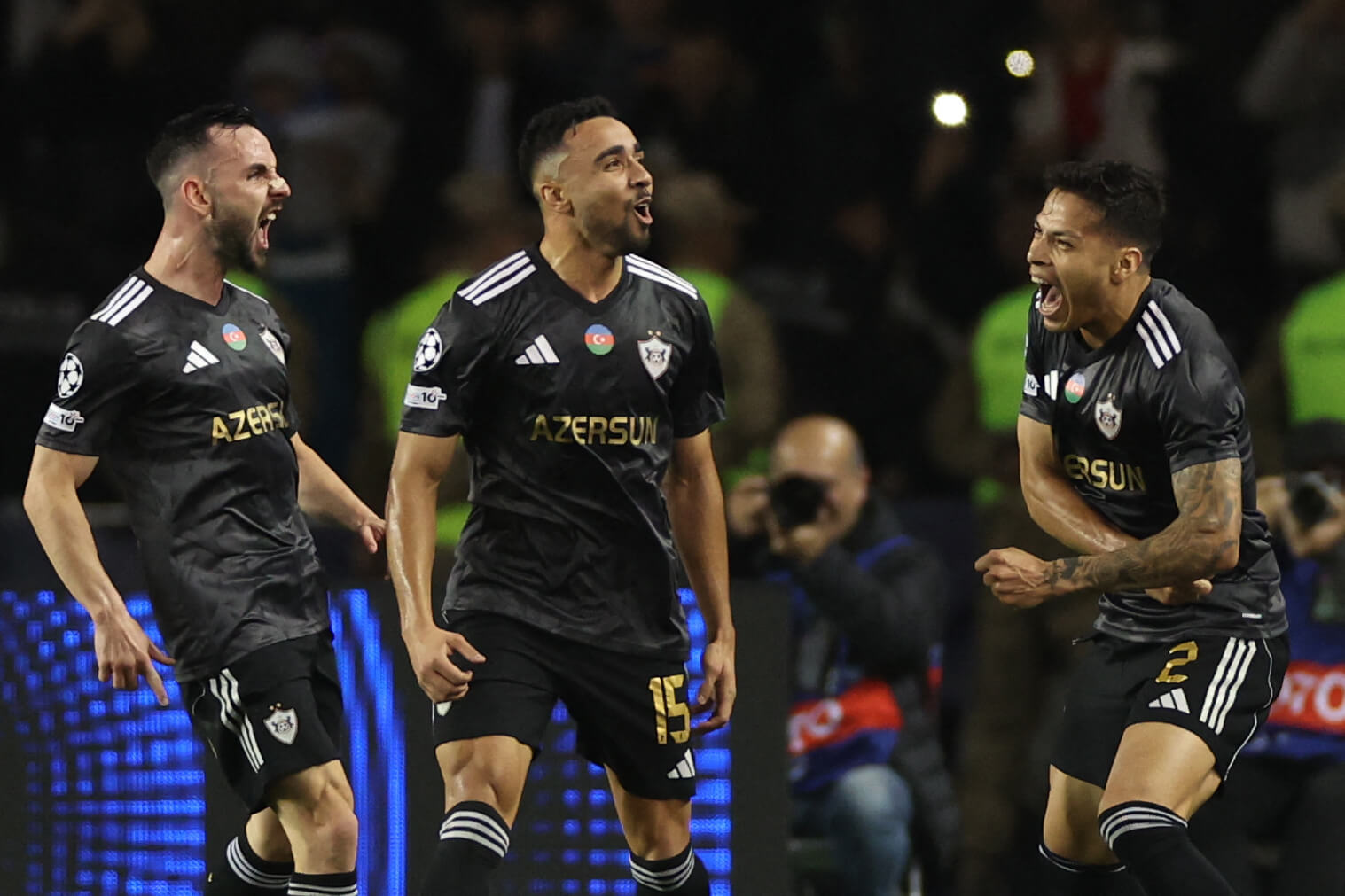
Qarabag are one of the stories of this season’s Champions League.
The Azerbaijani side are in contention for a play-off spot after a 3-2 win against Eintracht Frankfurt last week. That would mean a historic first appearance in the knockout rounds of Europe’s premier competition — but, before that, they visit Anfield to face six-time winners Liverpool.
More than 3,000 miles separate Merseyside from Baku, where Qarabag play their home games. But they are actually from Aghdam, more than 186 miles to the west of the capital, in the Nagorno-Karabakh region of the South Caucasus. This is disputed territory that neighbouring Azerbaijan and Armenia — two former Soviet states that regained independence in 1991 — each claim as its own.
Qarabag is the Azerbaijani word for this mountainous territory. In Armenian, it is known as Artsakh.
They have beaten two-time champions Benfica, held Chelsea to a draw, and now beaten 2022 Europa League winners Frankfurt in this season’s Champions League. Could Liverpool be in for a shock?
Here, The Athletic explains who they are, the background of the Nagorno-Karabakh war, and when they might return home.
Who are Qarabag?
Qarabag are the most successful Azerbaijani football club, part of a country that belonged to the Soviet Union from 1920 to 1991.
They are originally from Aghdam in the Nagorno-Karabakh region. But in 1993 the club were forced to flee, as Armenian forces seized the territory during the First Nagorno-Karabakh War between Armenia and Azerbaijan, which lasted from 1988 to 1994 as the Soviet Union disintegrated. Around 40,000 Azerbaijanis were displaced, mostly to Baku, Azerbaijan’s capital.
For three decades since, Aghdam has been a ghost town. It was returned to Azerbaijani control in November 2020 as part of the Second Nagorno-Karabakh War that year, as hostilities resumed after two and a half decades.
Qarabag never competed at the top level of Soviet football and won just one Azerbaijani league title in the first 22 years after the country gained independence. But since being bankrolled by food production conglomerate Azersun Holding — and with the help of the Azerbaijani state — they have won 11 of the past 12 titles.
They are also regulars in the main phases of European competition. Qarabag have reached the group/league stage of the Europa League or the Champions League in each of the last 12 seasons, including this one.

Leandro Andrade, centre, celebrates after scoring against Chelsea (Giorgi Arjevanidze/AFP via Getty Images)
This season has seen their best performance in Europe yet, with wins against Benfica, Copenhagen and Frankfurt and a draw against Chelsea propelling them to 18th in the table. Teams from ninth to 24th progress to a round of play-offs to reach the last 16. Qarabag are level on 10 points with Galatasaray, with nine teams behind them by three points or less, meaning they need a win to guarantee their play-off spot.
However, a game between their academy team and Chelsea, in the UEFA Youth League, was marred by allegations of racist abuse from the stands, with a video circulating on social media showing at least one fan making monkey gestures towards Chelsea players. Qarabag were later fined €5,000 and their academy were ordered to play their next UEFA competition match behind closed doors.
Qarabag’s budget is a fraction of most clubs at this level. Their record signing — Richard Almeida, who joined from Brazilian side Santo Andre in 2012 — cost €1.28million ($1.5m; £1.1m at current exchange rates). Just four players in this squad were signed for more than €500,000. They do not have a reputation for signing or developing players.
Their record sale, Brazilian forward Juninho to Flamengo, has scored just one league goal since his €5m January transfer. Another Brazilian, Kady Borges, joined Russian club Krasnodar for a reported €2m in 2023, but returned to Qarabag as a free agent this year.
The funding is significant at a national level, but their European results are undoubtedly an overachievement.
Why can Qarabag not play in their hometown?
The 1993 battle for Aghdam, between Armenian and Azerbaijani forces, lasted 11 days, with the area heavily bombed and mined — forcing Qarabag out of their hometown. The Imarat Stadium, where they played home matches, was destroyed in the conflict.
Former Qarabag manager Allahverdi Baghirov, who led the city’s Azerbaijani Popular Front Party, was among the Aghdam casualties. He was posthumously awarded the ‘National Hero of Azerbaijan’ title by the government.
Human Rights Watch (HRW) said that Aghdam was “intentionally looted and burned under orders of Karabakh Armenian authorities”. HRW acknowledged this was a war violation while adding that the destruction was comparable to the actions of Azerbaijani forces in Martakert, also in Nagorno-Karabakh, the previous year. Martakert is ethnic Armenian territory — referring to descendants from the Armenian Highlands who speak the Armenian language, share its culture and are predominantly Christian.
HRW concluded: “Serious human rights violations by both sides characterised all the above actions.”
What is the history of the Nagorno-Karabakh region?
The conflict over Nagorno-Karabakh dates to the late 19th century.
The territory lies in the mountainous South Caucasus region between the Black Sea and the Caspian Sea. This region includes the post-Soviet nations of Armenia, Azerbaijan and Georgia, alongside parts of southern Russia.
Nagorno-Karabakh is a majority ethnically Armenian enclave in a geographical Azerbaijani region. The town of Aghdam, Qarabag’s home, was predominantly Azeri — a people with a Turkic language and a majority Shia Muslim population whose culture blends Turkic, Iranian, and Caucasian elements.
From 1918 to 1920, Armenia and Azerbaijan were at war, which was brought to an end by the Soviet Union taking control in the South Caucasus, with disputed territories divided between the two states. Karabakh, one of the disputed regions, was given to Soviet Azerbaijan. The dissolution of the Soviet Union in 1991 saw regional tensions in Karabakh escalate into conflict.
By the end of the First Nagorno-Karabakh War in 1994, Armenia was in full control of the area.

Aghdam, pictured in November 2020 (Karen Minasyan/AFP via Getty Images)
The Second Nagorno-Karabakh War in 2020 brought an Azerbaijan military victory. During the conflict, then-Qarabag press officer Nurlan Ibrahimov allegedly posted on social media to call for the killing of all Armenians “old and young, without distinction”, which resulted in UEFA, European football’s governing body, issuing him a ban for life from all football-related activities.
In 2023, the entirety of Nagorno-Karabakh came under the control of Azerbaijan following a fresh military offensive.
There were then fresh developments in August, when the leaders of Azerbaijan and Armenia signed an agreement aimed at ending decades of conflict at a White House event hosted by U.S. President Donald Trump.
Trump described the ceremony as “historic”, as Azerbaijan’s President, Ilham Aliyev, and Armenian Prime Minister Nikol Pashinyan shook hands on a commitment towards a peace deal.
What are Azerbaijan’s links to football?
Azerbaijan is not a traditional football hotbed. The nation has never competed in a major tournament, and just three of its clubs played in the Soviet Top League, which ran between 1936 and 1991. It was the only Caucasus nation not to have a Soviet champion — Georgia’s Dinamo Tbilisi and Ararat Yerevan of Armenia each won the title.
Azerbaijan — south of Russia, east of Armenia, and north of Iran — is geographically situated between Europe and Asia, but is a member of European football’s governing body UEFA rather than its Asian equivalent the AFC. Azerbaijan, like Armenia and Georgia, is a former Soviet republic that competes in Europe, with the Soviet Union having been a longstanding UEFA member before its dissolution.
These nations in the area between the Black Sea and the Caspian Sea are considered to have a mix of European and Asian cultures.
Oil-rich Azerbaijan has seen the value in football for national promotion. In 2013-14, Atletico Madrid won La Liga and reached the Champions League final with the nation’s tourist board sponsoring their kit.

Diego Godin after scoring the goal against Barcelona that gave Atletico Madrid the La Liga title in 2014 (Alex Livesey/Getty Images)
Baku hosted four matches at the delayed Euro 2020, alongside the 2019 Europa League final between Chelsea and Arsenal. Henrikh Mkhitaryan, Armenia’s highest-profile footballer who, at the time, played for Arsenal, decided not to travel due to safety concerns. The Azerbaijan FA (AFFA) said it was “disappointed” with Mkhitaryan.
HRW said before the final that Azerbaijan’s foray into football was designed to “whitewash their image”. Amnesty International said the nation was attempting to “sportswash its appalling human rights record” by hosting high-profile games. Football Supporters Europe commented on Azerbaijan: “The human rights situation is critical”.
When might Qarabag return home?
In December 2023, Azerbaijan’s president, Ilham Aliyev, pledged that his government would oversee Qarabag’s return to Aghdam. The president laid the foundation stone at the club’s destroyed old Imarat Stadium to show his commitment to the project.
Qarabag coach Gurban Gurbanov has welcomed Aliyev’s plans. “I will be happy when Qarabag return to our Qarabag land,” he told BBC World Service in August. “To play against European teams in Aghdam would make the people happy. As a soldier, I am happy.”

Gurban Gurbanov speaks to his squad (Giorgi Arjevanidze/AFP via Getty Images)
But the region remains one of the most heavily mined areas in the world due to the widespread planting of the explosive devices during the Nagorno-Karabakh conflict. Azerbaijani authorities are actively trying to clear the mines.
At present, the Azerbaijani government is funding the construction of highways and a rail route to connect Aghdam, restoring power and water supplies, with residential areas to be built around the area.
Qarabag claim that Aghdam has “a real and tangible prospect” of hosting Champions League football in the near future. The club have not put a timescale on their return, insisting they will only do so once the city’s population can go back.
The plan is to build a UEFA Category IV stadium — providing the most comprehensive facilities for players, VIPs, and media — which could host European heavyweights in the future.