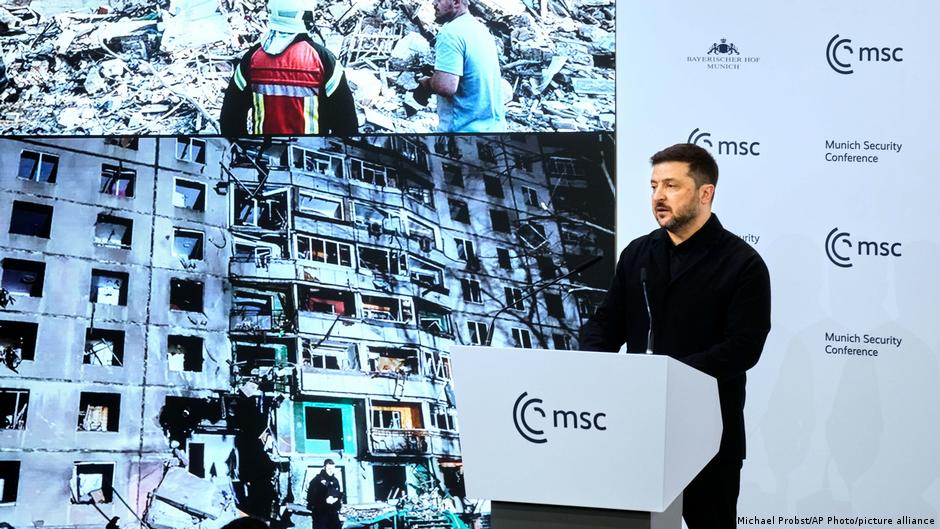
Ukrainian President Volodymyr Zelenskyy has called on Western allies to speed up weapons deliveries to his country. Speaking at the Munich Security Conference (MSC) on Saturday, he argued that there were cases in which missiles to ward off Russian airstrikes were delivered “just before an attack and sometimes at the last very last moment.”
In January alone, he added, Russia had attacked Ukraine with an estimated 6,000 combat drones.
The Ukrainian president went on to thank the West for its support, but added that his country urgently needed more anti-aircraft missiles — particularly to protect Ukraine’s power supply from Russian attacks amid an icy winter.
NATO Secretary-General Mark Rutte backed Zelenskyy’s appeal. “Keep them [Ukraine] strong in the fight,” he said at an MSC panel discussion after Zelenskyy’s remarks . “They will do it [the fighting], but they need our support.”
Rutte added that Russia was currently not winning the war in Ukraine, and had lost some 65,000 troops in the past two months. “They make very small gains,” Rutte said. “So small that it’s almost not relevant.”
On Thursday, Rutte announced that NATO states had pledged hundreds of millions of dollars for Ukraine’s urgent military needs enumerated in the so-called Prioritized Ukraine Requirements List (PURL). Under the PURL initiative, NATO members buy military equipment from the US for Ukraine. According to Rutte, nine out of 10 anti-aircraft missiles in use in Ukraine have bee purchased through this scheme.
The PURL initiative has been NATO’s attempt to appease US President Donald Trump, who is reluctant to provide US aid, but eager to sell US weapons.
Talks planned in Geneva
US Secretary of State Marco Rubio, meanwhile, only mentioned Ukraine in passing during his highly anticipated speech. Instead, he spoke of peace that was difficult to achieve. “We don’t know the Russians are serious about ending the war,” he said.
Russian, Ukrainian and US representatives are expected to meet in Geneva next week to discuss an end to the war in Ukraine. The US had previously mediated similar talks in Abu Dhabi — without success.
Speaking in Munich, Zelenskyy said he hoped the upcoming talks in Geneva would be “serious and substantive.”
“The Americans often return to the topic of concession, and too often those concessions are discussed in the context only of Ukraine, not Russia,” he said.
Zelenskyy added that he also felt US pressure when it came to the topic of elections. Trump has joined Moscow’s calls for early presidential elections in Ukraine, despite Ukraine’s constitution prohibiting elections when martial law is in effect.
“Give us two months of ceasefire. We will go to elections,” Zelenskyy told his audience at the MSC.
Europe to increase defense capabilities
Zelenskyy also repeated his warning that Russian President Vladmir Putin might also attack other European countries. “Can you imagine Putin without war?” he asked. “Be honest.”
“Right now his focus is on Ukraine […] but he will not let other European nations go either,” Zelenskyy argued. “[Putin] cannot let go of the very idea of war. He may see himself as a czar but in reality he is a slave to war.”
While speaking with DW in Munich, Polish Foreign Minister Radsloav Sikorski voiced similar concerns. “In Poland, we think that if Putin succeeded in conquering Ukraine, we would be next,” he said.
Many speaking at this year’s MSC have stressed that, in light of Russian aggression under Putin, Europe needed to beef up its defenses and decouple from US dependencies.
In his opening speech on Friday, German Chancellor Friedrich Merz reiterated his pledge of turning German forces, the Bundeswehr, into the strongest conventional army in Europe.
Also on Friday, French President Emmanuel Macron said it was time to turn Europe into a “geopolitical power,” while British Prime Minister Keir Starmer called for more “hard power” and “a shared industrial base across our continent which could turbocharge our defense production.”
The road may still be long, but at the MSC, it appears European leaders may have at least agreed upon the destination.
This story was originally written in German.