There’s a line from classic film you could paraphrase when talking about Premier League teams and their supposed dominance of European football.
In this competition, you gotta make the money first. Then when you get the money, you get the power. Then when you get the power, you get the trophies. Or something like that.
This week has offered a reminder that, while the Premier League certainly has the money and, in the transfer market, undoubtedly has the power, it doesn’t yet have the dominance of European football that some might have you believe.
The Champions League last-16 ties are only at the halfway stage and no team has progressed or exited yet, but no victories in six first-leg ties and an aggregate score of Europe 16-6 Premier League are humbling numbers for English football.
Five of the six were playing away from home, which must be taken into account, as must the circus that is Tottenham Hotspur Football Club. However, watching Manchester City swept aside by perennial Champions League specialists Real Madrid, or Chelsea wilt against last year’s winners Paris Saint-Germain, or even Arsenal labour to a 1-1 draw at Bayer Leverkusen, stirred echoes from previous European campaigns at this time of year.
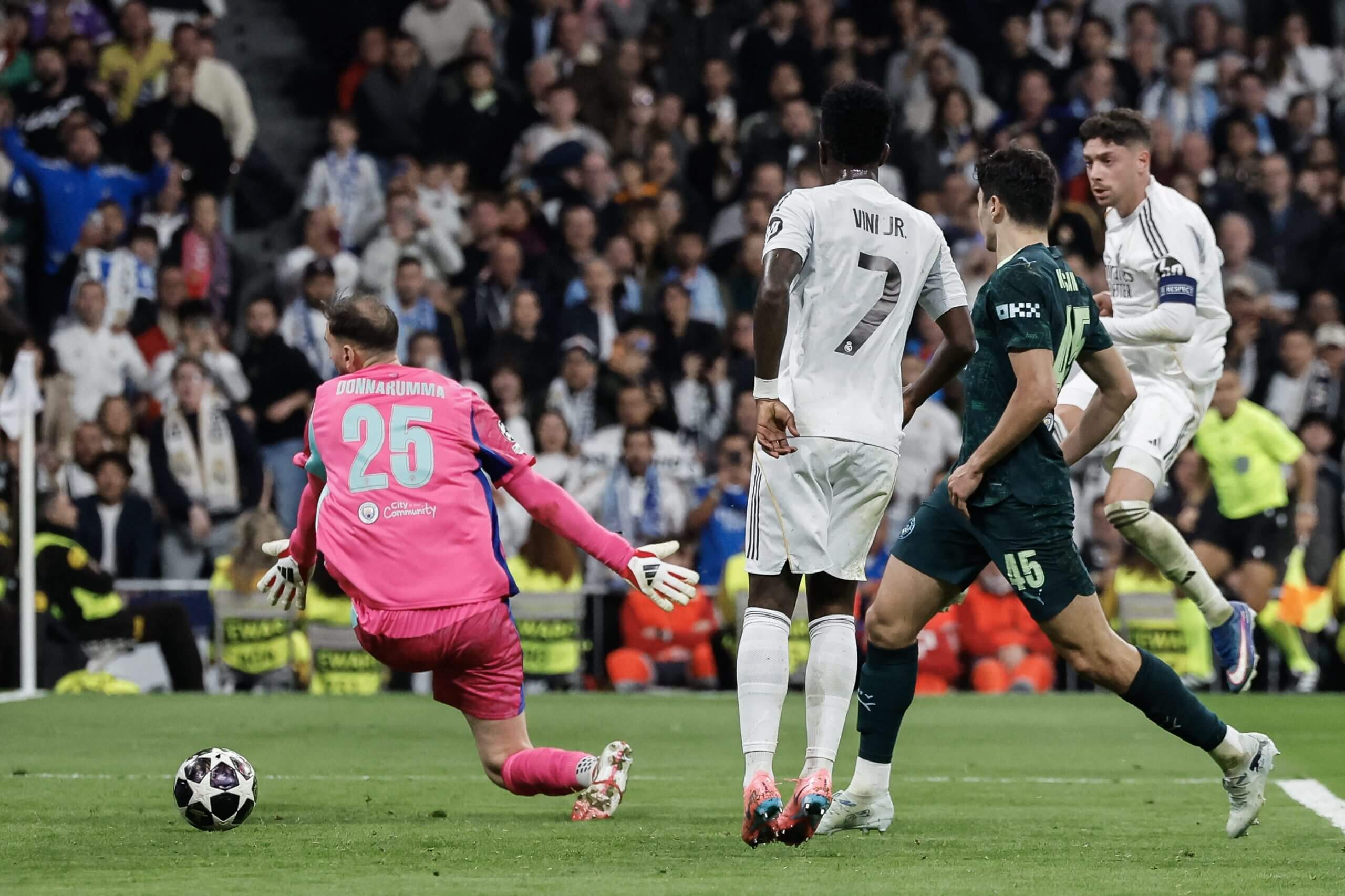
They looked knackered, frankly — exhausted in both mind and body. Hence the litany of defensive mistakes and of conceding goals in quick succession; Chelsea leaked two late goals to turn a slender PSG advantage into a daunting one, Manchester City were bulldozed by three Federico Valverde goals in 22 minutes and Spurs were 4-0 down after 22 minutes.
Federico Valverde drills in Real Madrid’s third goal against Manchester City (Oscar Del Pozo/ AFP via Getty Images)
Given the Premier League is probably still the fastest and most intense league in Europe, and possibly the world, as we get towards the business end of the season, fatigue is inevitable. Replicating that intensity every single match is impossible and performances will drop off as injuries and tiredness build. We’ve seen it time and again.
For English club teams and, indeed, the national side there is a sense that players are at breaking point. Throw in a massive Club World Cup featuring Chelsea and City last summer, a Nations League and bigger Champions Leagues, Europa Leagues and World Cups to the calendar, these problems are only going to be exacerbated for footballers already subjected to the grind of a physical, fast-paced division.
Unlike their European rivals, assistance with the schedule is rarely forthcoming. While Chelsea spent their weekend being pushed all the way to the end of extra time by a Championship club in Wrexham, PSG were given the weekend off after opponents Nantes and the LFP (Ligue de Football Professionnel) agreed they could rest ahead of the tie, an alien concept in England.
While Bayern Munich cruised to a 4-1 home win over Borussia Monchengladbach, a match moved to Friday night to give them an extra 24 hours to prepare for Tuesday’s trip to Atalanta, Newcastle United and Manchester City went head to head late on Saturday evening for their FA Cup fifth round clash.
But it isn’t just the timing of fixtures where some European clubs are occasionally helped more than Premier Leagues sides; the brutal competitiveness of the Premier League is clearly a hindrance.
In a league where even a team that was heading for one of the worst top flight point tallies in history in Wolverhampton Wanderers can claim four points off two Champions League sides (Arsenal and Liverpool) in two weeks, the old adage of ‘no easy games’ feels like it rings true more than ever.

Even Wolves can make Arsenal’s life hard in the Premier League (Paul Ellis/ AFP via Getty Images)
On the weekend of January 24-25, Liverpool lost at Bournemouth, Spurs drew at Burnley and Newcastle were beaten at home by Aston Villa. In the Champions League, either side of that weekend, Liverpool beat Marseille and Qarabag (with an aggregate score of 9-0), Spurs comfortably saw off Borussia Dortmund and Eintracht Frankfurt 2-0 (their only wins of the calendar year, having gone winless in 12 domestic matches) and Newcastle hammered PSV 3-0 and drew 1-1 away at PSG.
At the time, most English clubs were breezing through their European matches, with five finishing in the top eight of the league phase of the Champions League and a record nine then making it through to the knockout stages of the three European competitions.
It may have been tempting from those numbers to claim that England unequivocally has the best teams and/or the strongest league on the continent. But that claim remains exactly that until English clubs dominate the winners’ lists, which at the moment they are nowhere near doing.
In the last five seasons, of the 10 Champions League finalists, three have come from England, with two winners (Chelsea in 2021, Manchester City in 2023). Spain has the same number of winners (Real Madrid in 2022 and 2024).
The last five Europa League finals yield similar numbers; three English finalists of 10 and one winner (Spurs last season). Spain, again, has two winners (Villarreal in 2021, Sevilla in 2023).
Based on those numbers, there is no English dominance in European football. Not even close.
Dominance is what La Liga achieved in the mid-2010s, when from 2013 to 2018 nine of the 10 Champions League and Europa League titles went to Spanish clubs (four Champions Leagues for Real Madrid and one for Barcelona, plus three Europa Leagues for Sevilla and one for Atletico Madrid).
In terms of consistently cracking Europe, that has been beyond English teams, either collectively or as individual clubs. Even Pep Guardiola, whose Manchester City team have dominated domestically during his time in England with six Premier League titles in his nine completed seasons to date, has only guided City to two finals and one semi-final in that time, a record he will now struggle to improve given their 3-0 deficit from the Bernabeu.

Pep Guardiola has found the Champions League tough going with City (Florencia Tan Jun/Getty Images)
If Guardiola leaves City this summer, his ratio of umpteen domestic titles but only one Champions League win in 10 seasons will roughly mirror that of Sir Alex Ferguson at Manchester United, who mostly managed at a time when English clubs were considered inferior to their European rivals.
Mikel Arteta, who saw his team Arsenal-d by a Bayer Leverkusen corner kick routine, was asked if their 1-1 draw in Germany was a reminder of how difficult it is to win the Champions League.
“Yes, and how difficult it is to win against any opponent in the competition and especially away from home,” he said. “There is a big factor there. Then you realise what we’ve done to win it, this competition, because it’s so tough that nobody did it before.
“Fully aware of that, we knew the importance of the game and the difficulty of the opponent and now we need to finish it in London.”
Before that, they’ve got Everton at home. Never an easy prospect. Chelsea and Newcastle may want to rest players this weekend ahead of their crucial second legs next week; instead they’re playing each other. Spurs travel to Liverpool on Sunday desperate for points in their relegation battle while the hosts need them to qualify for next season’s Champions League, and Manchester City are away at a rejuvenated West Ham knowing they cannot afford another slip in the title race. It’s relentless.
Arsenal may well finish the job in London next week, Chelsea, Spurs Manchester City may produce miracles in their second legs, Liverpool may come from behind to beat Galatasaray and Newcastle could produce one of the greatest results in their history in Barcelona.
But, as Bayern, Real Madrid and PSG, who share the financial might of Premier League clubs but not their exhaustion, decisively moved through the gears when it really mattered this week, English clubs generally did the opposite. History tells us that’s no surprise.