Another weekend boxed off, and the Premier League narratives continue to be written.
With Arsenal without a win in three league games, is their title charge beginning to wobble? Could Aston Villa continue to stick in the three-horse race for the rest of the season? Are West Ham United building enough momentum to escape relegation?
Liverpool and Tottenham Hotspur have not tasted league victory in five games, piling more pressure on Arne Slot and Thomas Frank. Spurs’ 2-2 draw with Burnley was the only game that saw the points shared this weekend, with each side continuing to take points off each other at an unpredictable rate.
There has been plenty of drama, quirks, and perfectly executed goals, so allow The Athletic to open up this week’s Premier League data notebook.
This title race is truly heating up
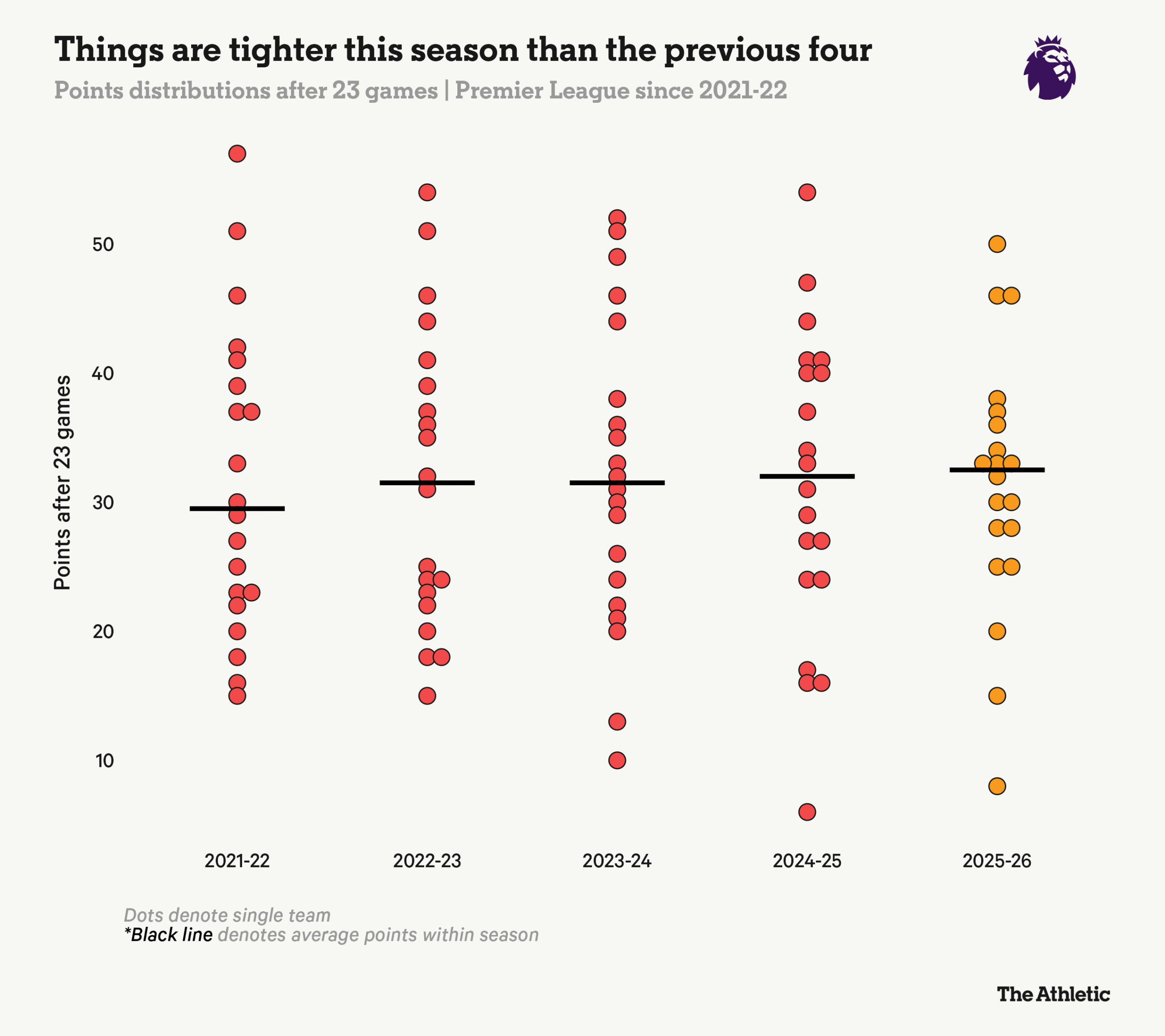
It has been the theme of this season, but the Premier League table remains as congested as ever across some crucial positions. European spots are still up for grabs for more than half of the division, with just seven points separating Chelsea in fifth (37 points) and Bournemouth in 13th (30 points).
Looking at the spread of points across the entire league compared with previous campaigns at this stage, this season is — statistically speaking — the most compact it has been for quite some time.

This weekend has also made things tighter at the top, as Manchester City and Aston Villa closed the gap on Arsenal to just four points, after the leaders’ 3-2 home defeat to Manchester United.
With 15 games remaining, sights are now firmly set on each side’s run-in for their remaining fixtures.
While Unai Emery continues to downplay their credentials, Aston Villa can no longer play the role of stealthy underdog, particularly with a favourable run of fixtures ahead.
According to Opta’s Power Rankings, Villa face the easiest schedule in the league over the next 10 matches. On Sunday, they host eighth-placed Brentford, the highest-ranked opponent across their next five games.

Among the other title contenders, Arsenal edge Manchester City for fixture difficulty, even if the idea of an “easy” game all but disappears at this stage of the season.
Sunderland’s contrasting fortunes
Sunderland’s travelling fans will have been disappointed with a 3-1 defeat to West Ham United in Saturday’s early kick off, but away days have come with different expectations this season.
Regis Le Bris’ side have had an incredible campaign on their return to the Premier League, and it is even more impressive given how their home form contrasts with their results on the road.
The stereotyped view that a promoted side need to make their home ground a fortress has never rung more true for Sunderland this season. They remain the only undefeated Premier League side on home turf, with a rate of 2.1 points per game bettered only by Aston Villa, Arsenal and Manchester City (2.4 per game).

Regis Le Bris’ side have not enjoyed their away trips as much as their home games this season (Julian Finney/Getty Images)
When looking at their home advantage ratio — calculated as the comparison between goals scored and conceded when home versus away — Sunderland comfortably lead the league in their contrasting fortunes, ahead of fellow promoted side Leeds United.
In attack, they are almost three times more likely to find the back of the net at home, scoring 1.6 goals per game compared with their away return (0.5 per game). Defensively, 1.4 goals conceded on their travels is notably higher than the robust defence at the Stadium of Light (0.8 per game).
Incidentally, Everton, Chelsea, Spurs and Crystal Palace are the only four teams who do not have dominant output on home soil — performing marginally better away from home this season.

Centre-back goalscorers are on the rise
Tottenham cannot be picky about where their goals come from, given their recent poor form, but their continued reliance on centre-backs to score points to wider attacking issues.
On Saturday, Micky van de Ven opened the scoring against Burnley before his central defensive partner Cristian Romero salvaged a point in the 90th minute with a powerful header.

That takes Spurs to eight league goals scored by centre-backs, four more than any other side and accounting for 25 per cent of their total goals (excluding own goals). “It’s fantastic, two defenders scoring again. That is very positive, but of course, you need more from the offensive players,” said head coach Thomas Frank after the match.
Across the league, centre-backs have contributed 50 goals in total, accounting for 8.9 per cent of all Premier League goals, the highest share since 2021-22. With set-piece goals up sharply this season, that rise is not entirely surprising. Still, it is not a trend typically associated with successful sides.
Over the past seven seasons, six teams have had more than 20 per cent of their goals scored by centre-backs — and none of them finished higher than 10th.

A quarter of Tottenham Hotspur’s goals this season have come from centre-backs (Molly Darlington/Getty Images)
Harry Wilson cannot stop scoring
Are there many players in better form than Fulham’s Harry Wilson?
A stoppage-time free kick saw the 28-year-old clinch three points against Brighton on Saturday, making it four goals in his last five games in all competitions. It takes the Wales winger to eight Premier League goals for the season, beating his previous best of seven, achieved on loan at Bournemouth in 2019-20.
As his shotmap below shows, Wilson does not do tap-ins. Instead, he prefers to lean on technique and unerring placement to find the back of the net — with an average shot distance that sits outside the dimensions of the penalty area.

“I’ve hit a really good run of form from the end of November until now, but before that I felt like I was playing well and I felt really fit,” Wilson told BBC Sport after the victory.
“Maybe my numbers were not quite as good as what I wanted, but as an attacker, you’re judged on those numbers. So when you’re in this kind of form and you’re helping the team — through goals or assists — then it’s an amazing feeling.”
Saturday’s finish also made it six goals from outside the box for Wilson since the start of 2023-24. Only five players (Cole Palmer, Matheus Cunha, Callum Hudson-Odoi, Bruno Fernandes and Phil Foden) have scored more in that time.
He might defy the odds with his finishing at times — with nine goals more than his expected goals tally since 2019-20 — but the technical ability that Wilson possesses in his left foot means no goalkeeper is safe when he looks up to shoot from distance.

Harry Wilson bends home against Brighton on Saturday to take Fulham up to seventh (Clive Rose/Getty Images)
Talking of goals from distance…
Wilson’s free kick highlighted another clear trend this season: more goals from outside the box.
Across the weekend’s fixtures, there were six strikes from range, the second-highest total in a single Premier League matchweek this season. Dominik Szoboszlai also converted a set piece for Liverpool against Bournemouth. Emiliano Buendia’s vicious strike took Aston Villa to a league-high 13 goals from outside the area.
For Manchester United, spectacular efforts from Patrick Dorgu and Cunha helped secure their win against Arsenal, while Mateus Fernandes’ stunning opener set West Ham on their way to their much-needed victory against Sunderland.
The Premier League is now averaging four goals from outside the box per matchweek, higher than in any of the last seven seasons, dispelling the notion that data analytics is discouraging long-range efforts. It is not only the volume that is up, but the accuracy too. As the chart below shows, conversion rates have peaked at 5.2 per cent this season.

Unsurprisingly, Aston Villa lead the way here, with a staggering 13.2 per cent conversion rate from outside the box. Attacking midfielder Morgan Rogers put that down to design rather than chance. “We are not taking pot-luck shots,” he told Sky Sports.
Whether this season’s long-range accuracy proves a temporary spike or something more lasting, the wonder strike is not going into hibernation any time soon.