Key Points
Tesla (NASDAQ: TSLA) is now a $1.3 trillion behemoth. How did it attain such a tremendous market cap? There are many reasons, but the latest catalyst is arguably the company’s rising status as an AI stock.
For decades, the trick to enabling self-driving cars was thought to lie in cameras and sensors. But today, artificial intelligence (AI) is increasingly viewed as the “golden ticket” to achieving fully autonomous vehicles.
Will AI create the world’s first trillionaire? Our team just released a report on the one little-known company, called an “Indispensable Monopoly” providing the critical technology Nvidia and Intel both need. Continue »
While Tesla may very well be able to back up its lofty $1.3 trillion valuation, there are other smaller EV stocks with rising AI exposure worth a closer look. In fact, one company is ramping its AI investments aggressively. Yet the market still doesn’t recognize it as a bona fide AI stock, resulting in a cheap valuation that patient investors can take advantage of.
Like Tesla, Rivian is betting big on AI
Earlier this year, Tesla agreed to invest $2 billion into xAI, Elon Musk‘s artificial intelligence start-up. According to Reuters, the news “supported Musk’s plan to pivot Tesla from an electric vehicle maker to an AI company, which is key to the company’s roughly $1.5 trillion valuation.” With AI proving more and more important for developing fully autonomous driving features, a direct partnership between Tesla and xAI made a lot of sense both on paper and in terms of practical deployment.
Alongside the announcement, Musk also noted the growing shortage of AI chips worldwide. Because chips are necessary for running AI applications, he suggested Tesla would explore manufacturing its own chips. “If we don’t do that, we’re just going to be fundamentally limited by the supply chain,” he stressed. “In a worst-case geopolitical situation, it would be quite a severe situation.”
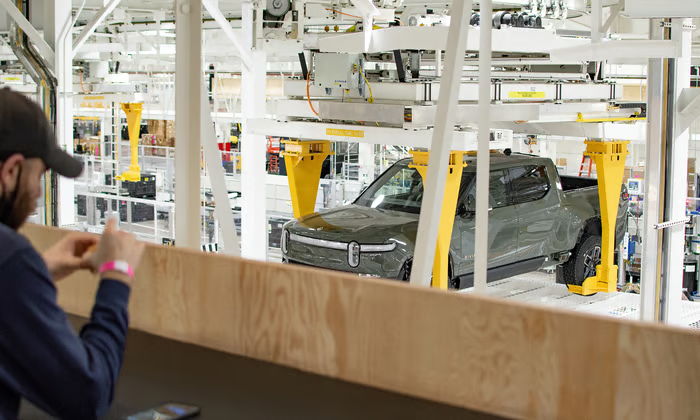
Image source: Rivian.
While Rivian (NASDAQ: RIVN), a competing EV manufacturer, didn’t get as much publicity for its recent AI announcements, it too is pursuing a very similar strategy to Tesla. Last December, the company hosted its first AI day, outlining how important the emerging technology will be for its growth.
If full autonomy is achieved by a competitor, customers may flock to those vehicles, generating even more data for that company, further entrenching their first-mover advantage. By investing in its own AI capabilities, Rivian can ensure that it isn’t left behind in the race for autonomy, even if it isn’t strictly first to achieve full autonomy. This way, its long-term competitiveness remains intact, and the company isn’t forced to pay outside suppliers for a feature that is critical for buyer satisfaction.
What exactly is Rivian doing on this front? The company created a new investment vehicle focused on applying AI to factory efficiency. It’s further developing its own in-vehicle AI assistant. It’s launching a new “Universal Hands-Free” feature on select models to generate more real-world data to train its models. And, as Musk teased will be the case for Tesla, it is pursuing the manufacturing of its own AI chips.
There’s a long way to go to see if Rivian’s AI bets will pay off. But right now, the company is valued below $20 billion. If the market builds confidence in its AI future, that valuation could quickly look like a bargain.
Should you buy stock in Rivian Automotive right now?
Before you buy stock in Rivian Automotive, consider this:
The Motley Fool Stock Advisor analyst team just identified what they believe are the 10 best stocks for investors to buy now… and Rivian Automotive wasn’t one of them. The 10 stocks that made the cut could produce monster returns in the coming years.
Consider when Netflix made this list on December 17, 2004… if you invested $1,000 at the time of our recommendation, you’d have $532,066!* Or when Nvidia made this list on April 15, 2005… if you invested $1,000 at the time of our recommendation, you’d have $1,122,072!*
Now, it’s worth noting Stock Advisor’s total average return is 960% — a market-crushing outperformance compared to 193% for the S&P 500. Don’t miss the latest top 10 list, available with Stock Advisor, and join an investing community built by individual investors for individual investors.
*Stock Advisor returns as of March 5, 2026.
Ryan Vanzo has no position in any of the stocks mentioned. The Motley Fool has positions in and recommends Tesla. The Motley Fool has a disclosure policy.
The views and opinions expressed herein are the views and opinions of the author and do not necessarily reflect those of Nasdaq, Inc.