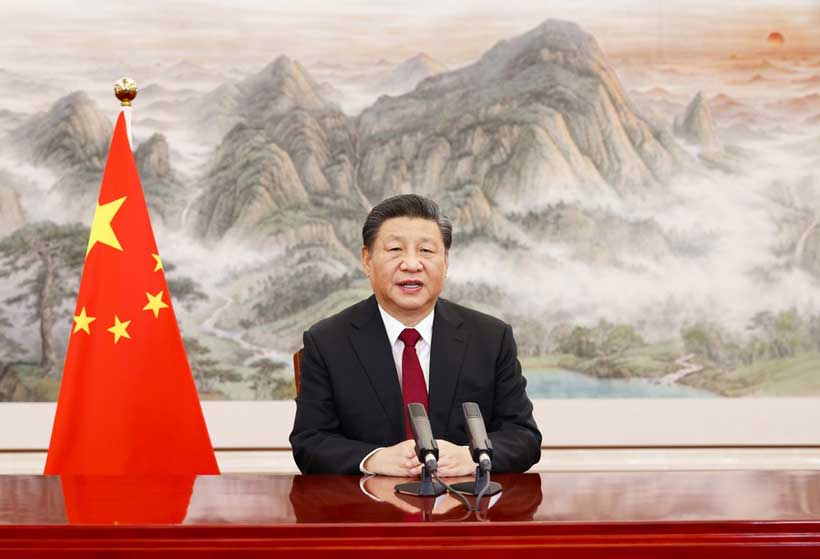
In China’s political history, ideology has always played a central role in shaping social order and legitimizing political power. In times of crisis, when the legitimacy of the ruling class is challenged, the role of ideology becomes even more decisive. In the 14th century, Zhu Yuanzhang, after overthrowing the Yuan Dynasty, faced the problem of consolidating a young dynasty, in which Confucianism became the foundation for shaping order and legitimizing his power. Six centuries later, another “emperor”—Xi Jinping—came to power in the context of China’s deep integration into globalization but at the same time faced a legitimacy crisis after reform and opening up and challenges from geopolitical competition. Xi also chose to rely on an ideology to consolidate his personal power and the legitimacy of the Communist Party.
The common point of both leaders is the thorough use of political ideology as a tool of social governance but also as a mechanism to legitimize power. While Zhu Yuanzhang made Confucianism the official value system, Xi Jinping placed socialist ideology at the center of political life and directly linked it to his leadership role.
According to sociologist Max Weber, political power is only truly sustainable when it is linked to “social confidence in its legitimacy.” In China, that confidence is rarely based solely on legal institutions or economic performance but is often anchored in an orthodox ideology. Confucianism in feudalism and socialism in the modern era both provided traditional legitimacy, provided a legal framework for the state, and were tied to the individual figure of the leader. Scholars emphasize that ideology in China has never been limited to philosophy but has always been a “logic of power” and an indispensable element of governance.
Emperor Zhu Yuanzhang, who came from a poor peasant class, needed a foundation to legitimize his new dynasty after defeating the Yuan Dynasty. Confucianism, which had been strongly revived during the Song Dynasty, provided him with a political-moral value system to shape the social order. He quickly restored the imperial examination system, recruited officials according to Confucian standards, and established Confucianism as orthodoxy, forcing all officials and people to refer to this value system. Through Confucianism, the emperor became the “son of heaven”—the one who ruled the world on behalf of Heaven—while officials and people were bound by the obligations of “loyalty,” “filial piety,” and “rituals.” In this way, Zhu Yuanzhang both legitimized his commoner origins and created a solid political foundation for the Ming Dynasty. However, the absolutization of this ideology also led to despotic consequences. Emperor Zhou carried out many purges of meritorious officials or talented officials that he thought would threaten his power and built a model of absolute imperial power.
If Zhu Yuanzhang faced a legitimacy crisis after the chaos of war, Xi Jinping must deal with a crisis after three decades of reform. During the Deng Xiaoping era, the Party’s legitimacy shifted from ideology to economic growth. But as growth slowed, inequality increased, and corruption spread, the model’s limitations were exposed. Under such pressure, Xi sought to re-legitimize his power by affirming Marxism–Leninism and “Mao Zedong Thought,” the “Three Represents,” and the “scientific outlook on development” of his predecessors as foundations, and he put forward “Xi Jinping Thought on Socialism with Chinese Characteristics for a New Era.” Since taking power in 2012, President Xi has declared that China needs to “restore ideological confidence.” He stressed that “Marxism remains the guiding compass and must not be shaken.” This ideology is enshrined in the Party’s constitution and official documents, becoming a guiding principle for the entire political system. At the same time, the concept of the “Chinese Dream” evokes the aspiration for national rejuvenation, creating a combination of socialism and nationalism. Through this, Xi links the legitimacy of the regime to his own role as the core leader.
Xi’s socialist ideology has been disseminated through multiple channels: the education system, the media, the Internet, mandatory political courses, and anti-corruption campaigns. Xi’s most famous anti-corruption campaign, “Swatting Tigers and Flies,” has been described as both a fight for morality within the Party and a purge of political opponents. As a result, Xi Jinping has abolished constitutional term limits, effectively consolidating his personal power in a way not seen since Mao Zedong. Ideology has thus become the pillar not only of the regime but also of his personal power as he seeks to be revered as a leader.
Comparing the two cases, one can see deep similarities in the way Emperor Zhu Yuanzhang in the past and President Xi Jinping today use ideology to legitimize power.
First, both turned an ideology into an absolute orthodoxy: Confucianism under the Ming Dynasty and socialism with its own characteristics under Xi. Second, the leaders tied their power to ideology: Zhou was the Confucian son of heaven, while Xi was the “leadership core” tied to socialist ideology. Third, ideology was used to control society: Zhou imposed morality and ritual through imperial examinations, and Xi used communication technology and the Internet to shape the ideological space. The final common point is that both relied on ideology to consolidate power in order to deal with the chaos that could arise when the legitimacy of the government was not sufficient. For example, Zhou had to stabilize society after the collapse of the Yuan Dynasty, and Xi had to deal with the economic crisis in the era of globalization.
However, there are also important differences. Confucianism is traditional, emphasizing morality and family-social order, while socialism with Chinese characteristics is modern, combining Marxism-Leninism with Chinese nationalism. Confucianism mainly serves the goal of domestic politics and social stability, while socialism with Chinese characteristics is associated with global ambitions, especially through the “Belt and Road Initiative” (BRI). The means of dissemination are also different in each period, from imperial examinations and rituals under Zhu Yuanzhang to digital technology, social networks, and mass media under Xi. The image of the leader has therefore changed from an “emperor” who saved the people from chaos to a modern leader leading China to revive the “dream” in global competition.
The consequences of relying on a single ideology to legitimize power should also be emphasized. Confucianism helped the Ming Dynasty stabilize society, but it also legitimized autocracy and led to conservatism and backwardness compared to the times. Socialism with special characteristics helped Xi Jinping consolidate his legitimacy but at the same time increased dictatorship and limited ideological pluralism in Chinese society. This tradition of “ideologizing” politics reflects the continuity of China’s governance model, where power always needs a set of values as its pillars.
From Zhu Yuanzhang to Xi Jinping, Chinese history shows a remarkable succession, with ideology chosen not only as a means of social regulation but also as a basis for legitimizing political power. If Confucianism provided Zhu Yuanzhang with the tools to transform a commoner into a legitimate emperor, then socialism with Chinese characteristics allows Xi Jinping to re-legitimize the Communist Party in a new context of change. Both cases demonstrate the close combination of personal power and official ideology, while also pointing out the limits of this model: short-term stability can be exchanged for long-term pluralism and flexibility.
This comparative analysis helps us gain a comprehensive perspective to better understand the “tradition in modernity,” “continuity,” and “inheritance” of Chinese politics. Despite the changing times, the reliance on ideology as a legitimizing pillar continues, from feudal Confucianism to distinctive socialism. This affirms that, to deeply analyze current Chinese politics, we cannot only look at economic factors or military power but must focus on the role of ideology as well as traditional inheritance as a mechanism to legitimize power.