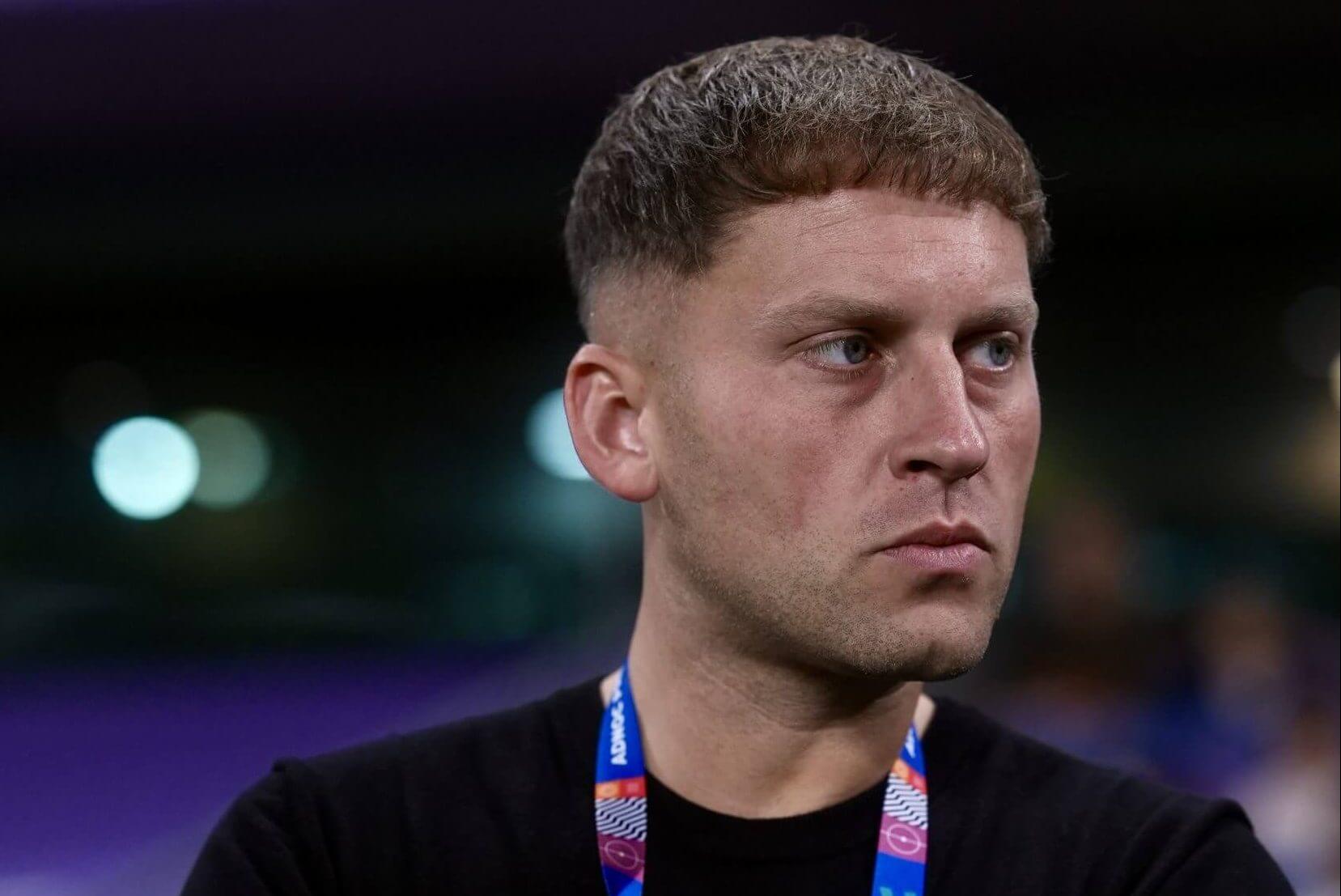
Considering the role of a player liaison officer or, in Matt Bennett’s case, head of first-team operations, the answer was predictable.
“The phone has always got to be on,” Bennett says, when asked by The Athletic if he can ever afford a period of complete downtime. “You have to take the call, and sometimes it’s a call that you don’t need, or it’s bad news. With experience, especially if it’s bad news, you know how to react. You know how to stay calm — that’s a big part of the role.
“You could be working from 6am to midnight. Football is a very demanding job, especially when you have the responsibility of 60 to 100 people travelling, and it’s on your head should anything go wrong.”
Bennett left Aston Villa after six successful years as head of first-team operations last May, by which time he had broadened his remit from when he initially came into football in 2017 as a player liaison officer at Hull City, having seen the post advertised while teaching Spanish and German at a school in the area.
Even as head of first-team operations at Villa there was still a responsibility towards player support and care, but the role largely focused on the logistical and practical needs of the club’s senior side.
It was a demanding, all-encompassing job, with no two days the same. Bennett’s last match at Villa was the painful defeat at Old Trafford on the final day of last season, which meant they missed out on Champions League football on goal difference. The sense of sorrow that Sunday, though, proved the exception rather than the norm over his six years at the club.
The 32-year-old’s time in the Midlands coincided with Villa’s 2019 return to the Premier League after three seasons in the second-tier Championship and then, in late 2022, the arrival of current manager Unai Emery. Bennett’s job necessitated a close working bond with the manager, and that has translated into a personal relationship with Emery that continues today, even though Bennett has moved on to Al Ain of the United Arab Emirates Pro League, based in Abu Dhabi.
“I joined Villa when they’d just been promoted and had a void in their operations,” Bennett recalls. “They didn’t have anyone who was travelling with the team, or ensuring logistics operations were all carried out. It was everybody doing little bits but no one taking ownership.
“My job was to pull everything together, so players could just focus on their performance. Although my role slightly shifted as I’ve gone through my career — I started more (in) player care, and that’s transcended into team operations, involving logistics, I still worked together with Phil Roscoe (first-team support manager), Sharon Barnhurst (head of football administration) and the player-support team.
“Phil would concentrate more on the day-to-day logistics of the players, in terms of housing, cars, banks and schools, and I would concentrate on pre-season tours, training camps, matchdays, tickets for family and friends, and the booking of the transport.”
Matt Bennett now works at Al Ain, a top-flight club from Abu Dhabi in the UAE (Al Ain)
Bennett’s preparation for any typical matchday could be extensive.
A by-product of Villa’s remarkable success, arrangements ahead of a European away fixture started months before the game was actually played. If he had become accustomed to what hotels and travel routes worked for Premier League games, Bennett and his team had to scout accommodation and learn about specific locations overseas.
“European trips took a lot more planning,” he says. “You are working with different people on the ground to facilitate that process and make it as seamless as possible for the players.
“Once we got the calendar from UEFA, we tried to get everything sorted as soon as possible.
“We would look around about six weeks before. That’s difficult when you’ve got a demanding schedule with the Premier League and cup competitions, but we would find a slot to visit the area, as well as sending out an inspection team to assess each facet — like the catering, security, ticketing, overall operations and matchday security. We’d also go with the police, to ensure everything was safe for the players and fans.”
The need for players, coaches, security and senior club figures to be looked after and taken from A to B with minimal fuss and without hampering match preparations could be taxing. Owing to Villa’s ever-growing number of personnel and the sheer volume of their fixtures, Bennett had to plan a detailed schedule.
“I would inform everyone, ‘This is the hotel we’re staying in; this is what time we’re going to leave for the airport or the ground’,” he adds. “Some managers like to stay close to the stadium. Some prefer to stay in a better hotel and further away — Unai always likes to stay very close.
“We tended to travel by the team bus, and then fly, to games that were probably over two-and-a-half hours away. That would mean planning the flights, arranging the hotel, logistics and coordinating with different departments, such as nutrition. At Villa, there is an on-coach chef who cooks the food just as players are returning to it post-match.”
The role demanded close alignment between Emery and Bennett’s operations. This is one of the challenges of the job: every manager/head coach is different in their preferences and how they work.
“A close relationship is extremely important,” Bennett says. “You have to build trust and learn what a manager likes and dislikes.
“A big aspect is delivering information, because the news is not always good news. But being positive and presenting solutions is what I have found to be the best way. One thing about Unai is that he is very passionate about football. He’s very passionate about winning, and so are his staff. He is extremely demanding, but Unai didn’t need to tell us what we needed to do, because we were extremely demanding of ourselves. We knew the level of professionalism he liked, we knew how we needed to operate.
“Unai was very easy to work with. He outlined what he would like, such as hotels, travelling times and how to prepare his players. He was always very respectful with me and didn’t ask anything out of the ordinary, but was extremely committed to ensuring players had everything at their disposal to perform. Our relationship has continued now as we still talk — even as recently as the weekend.”

Bennett says he found Emery easy to work with (Neville Williams/Aston Villa FC via Getty Images)
Nearly a decade earlier at Hull, the role of a player liaison officer was a nascent concept.
Yet when Bennett moved to Minnesota United after two years — on the recommendation of Hull striker Will Keane, whose father-in-law is former Everton forward Adrian Heath and was then head coach of the MLS side — he was tasked with implementing similar structures to those at Hull.
“What we built up there was a process regarding organising people’s lives and making them easy,” Bennett explains. “This could be a new player’s accommodation, opening and checking on bank accounts, having cars, and finding schools for their children. We supported players with their well-being and anyone struggling mentally.
“I was in Minnesota for one season when the chance came to join Villa. They had actually come over for a training camp, and I was looking after them as the English staff member. That’s how it all transpired.”
When Bennett said his goodbyes at Old Trafford following that final match of last season, Villa’s senior figures had wanted him to stay. Ultimately, though, the opportunity to build a new culture at Al Ain, who promised a blank canvas to implement the changes and additions he wanted, was compelling.
Paul Carter was promoted from his role as Villa’s senior kit and equipment manager to take over. Bennett, meanwhile, rolled straight into the Club World Cup in the United States with Al Ain, and was given the authority to make hires in multiple departments. This was key to Al Ain growing their professionalism and, as Bennett puts it, “implementing a structure of European standards”.

Al Ain played Juventus in the Club World Cup last summer (Daniele Badolato – Juventus FC/Juventus FC via Getty Images)
“It wasn’t an easy decision to leave because Villa were progressing in a really positive way,” he admits. “You always felt, under the guidance of Unai, that the club was going to go one way. But Al Ain was an opportunity to put myself into a new project that I could have more control over.
“When I arrived, there were some areas that needed to be addressed. For example, one was professionalising our kit department and recruiting a kit manager. We also needed a communications manager who had experience dealing with international media and dealing with high-level profiles plus more support within the player-care department.
“The medical department is now led by the experienced practitioner Dr Mark Waller, who I’d worked with at Hull. So the main pillars were the kit department, communications, player care, medical and nutrition.
“Recruiting European staff with elite-level experience, and most with Premier League experience, meant incoming staff knew their roles really well and raised standards with what we were used to experiencing in Premier League football.”
Al Ain are Bennett’s fourth club across three continents. They will play a domestic cup final in April, in line with their goal of winning the UAE’s two cup competitions as well as the league title. If they manage to do so, Al Ain will play in the Asian Champions League next season.
Bennett is now based in Abu Dhabi, but keeps in touch with friends at Villa and returned for one match late last year.
“People think player care and player operations are separate, but it’s actually a performance-related role,” he says. “If a player is supported off the field and all the staff buy into that, your role contributes towards players concentrating on the field.
“As much as I say football is extremely demanding, football is very rewarding. When you work hard, you feel you’re contributing something very small, but towards that success.”