Key Points
-
Nvidia’s data-center segment is driving virtually all of the company’s results.
-
Nvidia’s Rubin product line is designed to capitalize on agentic artificial intelligence (AI).
-
Compute demand for physical AI is one of Nvidia’s most exciting long-term opportunities.
- 10 stocks we like better than Nvidia ›
If you tuned into Nvidia‘s (NASDAQ: NVDA) Feb. 25earnings call you probably caught record numbers such as $215.9 billion in fiscal 2026 revenue, $120.1 billion in net income, or $96.6 billion in free cash flow.
Those are incredibly impressive results. But data centers comprised 89.7% of Nvidia’s fiscal 2026 revenue, while other segments like gaming, artificial intelligence (AI) personal computing, professional visualization, and automotive and robotics are having a relatively small effect.
Will AI create the world’s first trillionaire? Our team just released a report on the one little-known company, called an “Indispensable Monopoly” providing the critical technology Nvidia and Intel both need. Continue »
Here’s why Nvidia has an incredible opportunity beyond data centers that could power the growth stock higher over the next decade.
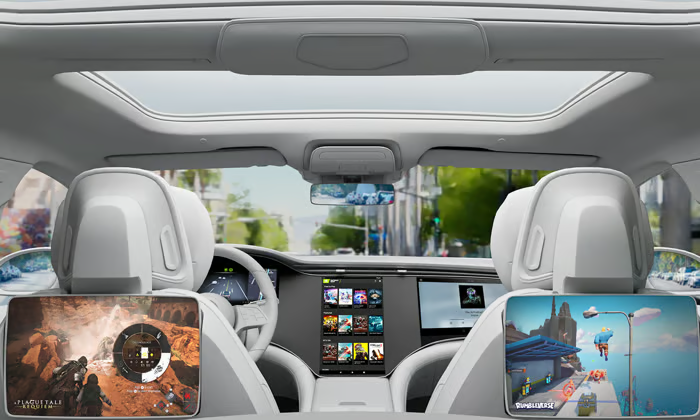
Image source: Nvidia.
From generative to agentic AI
In 2024 and 2025, Blackwell pole-vaulted Nvidia to be the top compute power behind generative AI. Earlier this year, Nvidia unveiled its Rubin architecture, which features six new chips — including a graphics processing unit (GPU), central processing unit (CPU), and various networking products. These products are sold separately, and can also be integrated into a well-oiled machine. For example, the Nvidia Vera Rubin NVL72 includes 72 Rubin GPUs, 36 Vera CPUs, and networking and infrastructure platforms. The integrated system functions as a plug-and-play supercomputer for large-scale AI factories.
Rubin’s improvements over Blackwell are meant to capitalize on what Nvidia founder and CEO Jensen Huang called the “agentic AI inflection point” in Nvidia’s Feb. 25 earnings release. This means enterprise adoption of AI agents.
In his 2025 keynote speech at Nvidia’s GPU Technology Conference (GTC), Huang discussed Nvidia’s AI roadmap, with generative AI focusing on digital marketing and content creation, agentic AI including applications like coding assistants, customer service, and patient care, and physical AI for autonomous vehicles and general robotics.
Nvidia’s product development is following this roadmap, with Blackwell custom-built for generative AI, Rubin for agentic AI, and the next architecture likely to focus on improvements for physical AI. Of course, Nvidia’s existing chips are already used in physical AI applications, from Boston Dynamics robots to Caterpillar earth-moving equipment to Tesla‘s Full Self Driving technology.
Nvidia CFO Colette Kress said the following on the Feb. 25 earnings call:
Physical AI is here, having already contributed north of $6 billion in Nvidia Corporation revenue in fiscal year 2026. Robotaxi rides are growing exponentially, with commercial fleets from [Alphabet‘s] Waymo, Tesla, Uber, WeRide, and [Amazon‘s] Zoox, and many others are expected to scale from thousands of vehicles in 2025 to millions over the next decade, creating a market poised to generate hundreds of billions of dollars of revenue. This expansion will demand orders of magnitude more compute, with every major OEM and service provider developing on Nvidia Corporation’s platform.
$6 billion in revenue is less than 3% of Nvidia’s fiscal 2026 total. But self-driving robotaxis remain in niche geographies, and general robotics is still a long way from everyday use in residential settings. That’s why the hundreds of billions in revenue potential Kress outlined doesn’t seem that far-fetched.
Nvidia has plenty of room to run
Generative AI and agentic AI give Nvidia a long runway for future growth within the data center. But the more it can expand beyond the data center into physical AI applications, the more diversified its revenue will become, and the greater its overall growth potential will be.
The beauty of Nvidia’s investment thesis is that it doesn’t depend on physical AI taking off anytime soon. It’s already a high-margin cash cow on generative AI alone, and widespread agentic AI adoption would be transformative in its own right.
Add it all up, and Nvidia has the makings of the perfect growth stock to buy and hold for decades to come.
Should you buy stock in Nvidia right now?
Before you buy stock in Nvidia, consider this:
The Motley Fool Stock Advisor analyst team just identified what they believe are the 10 best stocks for investors to buy now… and Nvidia wasn’t one of them. The 10 stocks that made the cut could produce monster returns in the coming years.
Consider when Netflix made this list on December 17, 2004… if you invested $1,000 at the time of our recommendation, you’d have $523,599!* Or when Nvidia made this list on April 15, 2005… if you invested $1,000 at the time of our recommendation, you’d have $1,118,640!*
Now, it’s worth noting Stock Advisor’s total average return is 951% — a market-crushing outperformance compared to 194% for the S&P 500. Don’t miss the latest top 10 list, available with Stock Advisor, and join an investing community built by individual investors for individual investors.
*Stock Advisor returns as of March 4, 2026.
Daniel Foelber has positions in Nvidia. The Motley Fool has positions in and recommends Alphabet, Amazon, Caterpillar, Nvidia, Tesla, and Uber Technologies. The Motley Fool has a disclosure policy.
The views and opinions expressed herein are the views and opinions of the author and do not necessarily reflect those of Nasdaq, Inc.