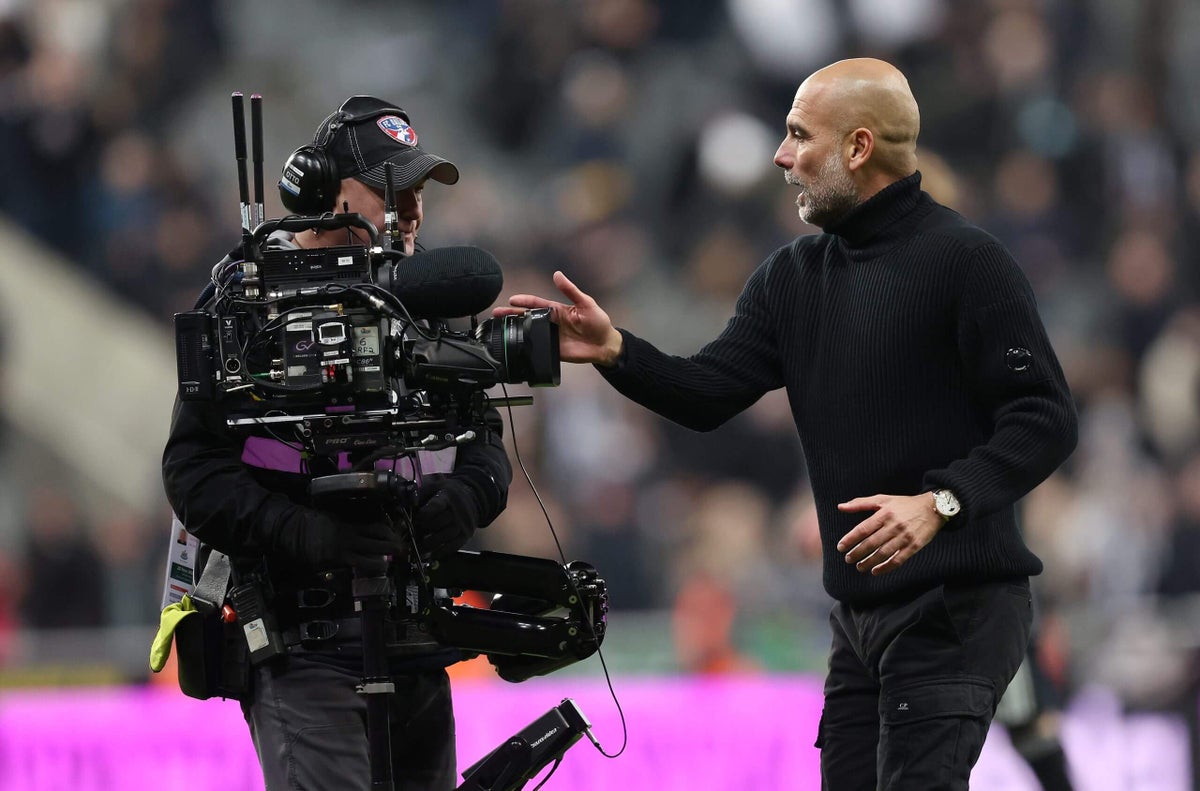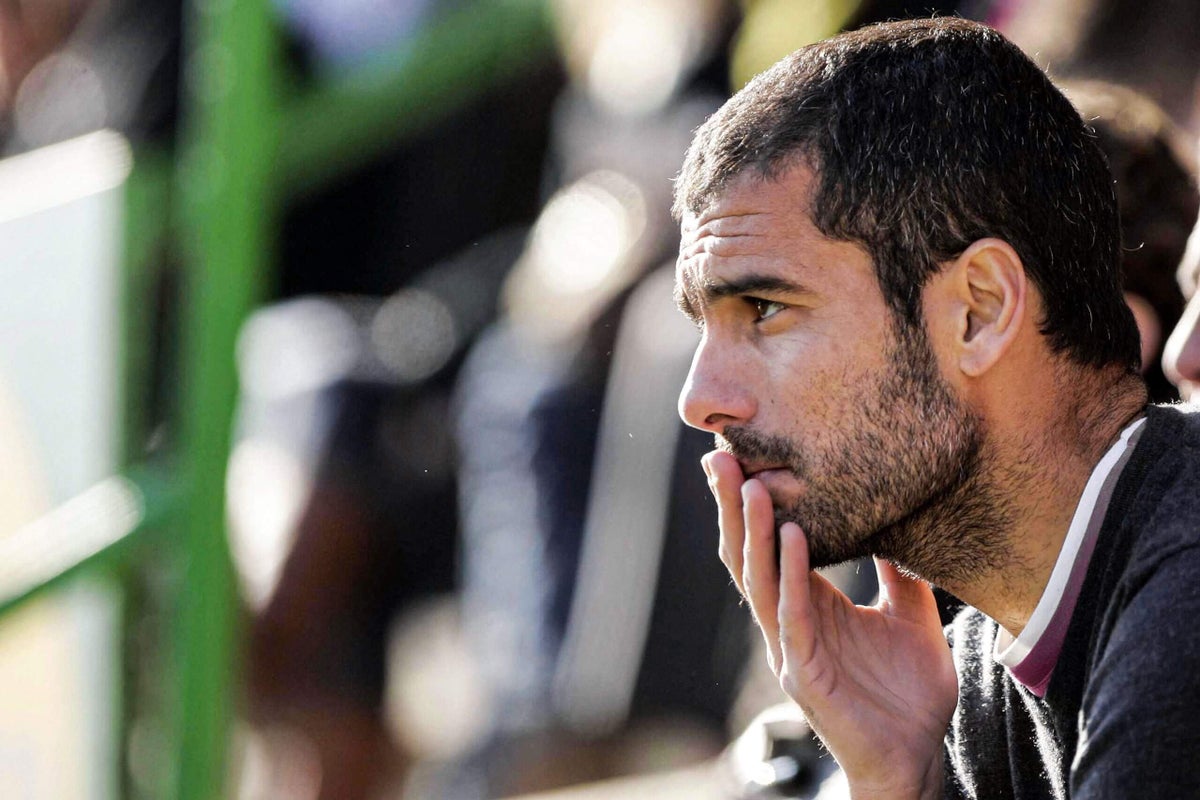
Why are we about to tell you about a 0-0 draw in the Spanish fourth division from 18 years ago? Because it was Pep Guardiola’s very first match as a manager.
Today, he is one of the most celebrated and decorated coaches in football history. On Sunday, he will take charge of his 1,000th game, when Manchester City host defending Premier League champions Liverpool.
He’s won the treble with Barcelona and Manchester City, league and cup doubles in three countries, and the Champions League three times. But you might be surprised to learn which of his many titles he values most highly.
In Guardiola’s eyes, the success he enjoyed over 2007-08 with Barcelona’s reserve team has been overlooked. It is a story of never-ending bus trips across his native Catalonia, of dirt pitches and old-school astroturf where the ball would bounce wildly. There was no time for tiki-taka.
And for him, it unleashed everything that would follow.
On September 2, 2007, Premia de Mar’s football ground was about as full as it gets.
The local team, CE Premia, were playing in Tercera Division — literally translating as third division but the fourth tier of Spanish football at that time, one step below the professional leagues. Players at that level usually worked a full-time job outside the game.
Tercera matches were not hugely popular; if Premia attracted 1,000 spectators to a match, it was a party. More than 2,000 showed up that day.
Barcelona B were making their league debut there after hitting a low point the previous season. They had just been relegated from the third tier — unnatural territory for them and the kind of failure that led the club’s executives, led by president Joan Laporta in his first spell and sporting director Txiki Begiristain, to look for a new manager.
The name of Pep Guardiola, then aged 36, was at the very top of Begiristain’s wishlist.
After sharing a dressing room as players in Johan Cruyff’s Barca side in the 1990s, Begiristain held Guardiola in high esteem. He initially thought of offering the former midfielder a role in his own department, but as soon as he learnt Guardiola had earned his badges and wanted to coach, the plan changed.
Laporta and Begiristain did not want to miss his debut, so they showed up in Premia de Mar with other members of Barca’s executive board. The buzz to see what the new boy could do was huge.
Guardiola, watching Barca B from the stands following a suspension later in the season (Lluis Gene/AFP via Getty Images)
“I can remember everything about that game, I’ve re-lived it in my head many times,” then-Premia manager Quim Ayats tells The Athletic. Ayats is a hugely experienced coach in the Catalan game who is now the director of the NAISE football academy in Bellaterra, Barcelona.
“We had an exciting team, so fans wanted to see us, but the publicity of having Pep Guardiola there made it a huge day.”
Ayats says he found out how seriously Guardiola was taking his new role a week before the match, when Premia played their final pre-season friendly.
“We were up against a lower-category side, Vilassar de Dalt. Nothing fancy. Five minutes in, my assistant came up and told me: ‘Quim, Pep Guardiola is in the stands scouting us’,” recalls Ayats.
“Now, it’s easier to get information about opponents and players across the whole league, but back in those days, you had no other option than driving all weekend and going to the games you wanted to see. That’s what Pep did the week before facing us.”
Guardiola partnered with Tito Vilanova as his assistant (they had been roommates at La Masia) and Domenec Torrent and Carles Planchart, who had been managing in Catalan regional football, were hired as analysts. That gave Guardiola the expertise he needed to enter unknown territory.
“It was brave for Pep to have his first experience as a manager in a tough division,” says Ayats.
“He came down to the mud — but he surrounded himself with people who gave him good advice. All his staff knew Catalan football by heart.”
The following season, Guardiola would bring all three staff members with him when stepping up to the Barca job. Vilanova succeeded him as Barcelona manager in July 2012, but died aged 45 in 2014, having suffered from throat cancer. Torrent and Planchart would go on to work with Guardiola at Bayern Munich and Manchester City, too.

From right to left: Planchart, Guardiola, Torrent and Hermann Gerland at Bayern Munich (Alexander Hassenstein/Bongarts/Getty Images)
Barca B started their first match under Guardiola on the front foot. The new coach planned to use a system with extremely high pressure. It took hosts Premia by surprise. Centre-back Xavi Torres had the best chance for Guardiola’s team in the first half, but his effort hit the woodwork.
“High pressing has been a principle in Pep’s playbook since the first day he coached,” says Ayats. “We did not expect them to push to that extent. Our goalkeeper couldn’t stop losing possession in the build-up. At half-time we had to adjust some things, and then the game changed completely.”
After the break, it was all about Premia. They found a way out of Barca B’s pressing and started to build momentum. With five minutes to go, and the score still at 0-0, Ayats’ team were awarded a free-kick right on the edge of the box. Carmelo Cortes, known as Melo, stepped up to take it.
Melo spent more than a decade playing for multiple semi-professional teams and is now retired. At 42, he now works as a bus driver, connecting Mataro and Barcelona. During his lunch break, he spoke with The Athletic by phone.
“That free kick is stuck in my head,” he says. “It was pretty much by the centre of their goal, and my only thought was to kick the ball as hard as possible towards their ‘keeper. It went like a rocket, I got an instant feeling my strike was a good one — but it crashed off the crossbar.
“It was all set up for Guardiola’s big debut that day, and a goal there would have surely ruined the party.”
Melo describes himself as a huge Barcelona fan who has travelled to many away games and whose childhood idol was Guardiola.
“I used to play as a holding midfielder when I was a kid and Pep was there at Barca. I’ve been a Guardiola diehard fan my whole life,” he says.
“Every now and then I crack a joke with my mates about that game — maybe I could have changed his career.”
Guardiola’s first-ever starting line-up as a coach was as follows: Oier Olazabal in goal; Fali, David Corcoles, Xavi Torres, Victor Espasandin in defence; Dimas Delgado, Victor Sanchez and Dani Toribio as the midfield trio; and in attack Eneko Fernandez, Emilio Guerra and a tiny winger then called Pedrito.
We know that winger better today as Pedro — now he has won Champions League, La Liga and Premier League titles, as well as the World Cup and European Championship with Spain. Sergio Busquets and Thiago Alcantara would also feature over the 2007-08 season for Barca B.
Ayats was astonished by one moment between Guardiola and Pedro during the match, which ended goalless.

Guardiola promoted Pedro to the Barcelona senior team for 2008-09 (Jasper Juinen/Getty Images)
“Close to the final whistle, Pedro fell to the pitch and claimed a foul just in front of our benches,” Ayats says.
“I still remember Pep stepping in, grabbing him by the shirt and pulling him up as if he weighed nothing at all, yelling: ‘You better start running to defend, because they are going to screw us!’ Pedro forgot about the foul and sprinted back like a headless chicken.
“At that time, there were rumours that he might not even make the cut to stay at Barcelona B,” Melo says. “But I guess Pep liked him when they started working together — and he was not wrong.”
In April 2008, Guardiola’s third child was born. Laporta paid the family a visit in hospital.
After congratulating them, the president asked to have a private chat. Laporta told Guardiola that they were considering promoting him to the first team. Frank Rijkaard’s group had been struggling and the Dutchman was determined to leave.
“You won’t have the balls,” Guardiola replied.
On May 8, the day after a 4-1 defeat at new La Liga champions Real Madrid, Barca announced exactly that. Rijkaard was leaving, and his replacement for next season would be Guardiola, now 37.

Laporta and Guardiola sealing the deal in June 2008 (FC Barcelona/AFP via Getty Images)
But Barca B’s season had not finished.
Despite a few early hiccups, Guardiola’s charges ended up top of Tercera Division. They claimed 83 points, one more than runners-up Sant Andreu, who were the only team to score more (74 goals to Barca B’s 70). They lost just five of their 38 games — the fewest of any side.
It meant they contested the promotion play-offs that year, beating Castillo CF (from the Canary Islands) and UD Barbastro (from Aragon) in the two-legged semi-finals and final to seal their place in Spain’s third tier.
It was June 2008. By that time, it was clear Guardiola would be moving on to bigger things. The next season, a football revolution was about to take place.
But in conversation with friends on several occasions since then, Guardiola has often said: “Don’t even dare to forget the most important trophy of my career.”
No specifics would follow. In the silence, some might think about the treble of 2008-09, or the Champions League title of 2011, when, after the final against Manchester United, Sir Alex Ferguson said his Barca team were the best he ever faced. What about the 100-point Premier League title won with City back in 2018, or their first Champions League in 2023?
Finally, the pay-off would come.
“The most important trophy of my career is the league title we won with Barcelona B.”