Is peace at hand between the U.S. and Iran, or is talk of an end to the war just more hype and spin? Is the potential agreement, as President Trump insists, a good deal that is much tougher than anything the Obama administration managed to negotiate? Or is it the thinly disguised surrender of a Trump administration desperate to liquidate a war the president now privately feels he should never have launched?
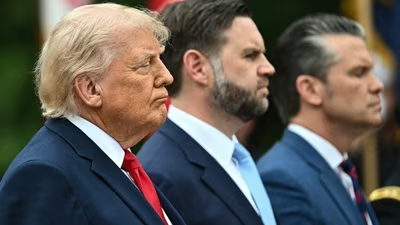
President Donald Trump, Vice President JD Vance and Defense Secretary Pete Hegseth in Arlington, Va., May 25.
As of Memorial Day, nobody, possibly including both Mr. Trump and Iran’s supreme leader, seems to know. That shouldn’t be surprising. Both the American president and his Iranian opponents believe that the purpose of speech is less to inform than to spin. Add this to the sensitivity and secrecy with which delicate diplomatic negotiations must proceed, and we have a fog of misleading statements, dramatic but disingenuous social-media posts, and intentionally obfuscatory leaks.
Both sides have an interest in proclaiming an imminent peace. Fuming American motorists want prices to drop at the pump. Mr. Trump’s political allies, haunted by falling poll numbers before the midterm elections, pine for good news. Anxious American allies in the region and beyond long for an end to the war’s energy and trade disruptions. Rumors of peace set financial markets surging. Rumors of renewed hostilities leave traders reeling in despair.
On the Iranian side, the rattled political authorities need some good news about sanctions relief to mollify a restless public. Leaders, not unreasonably fearing more waves of Israeli decapitation strikes, yearn for an end to that anxiety. And any result that can be spun as a victory for the Islamic Republic against Israel and the U.S. would provide badly needed legitimacy to an untested, unloved and nepotistically selected supreme leader.
The common interest in ending the war drives Iran and America together and gives all parties an incentive to hype the prospects for peace, but the gap between the two sides’ minimum requirements makes an actual agreement fiendishly hard to work out. Having alienated one wing of his coalition by launching the war, Mr. Trump seems reluctant to enrage another by accepting a weak peace. The Iranian regime feels that its ability to block the Strait of Hormuz and damage its neighbors by drone and missile attacks entitles it to painful concessions from the U.S. side.
Those who see a softening of the American position in recent days aren’t wrong. Administration critics blame Israel for Washington’s decision to attack Iran, but Saudi Arabia was also in favor of settling scores with Tehran once and for all. That has changed. Iranian attacks have awakened the Saudis to the vulnerability of their energy infrastructure as well as the desalination plants on which much of the kingdom depends.
Saudi Arabia’s cities rely heavily on massive desalination complexes. The capital, Riyadh, is particularly exposed, as most of its water comes through pipelines from large desalination plants on the Gulf. If those facilities were taken out of commission, much of Riyadh’s population would likely have to be evacuated within days.
Attacks on desalination facilities whose primary purpose is to provide drinking water to civilians constitute one of the most heinous imaginable war crimes. As attacks on desalination plants in Kuwait and Bahrain have demonstrated during the current war, that isn’t a problem for the self-proclaimed religious zealots of the Islamic Republic of Iran. The Saudis have taken note.
The threat to Gulf desalination facilities has shaken the coalition that supported the war and may loom larger in peace diplomacy than Iran’s threats to shipping in the Strait of Hormuz. The Trump administration faces a difficult choice. Does it reassure the Gulf Arabs by deterring Iranian attacks on their water supply via threats of massive retaliation, or does it seek a quick end to the war at the price of more-favorable conditions for Iran?
Mr. Trump’s demand that a group of Arab countries plus Turkey and Pakistan should simultaneously sign on to the Abraham Accords likely reflects the administration’s quest for a bright and shiny diplomatic win to offset compromises with Iran. At a time when memories of the Gaza war and the absence of progress on Palestinian issues have made Israel even more unpopular globally and among Muslims than usual, that would be a stiff price for the Saudis to pay.
The issue of water security for the Gulf populations will grow. Unless the U.S. is prepared to accept a long-term Iranian hegemony over the Gulf states as well as the Strait of Hormuz, it will need to find an effective deterrent to Iranian attacks on vital infrastructure. The choice may come down to providing a credible nuclear shield for our Gulf allies or abandoning them to the tender mercies of the Islamic Republic.