When Rick (Paul Rudd), the protagonist of Power Ballad, plays one of his musical works in progress for his teenage daughter (Beth Fallon’s Aja), she practically rolls her eyes at how old-fashioned it is. Girls these days don’t want songs about falling in love anymore, she informs her clueless dad. Asked what they are interested in, she has a quick and snappy retort: “Revenge.”
If Rick seems caught off guard, that’s only because he doesn’t realize his whole life is about to become defined by those two themes. But the magic of Power Ballad, from Once and Sing Street director John Carney, comes from its refusal to steer too blindly into either camp, instead forging its own path somewhere in between. Like the catchiest pop hits, it’s a little bit familiar, a little bit unexpected and utterly, thrillingly satisfying.
Power Ballad
The Bottom Line
Hits every note.
Venue: SXSW Film Festival (Narrative Spotlight)
Cast: Paul Rudd, Nick Jonas, Peter McDonald, Marcella Plunkett, Havana Rose Liu, Jack Reynor, Beth Fallon
Director: John Carney
Screenwriter: John Carney, Peter McDonald
Rated R,
1 hour 38 minutes
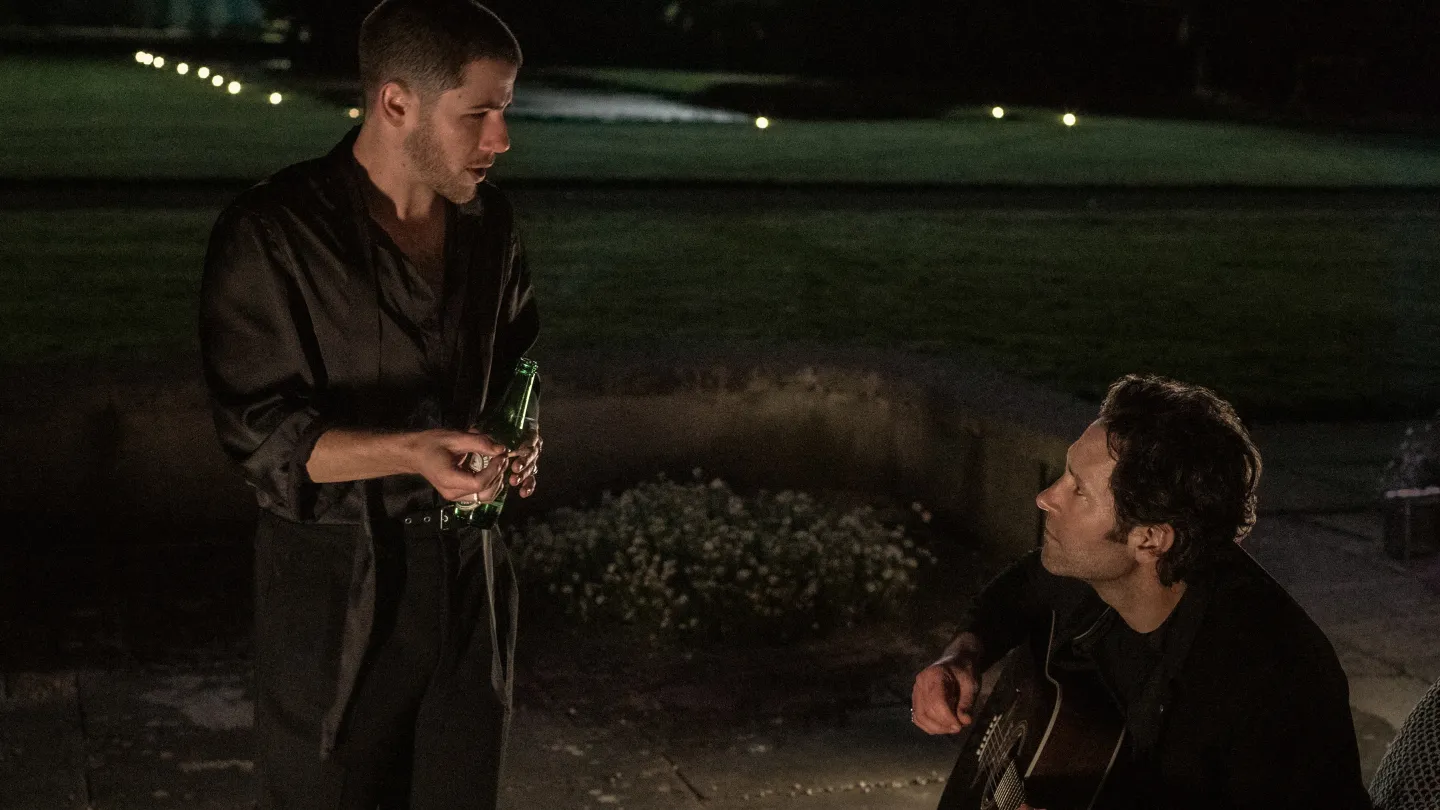
Of the two main themes presented by Aja, it’s love that comes to the forefront first. Rick is a rock musician who falls somewhere between “has-been” and “never-was,” and now enjoys a pleasant if unexciting career as the lead singer of The Bride & Groove — “Ireland’s grooviest wedding band,” per the decal on their truck. At one of their jobs, he happens to meet Danny (Nick Jonas), a former boy bander who’s trying to launch a solo career, so far without much success. Though the two men would not seem to have much in common at first glance, each seems to recognize something of himself in the other: a frustrated ambition, a genuine talent, a hunger for creative collaboration.
After the reception, fueled by joints and beers and many glasses of Irish whisky, the two strangers stay up late into the night trading stories about their lives, advice about each other’s work, compliments about each other’s talent. You don’t have to be familiar with Jonas’ actual career as a pop star to be dazzled by Danny’s innate magnetism, or Rudd’s long history of playing nice guys to recognize Rick’s inherent sweetness. The chemistry is immediate and easy and warm, and for a while, Power Ballad almost plays like a platonic version of one of Richard Linklater’s Before romances.
What Power Ballad actually turns out to be, however, is less predictable. Some months after their encounter, Rick is running errands when he hears a familiar tune: “How to Write a Song (Without You),” which he’d been noodling on for years when he played it for Danny. Unbeknownst to Rick, Danny — desperate to avoid the purgatory of washed-up pop stars “tasting bugs on a reality show or appearing at functions as that guy from that band,” as his agent Mac (Jack Reynor in an American accent) vividly puts it — has taken Rick’s song and passed it off as his own, riding it all the way to the top of the charts.
This is where the idea of revenge rears its head. Unable to conjure any hard evidence that he wrote the song, Rick has no recourse to claim a songwriting credit and the financial and professional gains that would come with it. Increasingly bitter about being cheated, and decreasingly able or willing to hide it, Rick exhibits erratic behavior that alienates his friends, his family, his band. With nothing left to lose, Rick — along with his slightly daffy but stalwartly loyal bestie, Sandy (Peter McDonald, who also co-wrote the script with Carney) — decides to fly from Dublin to L.A. to confront Danny face on. Though to what end, exactly, even he doesn’t seem to know.
About that song: Power Ballad is blessed with an in-universe hit single that, like “That Thing You Do” or KPop Demon Hunters’ “Golden,” sounds like it could be one in real life. Written by Carney and Gary Clark “How to Write a Song (Without You)” is exactly the sort of endearingly sappy, insanely catchy earworm that would sound just as right anchoring wedding playlists or selling out the Kia Forum or playing over the tinny speakers at every CVS you step into for the rest of your life. I love it, while at the same time hating it a little bit for how hard it’s been lodged into my head since watching this movie.
But the film’s real secret weapon might be its complete command of tone. Power Ballad is a comedy that pokes fun at Rick’s middle-aged dorkiness or Danny’s very L.A. excesses without reducing either to a caricature, and ribs the entertainment biz but takes the art seriously. (There’s also a very funny Once gag, for longtime Carneyheads.) It’s an earnest mash note to the power of music that resists over-sentimentalizing its sacrifices, or overstating its rewards.
It’s a drama about the dark price of ambition that sidesteps every cliché that seems to plague seemingly every other drama or biopic about the music industry. The confrontation, when it comes, feels true to the characters we’ve come to know so well, rather than beholden to any formulaic expectation about how such a climax is supposed to play out. Rick and Danny come out looking like neither role models nor villains, but just two imperfect men brought together by the whims of fate and a sincere passion for their art.
If “Power Ballad manages to avoid mucking anything up” sounds like faint praise, I mean it as quite the opposite. As Rick and Danny know well, the difference between a forgettable first draft that sits untouched in a drawer for years and one that goes on to become a world-conquering #1 single lies in the details — the gap between the right chord and the not-quite-right one, the mix that turns a sweet ballad into an arena anthem, the lyrics that land with the exact right combination of specificity and universality. Power Ballad hits every note, and makes it look easy. It, too, deserves to be a smash hit.