Key Points
-
Peter Thiel is a billionaire investor from Silicon Valley.
-
His hedge fund recently dumped Nvidia stock in favor of new artificial intelligence positions.
-
Investing in Apple and Microsoft may be the superior play in the long run.
- 10 stocks we like better than Nvidia ›
Some of the success stories that have come out of Silicon Valley are so legendary that they are almost hard to believe. One of the most interesting case studies out of the Bay Area in recent history is that of Peter Thiel.
Thiel was originally an entrepreneur, first minting a fortune as a co-founder of PayPal. However, following that success, he founded hedge funds and spread his investments across the technology value chain — notably becoming the first outside investor in Facebook (now Meta Platforms) and helping pioneer the world of defense tech with his involvement in Palantir Technologies, where he still serves as chairman.
Where to invest $1,000 right now? Our analyst team just revealed what they believe are the 10 best stocks to buy right now, when you join Stock Advisor. See the stocks »
Today, the hedge fund he manages is the aptly named Thiel Macro. According to its most recent 13F filing, Thiel Macro completely sold its stake in Nvidia (NASDAQ: NVDA) during the third quarter and redeployed that capital into a pair of its “Magnificent Seven” peers — Apple (NASDAQ: AAPL) and Microsoft (NASDAQ: MSFT).
On the surface, these moves might look like major head-scratchers. But I think Thiel could be onto something big.
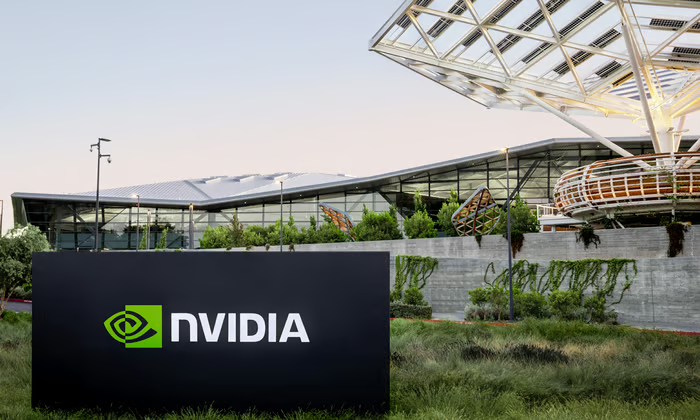
Image source: Nvidia.
Why Peter Thiel may have sold Nvidia stock
Since the beginning of the artificial intelligence (AI) revolution, Nvidia stock has gone parabolic — rising by about 1,000%, and making it the most valuable company in the world. For the last three years, investors have bid up Nvidia stock following each announcement of a new GPU architecture or megadeal struck with a hyperscaler.
Given that Nvidia has become one of the most widely owned stocks across both retail and institutional portfolios, you might think it foolish to sell one’s entire stake in it. But remember, Thiel is a notorious contrarian.
As Nvidia became even more crowded, contrarians like Thiel sold their tickets to the main event and began searching for new entertainment. Why is that?
Well, at Nvidia’s current $4.5 trillion market cap, it is slowly becoming less of a growth stock and more of a macroeconomic indicator — one that is increasingly exposed to geopolitics, tariffs, export controls, capital expenditure budgets, and infrastructure profiles moving toward custom chips from Broadcom.
This isn’t to say Nvidia’s best days are behind it. But it could suggest that the company’s risk profile is changing. When most of Wall Street is on the side of Nvidia, Thiel is almost certainly going to move his money in another direction.
Why Apple and Microsoft look like great buys right now
Prior to the AI revolution, Apple and Microsoft were viewed by some as dinosaurs in the technology realm. Apple hasn’t released a groundbreaking new device in years, and Microsoft has long been measured by its cloud computing platform, Azure. So what might Thiel see in these two businesses?
Regarding Apple, investors shouldn’t hold their breath thinking the company is about to surprise everyone with AI-related innovations.
Apple’s advantage will not depend on its ability to create a rival AI model. In fact, large language models (LLMs) like ChatGPT, Perplexity, Claude, Grok, and Gemini are already becoming commoditized.
But the iPhone maker’s ecosystem spans across more than 2 billion devices that leverage its hardware, software, app distribution, and services. In other words, Apple has the ability to essentially charge rent to the developers building AI products and services that it distributes to its loyal community.
Here’s the subtle idea: Apple doesn’t even need to invest in AI in order to become a winner from this megatrend.
On the other hand, Microsoft is building an AI-centric operating system. The company is a major player in cloud infrastructure (Azure), programming (GitHub), enterprise workflows (Office, Teams), and data analytics (Fabric).
Businesses developing AI need access to all of these protocols. OpenAI is already facing fierce competition from other LLMs. Nvidia may eventually lose its dominance in AI accelerator chips. By contrast, Microsoft’s lock-in at the enterprise level makes it extremely difficult for its users to switch to rival platforms.
The bottom line: Thiel may be thinking in terms of decades
Let’s turn the AI narrative into a metaphor. Think about Nvidia as a pick and shovel supplier during a gold rush. The company’s GPUs and accompanying network equipment are vital purchases during the initial exploration phase. In the short term, companies like Nvidia get rich.
Yet gold rushes are fleeting. Eventually, they come to an end.
However, the people who own the land where the gold was dug can continue to make money as property values compound over time. Think about Apple and Microsoft as the landowners in this situation — they possess the systems, distribution layer, and the marketplaces where AI digging is taking place.
By the 2030s, companies like Apple and Microsoft should evolve into AI empires — essentially taxing every operation that leverages their platforms. That will give both companies enormous leverage and control.
At the end of the day, I think Thiel’s decisions imply he is simply looking to maximize his risk-adjusted returns. In the world of AI investing, Nvidia is simply too obvious a pick — which is why Thiel rotated his capital away from it.
Should you buy stock in Nvidia right now?
Before you buy stock in Nvidia, consider this:
The Motley Fool Stock Advisor analyst team just identified what they believe are the 10 best stocks for investors to buy now… and Nvidia wasn’t one of them. The 10 stocks that made the cut could produce monster returns in the coming years.
Consider when Netflix made this list on December 17, 2004… if you invested $1,000 at the time of our recommendation, you’d have $474,847!* Or when Nvidia made this list on April 15, 2005… if you invested $1,000 at the time of our recommendation, you’d have $1,146,655!*
Now, it’s worth noting Stock Advisor’s total average return is 958% — a market-crushing outperformance compared to 196% for the S&P 500. Don’t miss the latest top 10 list, available with Stock Advisor, and join an investing community built by individual investors for individual investors.
*Stock Advisor returns as of January 17, 2026.
Adam Spatacco has positions in Apple, Meta Platforms, Nvidia, and Palantir Technologies. The Motley Fool has positions in and recommends Apple, Meta Platforms, Nvidia, Palantir Technologies, and PayPal. The Motley Fool recommends Broadcom and recommends the following options: long January 2027 $42.50 calls on PayPal and short March 2026 $65 calls on PayPal. The Motley Fool has a disclosure policy.
The views and opinions expressed herein are the views and opinions of the author and do not necessarily reflect those of Nasdaq, Inc.