
Donald Trump’s pardons of some of the world’s worst drug traffickers are an unprecedented assault on public safety in America. We should be concerned about the negative economic effect of letting cartels sink their corrupt tentacles into the highest levels of the federal government.
In Alaska, Trump’s pardons are personal because as a small state we all know families who have lost loved ones to the fentanyl epidemic. Trump coddling Central American and Chinese drug traffickers means more Americans and Alaskans will die of drug overdoses, and Trump’s calculus appears as simple as it is callous — drug cartels and crypto money launderers raise serious conflict-of-interest concerns, including the appearance that financial ties to Trump-linked crypto projects could be influencing policy and pardon decisions.
This incursion of organized crime into the highest levels of American government fundamentally threatens the rule of law, public safety and America’s capacity for sustained economic growth.
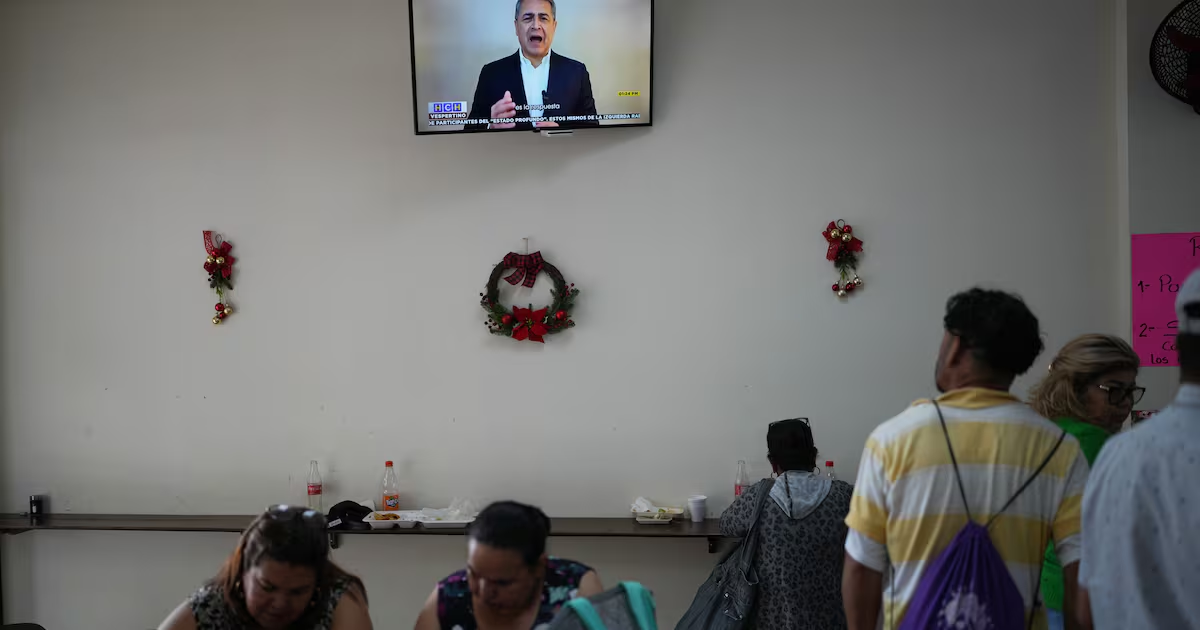
Any number of other countries offer disturbing lessons about what happens when drug dealers corrupt regional and national governments. In Mexico, drug cartels are the de facto governments in large regions. In Honduras, a former president was a drug trafficker, and Trump’s pardon of this cartel leader is one of the most appalling assaults on American public safety. But Trump isn’t just pardoning the drug traffickers. Just as insidiously, he is making it far easier for them to launder money.
Trump pardoned Chinese money launderer Chanpeng Zhao even though Zhao’s digital currency company continues to be one of the largest money launderers for drug dealers and scam artists. It would take another column to explore this thoroughly, but we must note that drug cartels today are generally diversified organized crime rings, often making money from internet scams, human and sex trafficking, and the drug trade. All of these criminal activities depend on digital money laundering, and many of the world’s worst criminals have figured out it’s all too easy to sway Donald Trump. Not only has he pardoned many of them, he shut down the Department of Justice’s task force focused on breaking up digital money laundering schemes of cartels and halted Securities and Exchange Commission oversight of crypto. Career law enforcement officials have watched with dismay after years of detective and prosecutorial work has been squandered after Trump pardons people like Ross Ullbricht, who ran the Silk Road dark money web for drug dealers and sex trafficking. Trump’s pardons are an insult to the heroes who are trying to catch and imprison the world’s worst criminals.
While the moral outrage about pardons for drug dealers is obvious, America has had transparent and clean federal law enforcement for so long it’s a little difficult for us to internalize the economic risk of corrupting our legal system. A short history refresher: In response to federal corruption in the late 1800s and early 1900s — which is eerily similar to the influence peddling of Trump’s White House today — Teddy Roosevelt successfully championed establishment of a nonpolitical, merit-based federal civil service. When corruption did occur after Roosevelt’s reforms, punishment was generally swift, for example in response to the Teapot Dome scandal. Trump’s multi-pronged assault on the rule of law, consisting of pardoning those who buy his cryptocurrency or fund his pet projects, and his dismantling of the federal civil service, threatens to return us to a level of lawlessness that American hasn’t experienced in over a century. Just how bad is the effect of corruption on economic growth? Some of the most rigorous analyses indicate it reduces GDP (economic output) by nearly 20%, but all we need to do is look around at failed states like Honduras to see how profound the effect of corruption is.
Congress should be stepping up and demanding that Trump hold drug dealers accountable. Instead, Trump’s lackeys in Congress are standing by silently while he throws open the prison doors for the drug traffickers who have caused the death of children in Alaska and every other state in the country. Crime isn’t just a threat to human life — it represents the most regressive tax on the planet, because America and Alaska’s working poor have no economic safety net. If we care about economic opportunity for working families, we must also care about law enforcement and sustaining the rule of law.
Zack Fields has represented downtown Anchorage in the Alaska House of Representatives since 2019 and co-chairs the Labor and Commerce Committee.
• • •
The Anchorage Daily News welcomes a broad range of viewpoints. To submit a piece for consideration, email commentary(at)adn.com. Send submissions shorter than 200 words to letters@adn.com or click here to submit via any web browser. Read our full guidelines for letters and commentaries here.