The US has cleared about 10 Chinese firms to buy Nvidia Corp’s second-most powerful artificial intelligence (AI) chip, the H200, but not a single delivery has been made so far, three people familiar with the matter said, leaving a major technology deal in limbo as chief executive officer Jensen Huang (黃仁勳) seeks a breakthrough in China this week.
Huang, who was not initially listed in a White House delegation to Beijing, joined the trip after an invitation from US President Donald Trump, a source said.
Trump picked him up in Alaska en route to a summit with Chinese President Xi Jinping (習近平), raising hopes that the trip could finally unlock stalled efforts to sell the H200 chips in China.
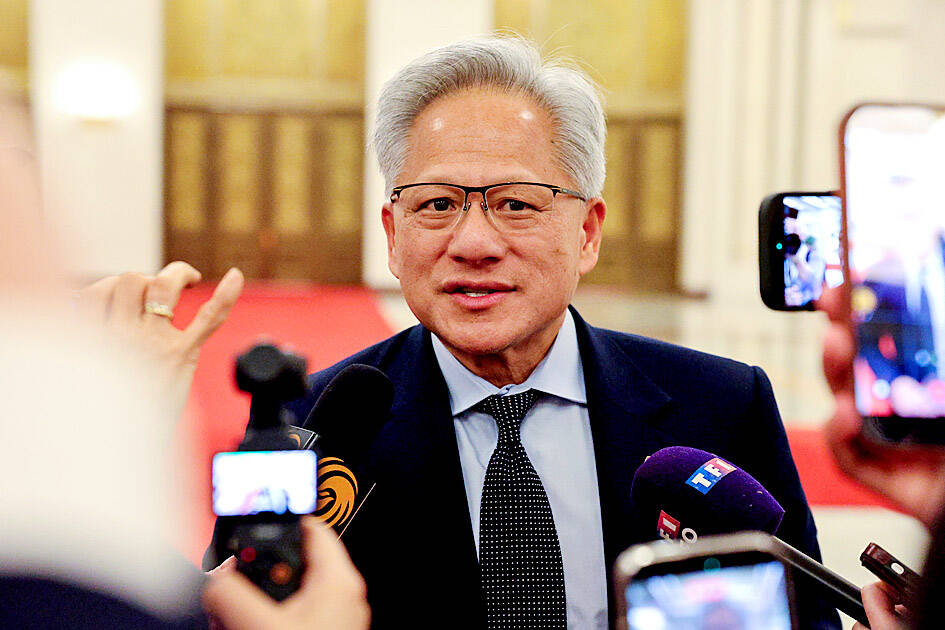
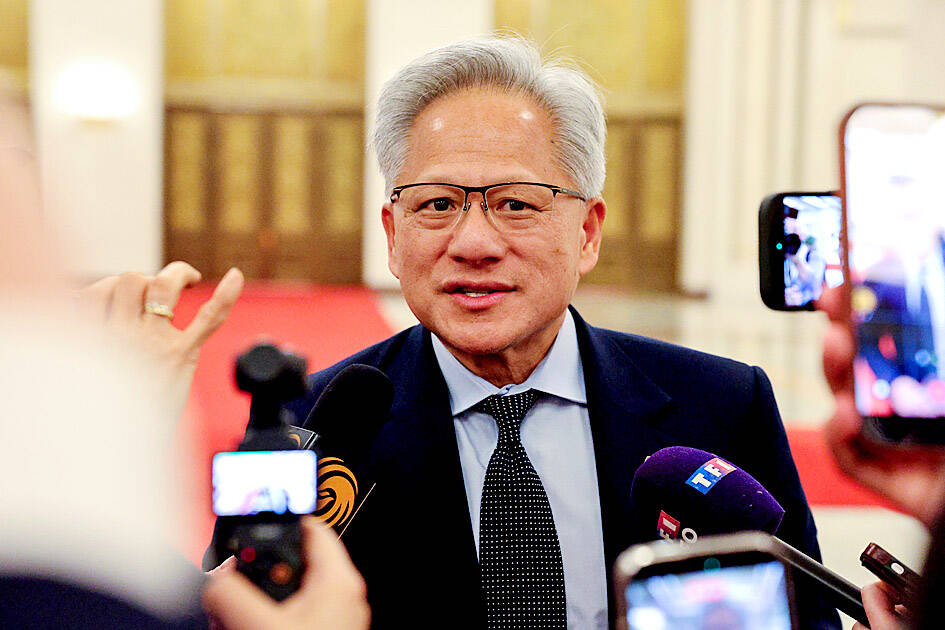
Photo: AP
The stakes are significant, highlighting how the US-China tech rivalry is now snarling even approved trade, leaving the world’s most valuable company and dominant chipmaker caught between dueling national priorities.
The US Department of Commerce has approved about 10 Chinese companies including Alibaba Group Holding Ltd (阿里巴巴), Tencent Holdings Ltd (騰訊), ByteDance Ltd (字節跳動) and JD.com Inc (京東) to purchase Nvidia’s H200 chips, according to the sources, who spoke on condition of anonymity due to the sensitivity of the matter.
A handful of distributors including Lenovo Group Ltd (聯想) and Foxconn Technology Group (富士康) have also been approved, they said.
Buyers are permitted to purchase either directly from Nvidia or through those intermediaries, and each approved customer can purchase up to 75,000 chips under the US licensing terms, two of them said.
The identities of the approved buyers, and the nature of their relationships with Nvidia and the authorized distributors involving the coveted AI chip, have not been previously reported.
Despite US approval, deals have stalled, as Chinese firms pulled back after guidance from Beijing, one source said.
The shift in China was partly triggered by changes on the US side, though exactly what changed remains unclear, the person added.
In Beijing, pressure is mounting to block or tightly vet the orders, a separate fourth source said. This reflects a strategic calculation, as Beijing fears imports could weaken a push to develop homegrown AI chips.
While China’s AI chips still lag behind Nvidia, firms like DeepSeek (深度求索) increasingly tout their reliance on domestic chips including those developed by Huawei Technologies Co (華為).
Their pivot to Huawei underscores Nvidia’s precarious position in China. Huang has warned that US export controls are eroding the company’s foothold in the market, saying its share of AI accelerators in China has effectively fallen to zero.