One blockade was bad enough. Iran’s closure of the Strait of Hormuz has pushed up prices for oil, natural gas and fertiliser, among other commodities. On April 13th America initiated a blockade of its own, halting the few vessels Iran had been letting past, which will presumably compound the problem.
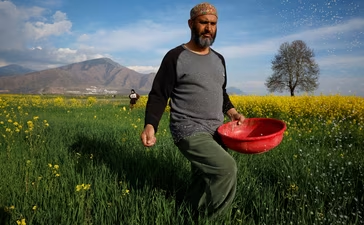
Abdul Qayoom spreads fertilizer on his mustard field in Pampore (REUTERS)
Commodity prices are rising again, to the dismay not just of drivers, but of farmers, too, who need fertiliser for their fields and diesel for their tractors. Some are planting or fertilising less, which inevitably means smaller harvests later in the year. Food prices are starting to rise. The World Food Programme (WFP, a UN agency) estimates that if the blockage continues until mid-year, an extra 45m lives will be at risk, on top of the more than 300m people who already struggle to feed themselves. If the El Niño weather pattern takes hold in the next few months, as many climate scientists think likely, things could get worse still; some of the poorest parts of the world could get too much rain and others too little, which means crops will fail.
The starting-point for the incipient crisis is higher energy prices. These affect every step in food production: planting, harvesting, processing, transport. In rich countries energy accounts for as much as half of variable costs in farming, says the International Energy Agency, a club of countries that are big oil consumers. Global food-price indices generally track the price of crude, albeit with a lag. Edgar Terry, who runs a fruit and vegetable farm in California, says the diesel he uses to power his tractors now costs $6.13 per gallon, up from $3.41 before the fighting began. As a result, he is planting less celery this spring.
The price of fertiliser, much of which is made with natural gas, is rising as well. The Gulf is arguably more central to the global fertiliser industry than it is to energy. It is the source of 30-35% of the international trade in urea and around 20-30% of ammonia, both widely used fertilisers. Perhaps 30% of the world’s fertiliser trade passes through Hormuz. The war has stopped that flow. Kpler, a data provider, reckons nearly 1.9m tonnes are stuck on the wrong side, equal to 12% of all the fertiliser shipped through the strait in 2024. Qatar Fertiliser Company, a state-backed firm that produces 14% of the world’s urea, has been offline for over a month.
Other suppliers are not in a position to fill the gap. Plants in Russia, the world’s biggest exporter, have been targeted by Ukrainian drones; those still operating are at full capacity. China, the second-biggest, is cutting exports to protect its own domestic supply. Gas shortages have forced fertiliser producers in other countries, including India and Bangladesh, to curb their output. And there is no global system of fertiliser stockpiles, as there is for oil. The prices of urea and ammonia have risen by 65% and 40%, respectively, since the start of the war. An index of fertiliser affordability from Rabobank, a Dutch lender, has plunged to a four-year low.
The timing could not be worse. The northern hemisphere and parts of Africa are in the midst of planting season. Farmers in South Asia will start sowing in the next couple of months, when the monsoon arrives. Agronomists say fertiliser doubles the world’s agricultural output and it typically needs to be used when crops are planted to have the optimal impact. Even if the war ends tomorrow, says Julian Hinz at the Kiel Institute, a think-tank, much damage is already done.
Wealthy farmers in the West are fairly sanguine. Many stockpile fertiliser and lots of them overuse it anyway. Those struggling with the cost are switching crops. This season America’s Department of Agriculture expects a shift from maize (which requires a lot of fertiliser) to soyabeans (which require less). In Europe a similar adjustment is under way.
For poorer farmers, the consequences are graver. Many of the world’s 500m smallholders barely grow enough to feed their families. They certainly cannot afford to keep stocks of fertiliser. Sayed, who farms wheat, barley and chickpeas on his tiny plot in central Afghanistan, is one of them. The price of a 50kg bag of urea has jumped to 2,400 afghanis ($29) at his local market, from 2,000 afghanis in January. He has given up using the stuff, which will shrink his harvest.
Asia and Africa rely especially on fertiliser from the Gulf. The region provided 71% of Thailand’s imports of urea last year, 67% of South Africa’s and 41% of India’s. More than half of Indians depend on agriculture for their livelihood. Before the war the government in New Delhi had planned to cut fertiliser subsidies to save money. Now, officials are scrambling to secure additional supplies from Russia and China, probably at significantly greater expense.
A detour de force
The result is what Michael Werz of the Council on Foreign Relations, a think-tank, calls a “slow-motion famine machine”. For now, the countries hardest hit are those that relied on humanitarian aid before the war began. The closure of Hormuz has trapped enough of the WFP’s supplies of food to feed 4m people for a month. It is scrambling to reroute these deliveries.
One example is a shipment of high-energy biscuits that the WFP wanted to send from Dubai to Afghanistan. Instead of trucking the biscuits across Iran it was forced to send them on a nine-country detour, to enter Afghanistan from the north. Corinne Fleischer, the WFP’s supply-chain chief, reckons this is extending the journey by weeks—and at added cost to boot.
Humanitarian groups can ill afford such expenses. Rich countries have slashed their aid budgets of late (while boosting spending on defence). Net official development assistance dropped by 9-17% year on year in 2025, after a 9% decline the previous year, according to the OECD, a club of mostly rich countries. As Jean-Martin Bauer at the WFP puts it, “The humanitarian shock absorber isn’t there any more.”
Higher fuel prices already mean smaller helpings for the world’s poor. Take Lalita Devi, a farmhand who lives just north of New Delhi in the village of Singhu. Since February, she says, the price of cooking gas has quintupled. Stalls that sold rotis for five rupees apiece have raised that to eight. With cooking out of the question and fast food pricier too, Ms Devi has begun skipping meals and all but given up vegetables.
The longer supplies are snarled, the more widespread such effects will be. If traffic through Hormuz is impeded for six months, Helios AI, a data provider, reckons global food prices will rise 12-18% above pre-war levels by the end of the year. Again, the effects are likely to be uneven. Analysts at Germany’s Kiel Institute predict food-price inflation will reach 30% in Zambia, 11% in India and 8% in Venezuela within a year. With oil above $100 a barrel, the diversion of crops to biofuels could send food prices higher still.
The pain will be felt by those already on the margin: people in the poorest corners of the poorest countries and in conflict zones with little buffer against shocks. In contrast to a conventional famine, in which hunger is concentrated in a particular spot, the effects will be distributed around the world, with little direct connection to local weather and harvests and with few television cameras present.
That does not mean they will be insignificant. After Russia and Ukraine, both big exporters of grain, went to war in 2022, food prices shot up. Researchers believe that more people have died of hunger than on the battlefield as a result of that conflict. Unless the strait reopens quickly and the fuel and fertiliser start flowing, the war in Iran could be as bad—or worse.