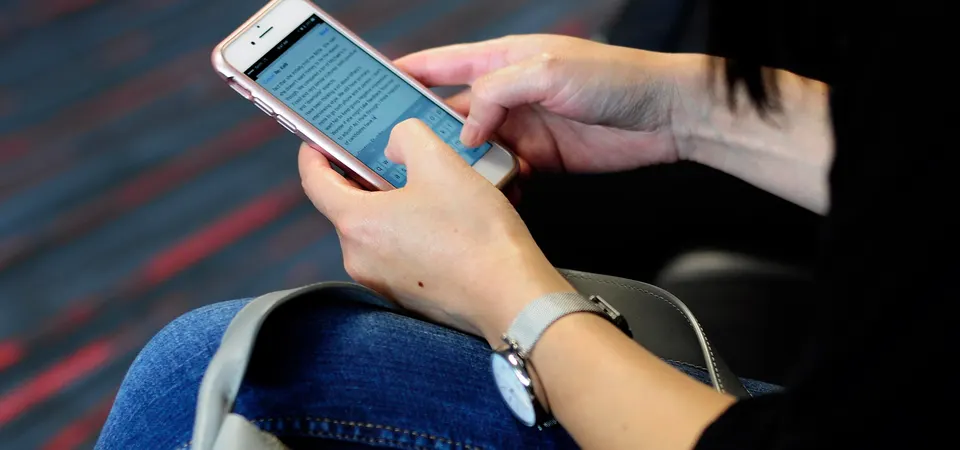

Phones are tempting targets for hackers and data thieves
Getty Images
Swiss start-up Soverli will today announce it has raised $2.6 million of seed finance for an innovative new approach to mobile phone security. The Zurich-based company is already trialling its technology with clients including the Swiss Government and hopes to accelerate its growth in 2026.
The business is focused on an increasingly worrying problem: that mobile phones are not very secure. Recent days have seen Google and Apple issue cybersecurity warnings to users in more than 150 countries, after detecting attempts to hack phones using spyware. Last month saw France’s national cybersecurity agency warn that smartphones have become a prime target for threat actors. And this year has already seen a string of damaging attacks – the security company Kaspersky has noted a 27% increase in malware infiltrations of mobile phones.
If you’re keen to keep the data on your phone private, that’s a problem. If you’re using your phone for work, it’s potentially disastrous – all the more so if you work for an organisation with lots of sensitive data, or a public sector agency charged with serving and protecting citizens.
“Smartphones are now central to nearly everyone’s daily life, relied upon by governments, emergency services and critical industries, but they are still un-auditable Android and iOS black boxes,” says Ivan Puddu, co-founder and CEO of Soverli. His point is that you have no control over the operating system in your phone or even visibility of what’s within it; that makes smartphone users completely reliant on the operating system providers for security.
Enter Soverli’s technology. The business has developed a solution that enables mobile phone users to run two different operating systems on their phones simultaneously. Your phone’s usual operating system, whether Apple, Android or something else, functions in the normal way, but you also have the option of switching to a different operating system designed to be much more secure and robust; Soverli offers a default secure system, or organisations can develop their own bespoke solutions.
The idea is a simple one. When you pick up your smartphone to message a friend or check the sports scores, say, you use it in the normal way. When you’re using the phone for work or a sensitive task, you press a button on the home screen to switch to a more secure operating system. A recent demonstration from Soverli showed how a compromised Android system could leave users of the popular messaging app Signal open to attack; inside its operating system, however, messages remained secure.
Puddu believes the technology will be attractive to a wide range of organisations, from governments determined to protect mission-critical systems to enterprises worried about data compromise. Journalists and human-rights activists, often targeted in recent times by malicious state actors, are another potential market.
Soverli has already begun running pilot projects with the Swiss government, amid growing interest in the concept of digital sovereignty in Europe. “There’s a growing awareness that we shouldn’t just be trusting technology that comes from abroad, but we’re so dependent on it right now,” adds Puddu.
The company’s technology was developed over four years at ETH Zurich, the Swiss technical university which is producing a growing number of start-up tech-focused businesses. However, Soverli doesn’t have the market to itself, with both the mobile phone giants themselves investigating solutions, and smaller businesses.
Both Apple and Android, for example, offer advanced protection modes enabling users to lock down their phones by reducing functionality to limit vulnerabilities. A more direct competitor might be Bittium, the Finnish scale-up business, which has already raised close to $20 million of funding; it provides a similar technology enabling the use of more than one operating system on a phone.
Soverli’s pitch is that it is both more user-friendly and less cumbersome. Users don’t have to compromise on functionality to secure their phones, it points out. And switching to the alternative operating system can be done from the home screen, rather than requiring a reboot of the phone. “You have to give people a usable experience because otherwise they’ll just look for a workaround,” argues Puddu.
Investors in the company believe it has the potential to scale rapidly from the pilot projects underway today. Soverli envisages charging organisations license fees for each user with a smartphone that has its technology installed, but also sees potential in licensing its technology to phone manufacturers that could supply handsets with the solution pre-installed.
Today’s seed round is led by Founderful, with participation from the ETH Zurich Foundation, Venture Kick and a number of leading figures in the cybersecurity industry. “People deserve phones they can actually trust and manufactuers must deliver it,” argues Antonia Albert, an investor at Founderful. “Soverli’s Swiss-made sovereign layer is the kind of breakthrough that can rewrite the rules of mobile security.”