On the weekend that James Milner made his record-breaking 654th Premier League appearance last month, two of his former England team-mates, Wayne Rooney and Micah Richards, found themselves applauding him from the comfort of the BBC’s Match of the Day sofa, respectively five and six years after hanging up their boots.
Theo Walcott offered his observations on a podcast, joking that, at 37, three years Milner’s junior, he should still be playing rather than in the third year of retirement. On that same weekend, another of Milner’s former England team-mates, Raheem Sterling, made his debut for Dutch club Feyenoord as he looks to relaunch his career at the age of 31 after being cut loose by Chelsea. Dele Alli, 29, was making an emotional return to the Tottenham Hotspur Stadium, applauded by the fans as he tries to find a club after a series of off-the-pitch difficulties that have plagued his career.
Rooney, Richards, Walcott, Sterling, Dele… this is a list of English football’s early starters, to which we could add Jude Bellingham, Jadon Sancho, Marcus Rashford, Jack Wilshere, Alex Oxlade-Chamberlain, Luke Shaw, Mason Greenwood and others. In the 153-year history of the England men’s national team, only 22 players have made their debut at the age of 18 or under. Fifteen of those 22 debuts have been since the turn of the century.
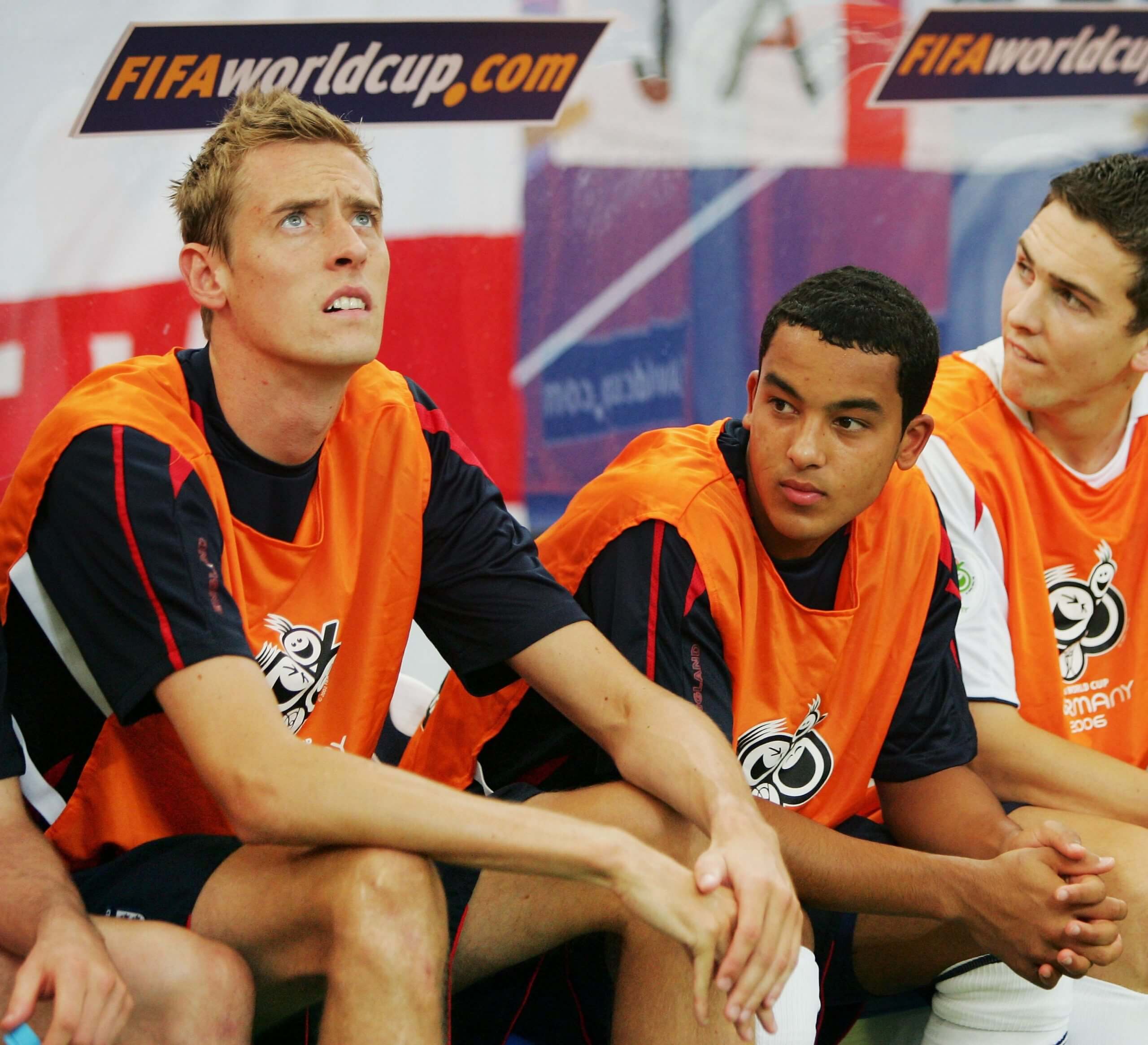
Theo Walcott, centre, went to the 2006 World Cup before he had even appeared in the Premier League (Ross Kinnaird/Getty Images)
Some have had top-class careers. But even Rooney, who went on to become Manchester United’s and (briefly) England’s record goalscorer, would concede it was hard to stay on the straight and narrow. Sterling has been a great success story, but his star began to fade in his late twenties, as did Walcott’s. Wilshere fell victim to injuries, too much football too young, and found his career in decline before he hung up his boots at 30. Rashford and Sancho have struggled at times with the intensity of the spotlight, as did Richards. Greenwood is a more complicated case entirely, but his departure from Manchester United was accompanied by much talk of the mental burden that weighed heavily after his life-changing early breakthrough.
Below that elite level, there are so many stories of young players who have lost their way after a first brief taste of stardom. Modern academies do everything they can to prepare youngsters and their families for the big time. But when success comes, followed by adulation, media exposure, riches beyond their wildest dreams and so many potential distractions at the very point their football career gets very serious, it is little wonder that so many of them end up overwhelmed by it all.
It is something Milner spoke about when we sat down at Brighton & Hove Albion’s training ground on the eve of the season. He said that, while advances in sports science, nutrition and professionalism theoretically make it easier for players to prolong their careers, the all-consuming nature of the modern game — year-round football, with money-spinning tours and tournaments book-ending every season, the relentlessness of the Premier League soap opera, the constant noise from social media — concerns him.
“The money, the social media, the hype… I don’t think any of that makes it easier,” the former England midfielder, still playing for Brighton at the age of 40, said. “It becomes so easy to get ahead of yourself. It’s all thrust on them so early and there’s no hiding place for them, just because they’re amazing at football and playing first team at 16, 17, 18. Everything is so public. And then if you’re expecting players to play from 18 to 32, 33, when are they going to get a break? Everyone will burn out. It’s going to become completely impossible.”
All of this is a long-winded way of saying that a player such as Arsenal’s Max Dowman, who on Saturday became the Premier League’s youngest goalscorer at 16 years and 73 days, should be handled with extreme care. As well as an extreme talent, his manager Mikel Arteta has cited a rare temperament that means the teenager “doesn’t seem to be fazed by the pressure or his team-mates or the opponent”. But there are still so many pitfalls. The number of players who sidestep them as astutely as Milner is vanishingly small.
It will be for Arteta to decide whether to keep Dowman in the spotlight over the weeks ahead. But no matter what the youngster might achieve between now and the end of the season, one line should be drawn in the sand immediately. Some of the excitable talk we have heard since Saturday, of a potential England call-up for the World Cup, should be nipped in the bud.
Some will feel otherwise: that if you are good enough, you are old enough. They will cite the example of Pele emerging as Brazil’s hero as a 17-year-old at the 1958 World Cup and Michael Owen and Rooney making a spectacular impact at the 1998 World Cup and Euro 2004 respectively. Far more recently, Lamine Yamal broke into the Barcelona team at 16, scored on his Spain debut and went on to illuminate the 2024 European Championship finals, starring in the final against England the day after he turned 17.
But Dowman only turned 16 on the final day of 2025. He is still almost two years from adulthood. His plans for May and June should revolve around his GCSE exams and then watching the World Cup as enthusiastically as any other football-mad teenager. He is able — for now — to live a normal life while playing for Arsenal, travelling from his family home, training in a familiar environment, his development managed carefully by Arteta and balancing that with as much schooling as his training regime allows. The World Cup? That would be a different matter entirely. Not because it is an elevated level of football — it is not — but because exposure to that highly-pressurised environment, away from home for weeks, could damage a 16-year-old.

A mural of Max Dowman stands alongside one of Dennis Bergkamp outside the Emirates (Justin Setterfield/Getty Images)
There have been times when a scarcity of alternatives has led England managers to fast-track players to the senior squad with indecent haste. The classic case is Walcott’s call-up for the 2006 World Cup at 17. Walcott has said many times it was “too early”, before he had made his Premier League debut for Arsenal, and that he “didn’t deserve” to be there. It was another two difficult years before he won the second of his 47 England caps.
In the years since then, English football has become so much better at producing talented attacking players that even Bellingham, Cole Palmer, Morgan Rogers and others would not dare to take their World Cup place for granted at this stage. The Football Association has also become better at creating a coherent national team setup.
But that inclination to fast-track players into the senior squad can still cause difficulties, particularly when a player’s development slows down. Kobbie Mainoo played at the last European Championship finals at the age of 19, but lost his place in the squad after a dip in form at Manchester United and has not represented England at any level since. He is expected to be recalled to the senior squad for the forthcoming World Cup warm-up matches, but it felt counter-productive that he was considered to have moved “beyond” the under-21s when, like Lewis Hall and Adam Wharton, he could surely have benefited from the experience at times over the past 18 months.
This time last year, when Thomas Tuchel named his first England squad, there was a minor clamour for him to select Ethan Nwaneri, who, at 17, had already made 31 appearances and scored eight goals for Arsenal. Tuchel gave it serious consideration but it was agreed Nwaneri’s development would be best served in the under-21s. A year on, on loan at Marseille after a lack of first-team opportunities at Arsenal in the first half of the season, the England Under-21s still seems the ideal place to learn for now.
Players develop at different rates. Development is rarely linear. Physically, mentally, environmentally, there are so many complicating factors. We can all look at Dowman, see the huge potential and predict a wonderfully bright future for him. But nothing is guaranteed. There is such a thing as too much too soon — too much exposure, too much fame, too much money, even too much football — and that means there is a responsibility to protect him and give him the best chance of optimising his enormous talent for years to come.
Again, some will feel the opposite applies: that because there are so many pitfalls, because the future is so hard to predict, there is no better time than the present. Strike while the iron is hot and all that. If Dowman is going to be as good as the hype suggests, then why wait another four years to unleash him on the World Cup stage?
That was the debate they had about a 17-year-old in Argentina in the lead-up to the 1978 World Cup. Diego Maradona was already producing stellar performances on a weekly basis for his club, Argentinos Juniors, but national team coach Cesar Luis Menotti reluctantly decided to leave him out, believing the pressure on the youngster would be too intense. It proved not to be a bad decision.
And that, to repeat, was Diego Maradona, regarded by many as the greatest player in the sport’s history. No two careers are the same, but there are enough lessons from history to suggest it is wise to play the long game. It is why Arteta has been careful with Dowman, restricting him to a handful of cameo appearances from the bench before his senior start against third-tier Mansfield Town in the FA Cup 10 days ago. Liverpool coach Arne Slot has handled their 17-year-old Rio Ngumoha cautiously too. JJ Gabriel’s stunning form in Manchester United’s under-18 side prompted talk of a first-team call-up until Michael Carrick pointed out last week that it is not allowed because he only turned 15 after this season began.
Gabriel is another one who, if he continues at this rate, will be in contention to play in the Premier League sooner rather than later. But even with the most spectacularly gifted players, there is a responsibility to do everything possible to prevent that “too much too young” scenario. They do not have to have a career like Milner, starting at 16 and still going strong at 40, but there is a concern — particularly in English football — that early starters are at risk of ending up burnt out, whether physically or mentally, simply from being overexposed to fame, fortune and celebrity too young.
As thrilling as Dowman’s talent undoubtedly is, it must be handled with care.