China continues to flex its fast-growing naval power by deploying multiple groups of warships across the western Pacific simultaneously, according to a Newsweek map.
Lin Jian, spokesperson for China‘s Foreign Ministry, said last week that Chinese naval and Coast Guard vessels operate at sea in accordance with international law, urging “relevant parties” not to overreact or overinterpret, or make groundless accusations.
Why It Matters
The Chinese military operates the world’s largest navy by hull count, with over 370 ships and submarines, including three aircraft carriers and four Type 075 amphibious assault ships, enabling Beijing to expand its military presence and assert its influence.
China’s naval deployments have concerned the United States and its allies and partners in the western Pacific, who fear China may attempt to alter the status quo in disputed waters by force and use its sea power as a coercive tool during diplomatic tensions.
What To Know
Using official information released by China, Australia and Japan, along with satellite imagery, a Newsweek map tracks at least seven groups of Chinese naval vessels across the western Pacific as of Sunday, including in the Philippine Sea and South China Sea.
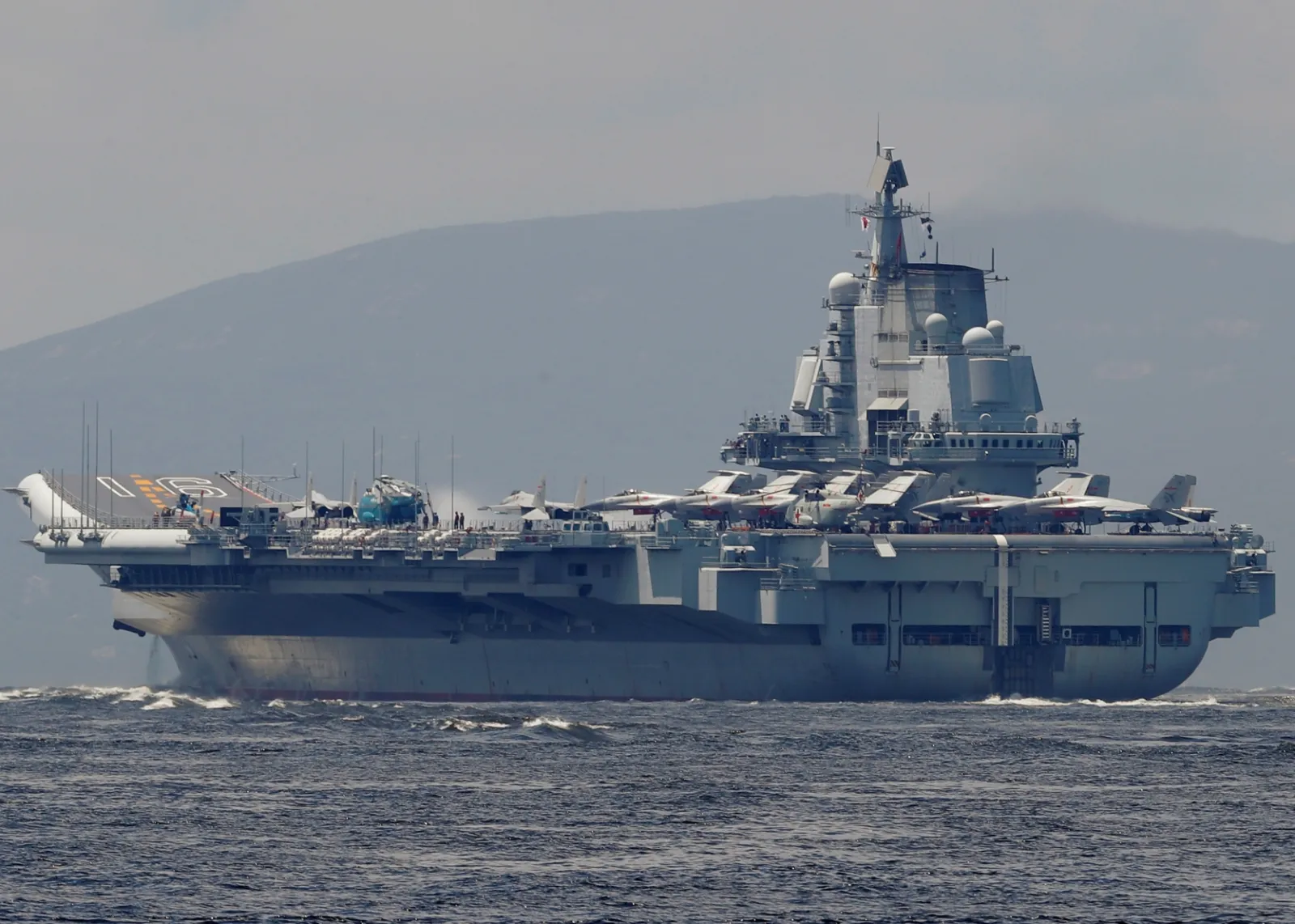
Regarding China’s aircraft carrier fleet, CNS Liaoning operated east of the First Island Chain—formed by Japan, Taiwan and the Philippines under a U.S. strategy aimed at constraining Chinese military activity—south of Japan’s main islands on Sunday.
The Liaoning was tracked by the Japanese military in the East China Sea on Friday and transited the Miyako Strait the following day. It remains unclear whether the Chinese aircraft carrier and its escort warships will continue northward in the Philippine Sea.
Meanwhile, satellite imagery of China’s Yulin Naval Base, provided by Colorado-based intelligence company Vantor, does not show the aircraft carrier CNS Shandong, which shares the South China Sea base as its home port with the aircraft carrier CNS Fujian.
This indicates that as early as Friday, the Shandong had departed the base and was operating somewhere in the South China Sea, while the Fujian remained docked at the port. The 3D satellite imagery also shows the base is constructing new quays and piers.
China also deployed at least two of its Type 075 amphibious warships. CNS Hubei, hull number 34, conducted “combat readiness training” with two Type 071 amphibious dock landing ships in the South China Sea, the Chinese military said on Saturday.
CNS Hainan, sister ship of the Hubei with hull number 31, was operating north of Papua New Guinea on Wednesday, operating alongside a Type 055 destroyer, a Type 054A frigate and a Type 903A replenishment ship, Vantor’s satellite imagery shows.
Australian Defense Minister Richard Marles confirmed the presence of the Hainan task group in the Philippine Sea and said the Chinese ships will remain under Australia’s surveillance “until we know that they are not coming in the vicinity of Australia.”
A three-vessel Chinese training task group led by the landing ship CNS Changbaishan, hull number 989, arrived in Jakarta, Indonesia, on Sunday for what the Chinese navy called a four-day visit. The group previously made port calls in Vietnam and Malaysia.
At the same time, two Chinese naval formations were on homebound voyages after completing missions. The three-ship 47th Escort Task Group concluded a four-day stopover in Singapore and transited the Singapore Strait, the Chinese navy said on Saturday.
The Chinese Type 055 destroyer CNS Anshan, hull number 103, was spotted by Japan as it returned to the East China Sea following a transit of the Miyako Strait on Friday with two other vessels—a Type 054A frigate and a Type 903A replenishment ship.
What People Are Saying
Lin Jian, spokesperson for the Chinese Foreign Ministry, said: “Let me stress that China is committed to a national defense policy that is defensive in nature. The Chinese navy and China Coast Guard carry out activities in relevant waters in strict accordance with China’s domestic laws and international law.”
Admiral David Johnston, Australian Chief of the Defense Force, said: “I am very confident that, depending on where the [Chinese] task group goes, and certainly…if it were to get closer to Australia, in our ability to provide air based surveillance, maritime based surveillance, where it’s relevant. But it, of course, depends on what the task group does.”
The Pentagon’s Chinese military power report commented: “The [People’s Liberation Army Navy, PLAN] continues to develop into a global force, gradually extending its operational reach beyond East Asia into a sustained ability to operate at increasingly longer ranges…The PLAN’s latest surface and subsurface platforms enable combat operations beyond the reach of the [People’s Republic of China]’s land-based defenses.”

What Happens Next
The Chinese navy is expected to continue expanding its presence across the western Pacific. It remains to be seen whether the Liaoning and the Shandong will conduct joint operations to signal China’s military might amid strategic competition with Washington.